Dieser Artikel ist nur auf Englisch verfügbar.
How to apply for a job in Switzerland: the 2026 guide

A Swiss application is normally one PDF: a cover letter, a CV, and copies of your work references and diplomas. Behind it sit a legal right to a work reference, diploma recognition for regulated professions only, and a registration rule that gives people signed on with a RAV a head start on some vacancies.
What the application file contains
The public employment service publishes the most direct description. Its page "Tips on applying for jobs" on arbeit.swiss (read on 12 October 2026, undated apart from a 2026 copyright line) says an application file generally comprises a cover letter, a CV, and work references together with diplomas and certificates. The career guidance portal berufsberatung.ch, on its page for working people and job seekers (read the same day, undated), lists the same three: a cover or motivation letter, a CV, and work references plus training certificates.
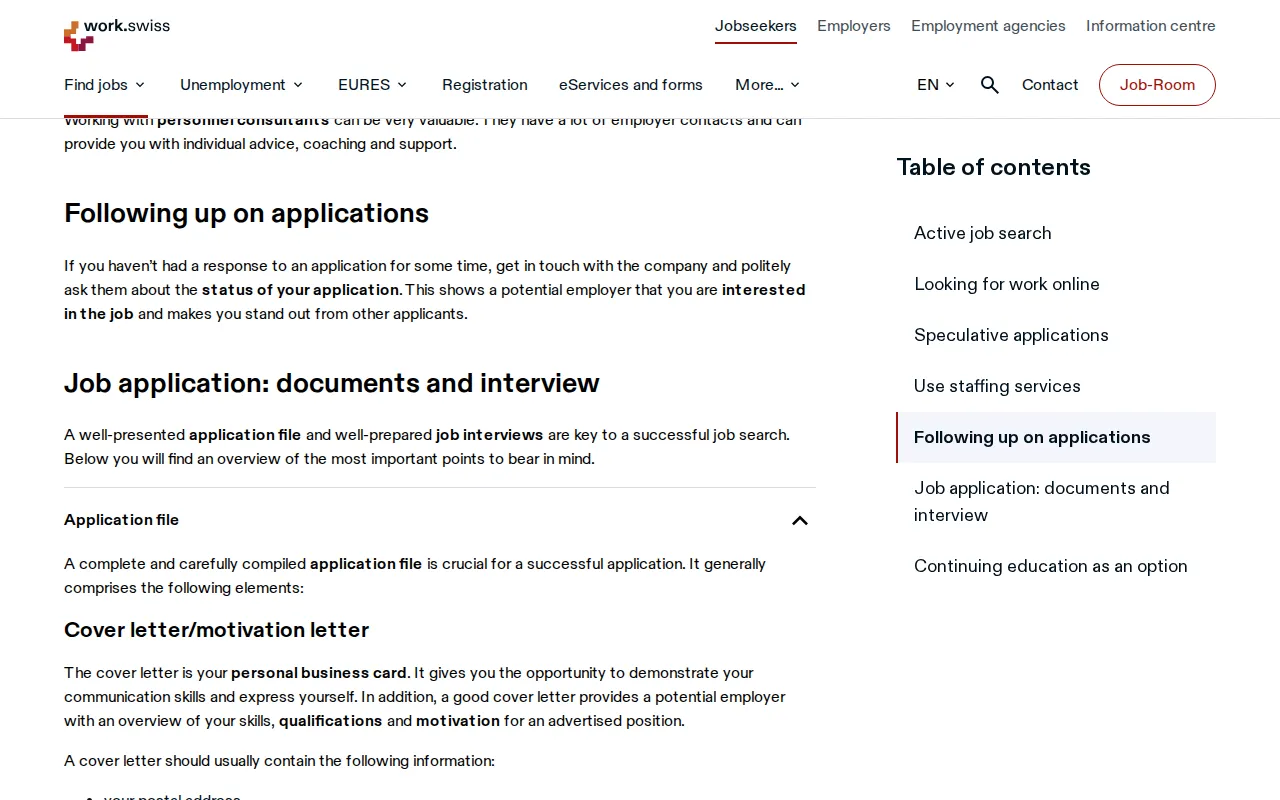
Here is what arbeit.swiss says about each part.
- Cover letter. It calls it your "personal business card" and says it should show your skills, qualifications and motivation for the advertised job. It lists the practical elements: your postal address, the company's address, the date, a subject line, a salutation and a closing with your signature.
- CV. It should be "complete, clear and not contain any gaps", no longer than three pages, in chronological order with the most recent job first. The page lists personal details including a photograph, professional experience, education and training, language skills, special knowledge, interests, and references.
- References. The page says the CV should note that references are available "on request", and that a separate sheet naming referees can be handed over at the interview. This is a different thing from work references (below), which go in the file.
- Work references, diplomas, certificates. Ask former employers for work references in good time. The page asks for them to be gapless and ordered by date, newest first, with the diplomas and certificates handled the same way.
- Format. Send PDFs, combine the documents into one file, and check spelling, completeness and file names. berufsberatung.ch gives the same advice on order and a single PDF, and adds that some industries ask for something else, such as a work sample.
Two points are about convention rather than law, so read them as such. Neither page requires a photograph; arbeit.swiss simply lists one among the personal details. Nor does either page say what to do when an advertisement asks for something different, so the advertisement is the better guide there.
If your permit status is still open, read our post on Swiss work permits first.
The work reference (Arbeitszeugnis)
In German it is the Arbeitszeugnis, in French the certificat de travail. The right to one sits in article 330a of the Code of Obligations (CO). In the English text on Fedlex (last amended 1 January 2026, read on 12 October 2026; the page notes English is not an official language and the translation has no legal force), it reads:
- The employee "may at any time request from the employer a reference concerning the nature and the duration of the employment relationship, the quality of his work and his conduct."
- "At the employee's express request the reference must be limited to the nature and duration of the employment relationship."
- At any time. You do not have to wait until you hand in notice. The wording gives you the right during employment too, which is useful if you are already looking elsewhere or your manager changes.
- Two versions. The full reference (paragraph 1) includes an assessment of work and conduct. The limited one (paragraph 2) states only what the job was and how long it lasted. The law gives them no names; we call them the full and the limited reference here.
- Your choice. The limited version exists only if you ask for it expressly.
Why do employers read the reference closely? The sources we read do not say, so this is our reading, not a quoted rule. A full reference is the one that carries an assessment of your work and conduct. It is the only document in the file written by a previous employer rather than by you, and the law fixes what it may cover. A limited reference is allowed, but a reader can see that the assessment is missing. That is a reason to think about which one you request, and for what use.
The official pages we read give no template wording and no guide to how a reference is phrased, so we offer neither.
Foreign diplomas: when recognition is required
Many newcomers assume every degree needs an official stamp. It does not.
berufsberatung.ch, on its page about recognition of foreign diplomas (read on 12 October 2026, undated, in German), states: "Die Anerkennung von Abschlüssen ist nur für reglementierte Berufe obligatorisch", so recognition is compulsory only for regulated professions. It names physician, physiotherapist, lawyer and architect as examples. For other professions, you can look for work without proof of equivalence. The page adds that Switzerland has no central authority for these applications; the responsible body depends on the profession. It points to the portal anerkennung.swiss, run by the State Secretariat for Education, Research and Innovation (SERI/SBFI), where you enter your profession and the country where you trained.
SERI's FAQ on the recognition procedure (read on 12 October 2026, undated) splits the outcome in two:
| Regulated profession | Non-regulated profession | |
|---|---|---|
| SERI issues | A recognition decision | A level certificate |
| Compulsory? | Yes | No, "not a prerequisite for employment" |
| Fee, per the FAQ | CHF 550 | CHF 350 |
| Average processing time | 4 months | Up to 10 months |
| Compensatory measures | Possible, at your expense | Not provided |
Take the figures with some care. The FAQ carries no date, and SERI's page "Recognition procedure at SERI" (read the same day) reports "significant delays in processing" because of high application volumes, and promises a first reply with next steps within 4 weeks. Check the current fee and timing on the portal before you plan around them. The SERI procedure page also lists the documents: a passport or ID card, the qualification in its original language, and an official translation if it is not in French, Italian, German or English.
A level certificate for a non-regulated job is optional, and whether it helps is a judgement call that the official pages we read do not make for you. Some professions have their own recognition body; anerkennung.swiss shows which one applies to yours.
Language: what the official pages say
The Swiss official source on languages, the foreign ministry's portal "About Switzerland" (page "Languages and dialects", published 26 June 2024, read on 12 October 2026), names four national languages: German, French, Italian and Romansh. French is spoken in French-speaking Switzerland, and Italian in Ticino and the southern valleys of Graubünden. In the German-speaking regions most people speak Swiss German dialects, but the page notes that Standard German is used for written correspondence. That matters for an application, because a letter is written correspondence.
The Federal Statistical Office page "Languages" (read on 12 October 2026, undated) adds a few numbers. 41% of employed people in Switzerland use more than one language at work at least once a week. German and English are the languages most often learned for professional reasons (32% and 31%), followed by French (19%), Swiss German (6%) and Italian (5%).
None of the official pages we read says which language an employer expects in which region, so there is no federal rule to quote. The language of the advertisement is the practical signal for what to write in: Standard German in the German-speaking regions, French in Romandy, Italian in Ticino. Boards by city show what each region posts.
RAV and the job registration requirement
RAV stands for Regionales Arbeitsvermittlungszentrum; in French ORP, in Italian URC. It is the regional employment centre of the public employment service. Its main job is to advise and place people who are unemployed or at risk of losing their jobs.
arbeit.swiss, on the page "Signing on and registration" (read on 12 October 2026, undated), says you sign on online through Job-Room or in person at your local RAV, and "must sign on by no later than the first day for which you wish to claim" unemployment benefit. You receive an invitation to an initial consultation within 15 days. The page also says RAV advisers keep in contact with regional employers and often hear about vacancies early, including during a notice period.
What the Stellenmeldepflicht means
The Stellenmeldepflicht is the job registration requirement. On the 2026 page "Job registration requirement and Check-Up for 2026" (read on 12 October 2026), arbeit.swiss states the rule: an occupation is subject to registration "if the unemployment rate for that occupation is 5% or more". That is the sole criterion. The rate is a Switzerland-wide 12-month average, using the occupations of the Swiss standard classification CH-ISCO-19 kept by the Federal Statistical Office.
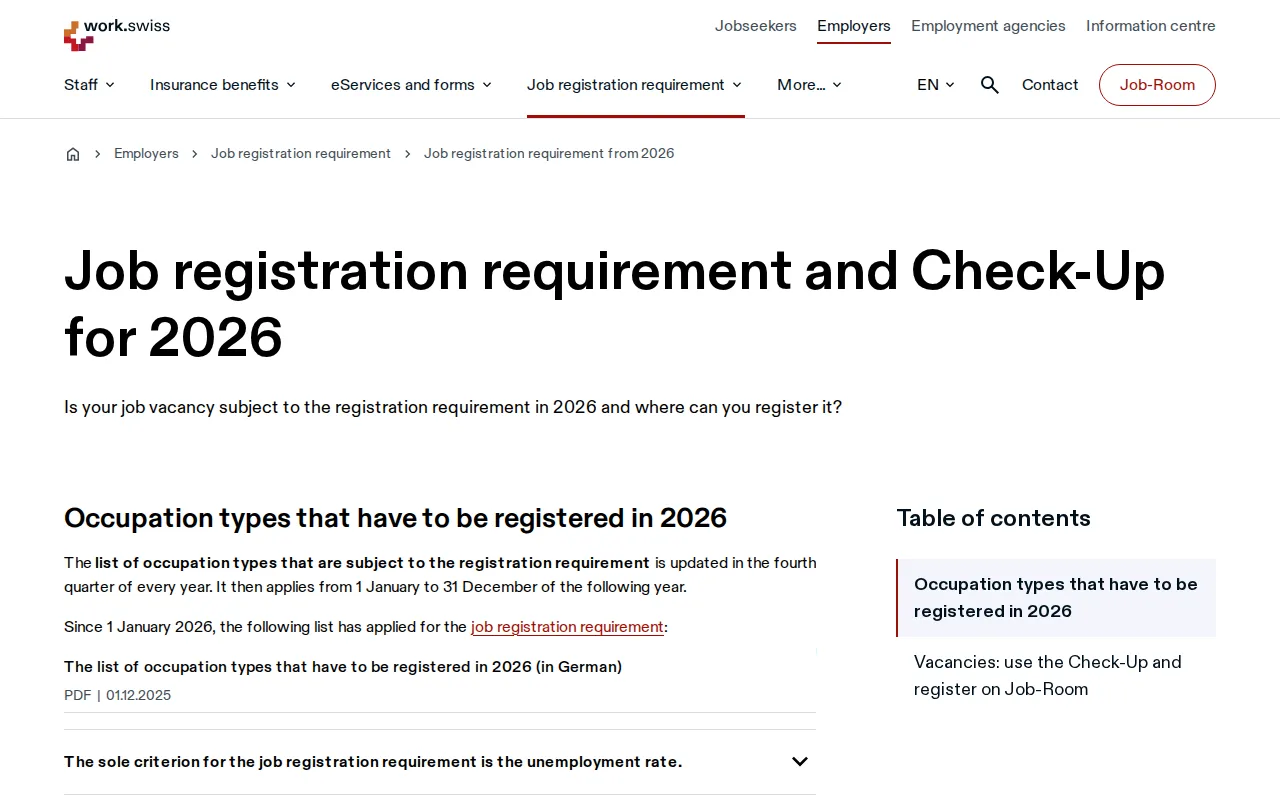
The list is updated in the fourth quarter of each year and applies from 1 January to 31 December of the following year. The 2026 list, dated 1 December 2025 and published in German, has applied since 1 January 2026. Per the same page, cleaning and auxiliary staff in offices, hotels and other establishments, and cooks were added in 2026, each with an unemployment rate of 5.3%. The page says the share of workers in affected occupations rose from 6.5% in 2025 to 10.8% in 2026, and that unskilled construction workers are the largest group, at 88,187 people. It does not give the total number of occupations.
The page also says the employer-side Check-Up, which matches job titles, is only a first indication: the RAV makes the final assessment based on the actual requirements and activities of the job.
The head start
The arbeit.swiss "FAQ on the job registration requirement" (read on 12 October 2026) explains what employers must then do. They register the vacancy in the protected area of Job-Room, where people registered with a RAV see it first. For five working days, counted from the working day after posting and excluding weekends and public holidays, the employer cannot advertise it elsewhere. The page calls this a publication ban and says it "cannot be shortened or circumvented". The page says the RAV then sends the employer a list of suitable candidates, or a note that there are none, within three days (one section says three working days, another says three days; the page does not reconcile them). It adds that a "no suitable candidates" note does not shorten the ban.
So if you see a vacancy on an open board, it can already have sat in Job-Room for a week. The FAQ also lists vacancies that need no registration:
- jobs filled by someone already registered with a RAV;
- jobs filled by internal staff employed for at least six consecutive months;
- employment of at most 14 days;
- employment of certain relatives of an authorised signatory;
- apprenticeships and internships that are a compulsory part of a course or training programme.
The same FAQ says the registration requirement took effect on 1 July 2018, and that the 5% threshold has applied since 1 January 2020.
Access to the head start depends on registration. arbeit.swiss's page "Registration" (read on 12 October 2026) says the Job-Room services tied to registration are open to people already signed on with a RAV. You need an AGOV login, your AHV number and the eight-digit person number your RAV assigns. We found no official statement of who qualifies for sign-on beyond the page's own wording, "unemployed or at risk of losing their job", and whether you would be entitled to benefits is a separate question that we do not cover here. Ask the RAV.
Probation and notice in the contract
Once you have an offer, two articles in the CO shape the first months. Both are quoted from the English text on Fedlex (last amended 1 January 2026, read on 12 October 2026, translation with no legal force).
Probation, art. 335b. During the probation period either party may end the contract at any time with seven days' notice, and the probation period is the first month of the relationship. A different length can be set by an individual written agreement, a standard employment contract or a collective employment contract, but it "may not exceed three months". If illness, accident or a non-voluntary legal obligation interrupts the period, the probation is extended accordingly.
Notice after probation, art. 335c. The contract may be ended with one month's notice in the first year of service, two months in the second to ninth years, and three months after that, in each case to the end of a calendar month. The periods can be varied in a written individual, standard or collective contract. They can be reduced below one month only by collective employment contract, and only for the first year of service.
These are the statutory defaults, and a contract may differ within those limits, so read your own. For the pay itself, our post on salaries in Switzerland has the official figures.
How we put this together
We read the pages named above on 12 October 2026: arbeit.swiss (application tips, sign-on, registration, the 2026 job registration pages and the FAQ), berufsberatung.ch (dossier, recognition), SERI's recognition pages and FAQ, the About Switzerland portal, the Federal Statistical Office page on languages, and the English text of the Code of Obligations on Fedlex. We did not use job boards, recruiters or CV-template sites. ch.ch pages on the work reference and probation period were not available when we tried to read them, so we rely on Fedlex for those rules. This is a description of rules, not advice for an individual case. For yours, ask the RAV, your cantonal migration office or an employment lawyer.
Häufige Fragen
- What goes into a Swiss job application?
- Official guidance names a cover letter, a CV, and copies of work references and diplomas, usually sent as one PDF. The public employment service says the CV should have no gaps and run to no more than three pages, newest job first.
- Can I ask my employer for a work reference?
- Yes. Article 330a of the Code of Obligations says an employee may request a reference at any time, not only when leaving. It covers the nature and duration of the job, the quality of the work and conduct, and you can ask for a version limited to nature and duration.
- Do I need my foreign diploma recognised to get a job in Switzerland?
- Only for regulated professions, such as physician, lawyer or architect. For other professions, the State Secretariat for Education, Research and Innovation says recognition is not a prerequisite for employment. An optional level certificate exists for those.
- What is the Stellenmeldepflicht?
- It is the job registration requirement. Employers must report vacancies in occupations with a national unemployment rate of 5% or more to the regional employment centre (RAV). For five working days, only people signed on with a RAV can see those vacancies in Job-Room.
- How long is the probation period and what notice applies?
- Under Code of Obligations art. 335b the first month is the probation period unless a written agreement sets another length of up to three months. During it either side can end the contract with seven days' notice. After it, art. 335c sets one month's notice in year one, rising with seniority.
Weitere Beiträge
Alle Beiträge
Salaries in Switzerland: what the official figures say
The official median salary in Switzerland is CHF 7,024 gross a month. See how region, sector and education move it, what gross includes, and minimum wages.

Swiss work permits in 2026: L, B, C and G explained
Which Swiss permit you need to work: L, B, C or G, how EU/EFTA and non-EU/EFTA rules differ, who applies, and what changes when you switch job or canton.