Do you need to speak German to work in Switzerland? (2026)

For most jobs, yes: German, or French in the west. Of the 179,108 approved ads live on jobsswitzerland.ch on 13 October 2026, 78% are written in German, 18% in French, 3% in English and 1% in Italian. English-only roles cluster in data, software, Geneva and Basel. The law sets no German level for a first work permit.
The short answer: 3 ads in 100 are in English
English is the language of 5,127 ads. German covers 139,914, French 31,992 and Italian 2,075. If you only work in English, that is the pool you're fishing in.
| Language of the ad | Ads | Share |
|---|---|---|
| German | 139,914 | 78% |
| French | 31,992 | 18% |
| English | 5,127 | 3% |
| Italian | 2,075 | 1% |
Be clear about what this counts. It's the language each ad is written in, which is a reasonable proxy for the language of the job, not a record of what people speak in the office. A German ad from an international firm can lead to an English-speaking team. An English ad can still ask for German, and the language of the ad alone doesn't tell us how often that happens.
Even so, the gap with daily practice is wide. The Federal Statistical Office counts 24% of employed people who usually speak English at work. Our reading: English is common inside Swiss workplaces, but mostly as a second working language next to a local one. Employers rarely advertise in it.
The question in the title is really two. Will an employer hire you without German? That depends on your field and canton, and the ads answer it. Will the authorities ask for German? That is the permit law, and its first fixed level comes with the settlement permit. We take them in turn.
By canton: Geneva and Basel, not Zurich
The highest English shares are in Geneva (13%), Basel-Stadt (9%), Ticino and Vaud (6% each) and Zug (5%). Zurich has the most English ads in absolute terms, 1,306, but that is 3% of the canton's 39,077.
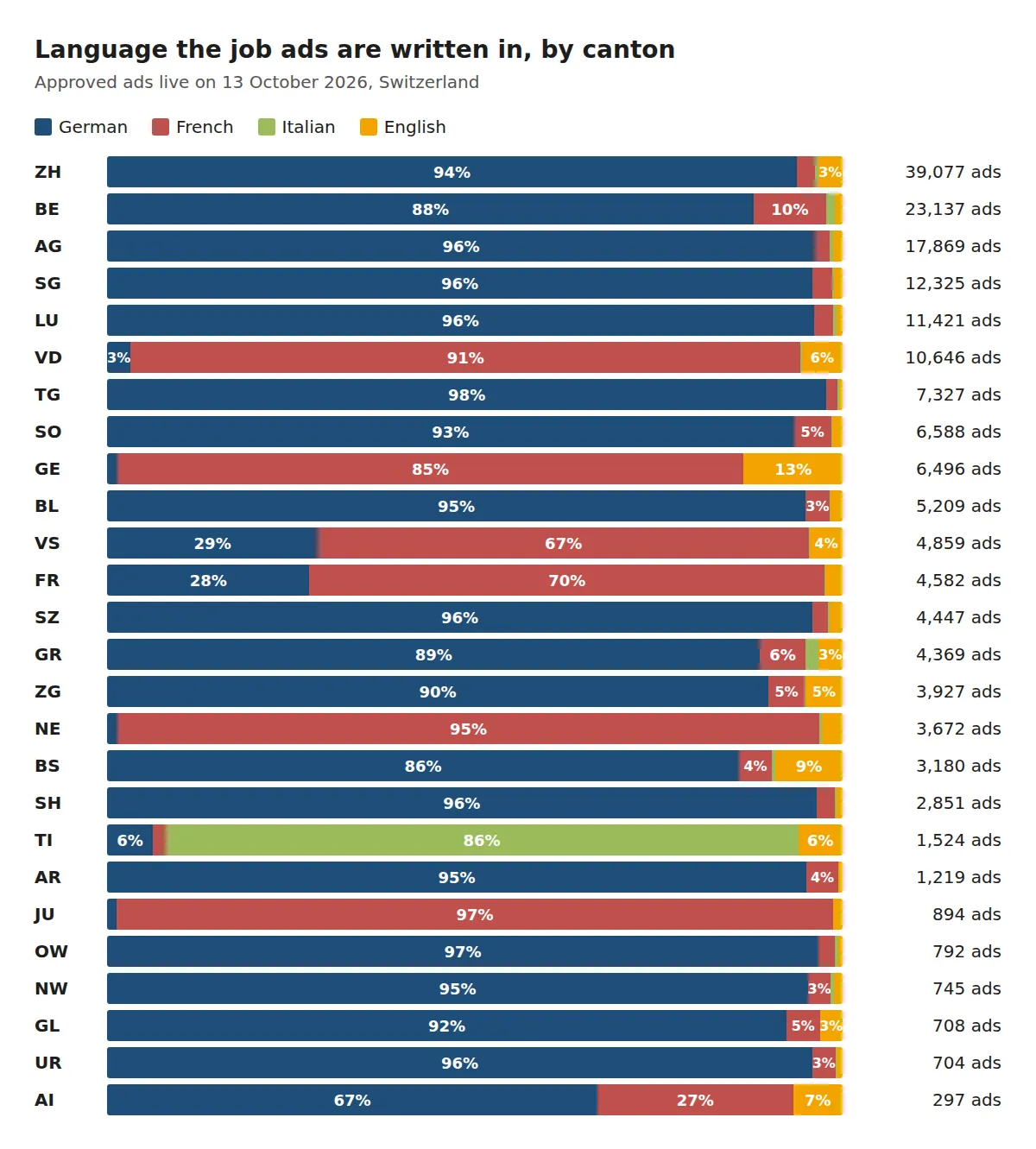
| Canton | German | French | English |
|---|---|---|---|
| Zurich | 94% | 2% | 3% |
| Bern | 88% | 10% | 1% |
| Vaud | 3% | 91% | 6% |
| Geneva | 1% | 85% | 13% |
| Basel-Stadt | 86% | 4% | 9% |
| Zug | 90% | 5% | 5% |
| Valais | 29% | 67% | 4% |
| Ticino | 6% | 2% | 6% |
In Ticino, 86% of ads are written in Italian. The bilingual cantons are mixed: in Fribourg 70% of ads are in French and 28% in German, and even Bern posts one ad in ten in French. The canton figures cover the 178,865 ads that carry a canton.
Zurich: the canton and the city
Zurich is a German-language job market with an English pocket in its biggest city. Across the canton, 94% of ads are in German. In Zurich city, 931 of 11,294 ads are in English, or 8%. Winterthur, in the same canton, sits at 2%. If someone tells you "you can get by with English in Zurich", they are describing one city's 8%, not the canton.
Geneva: French first, English second
Geneva has the highest English share of any canton: 873 ads, 13% of the canton's total. In the city of Geneva the share is 16% (724 of 4,644). French still carries 85% of the canton's ads, so English without French leaves you with 13% of them.
Basel and Zug
Basel city has 289 English ads out of 2,967, or 10%, and the canton of Basel-Stadt 9%. Zug reaches 5% (198 of its 3,927 ads). Lucerne, by contrast, sits at 0.8%, and in Lucerne city only 17 of 2,469 ads are in English.
By field: the deciding factor
Field matters more than place. In data and AI, 37% of ads are written in English (253 of 681); in software engineering, 30% (384 of 1,261). In the two largest fields, trades and healthcare, it is under 1%.
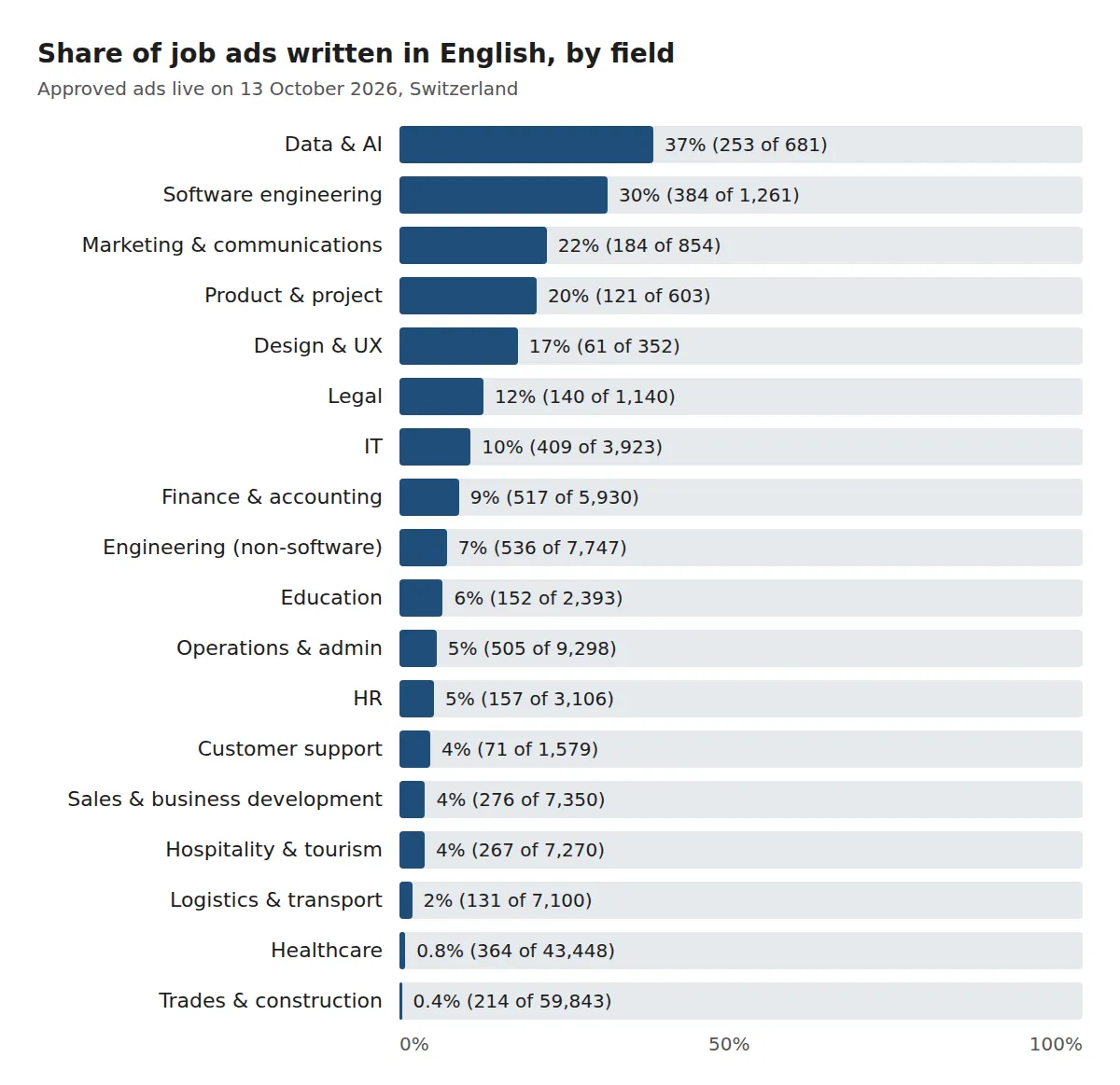
| Field | Ads | In English | In German |
|---|---|---|---|
| Data & AI | 681 | 37% | 39% |
| Software engineering | 1,261 | 30% | 48% |
| Marketing & communications | 854 | 22% | 55% |
| Product & project | 603 | 20% | 59% |
| Hospitality & tourism | 7,270 | 4% | 59% |
| Logistics & transport | 7,100 | 2% | 85% |
| Healthcare | 43,448 | 0.8% | 92% |
| Trades & construction | 59,843 | 0.4% | 83% |
Data and software
These are the fields where an English-only CV is realistic. Two caveats. First, they are small: together they carry fewer ads than hospitality alone. Second, even here English is not the majority. In data and AI, German (39%) still edges out English (37%), and another 23% of ads are in French.
Marketing, product, legal and finance
A middle band follows: marketing and communications at 22%, product and project at 20%, design at 17%, legal at 12% and IT operations at 10%. Finance and accounting has a lower share, 9%, but because the field is bigger it carries 517 English ads, more than data and AI.
Healthcare and trades
Trades and construction is the largest field, with 59,843 ads, and 214 of them are in English (0.4%). Healthcare follows with 43,448 ads, 364 in English (0.8%). In work with patients, clients or a site crew, plan on the local language as part of the job.
What the official statistics say about English at work
The Federal Statistical Office (FSO) counts 24% of employed people who usually speak English at work, behind Swiss German (61%), standard German (36%) and French (28%), and ahead of Italian (8%).
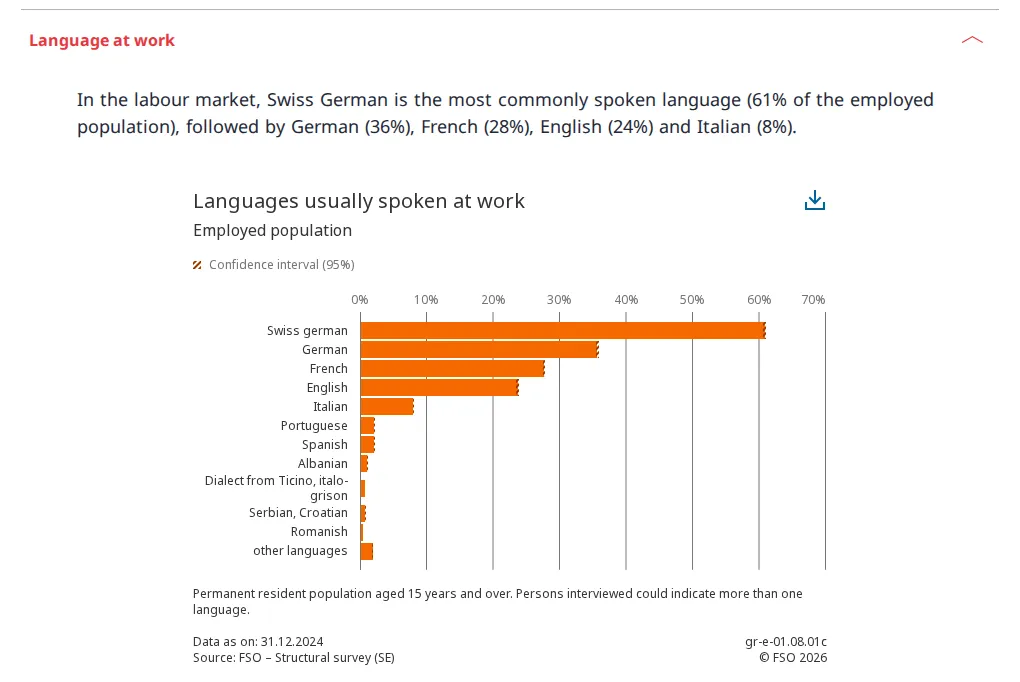
Three things to keep in mind when reading that chart:
- People could name more than one language, so the shares add up to well over 100%. On the same page, the FSO notes that 41% of employed people use more than one language at work at least once a week.
- It covers the permanent resident population aged 15 and over, so cross-border commuters, who live abroad, are not in it.
- At work, dialect is more common than standard German: 61% against 36%. Expect to hear Swiss German even if you learned standard German.
The trend is upward. The FSO's structural survey put English at work at 17% in 2010 and 21% in 2020, and the 2024 figure is 24%.
The FSO's separate 2024 language survey adds the other side. In its publication on language practices, about a quarter of residents whose main language is not the local one report language difficulties at work or when looking for a job. That survey had 14,528 respondents and could only be answered in German, French or Italian, so the people with the least German, French or Italian are the ones it misses.
What the law requires for your permit
No German level is fixed for a first work permit. Fixed levels start with the settlement permit (C), a spouse's permit renewal and naturalisation, and they always concern a national language. English never counts.
| Procedure | Spoken | Written | Rule |
|---|---|---|---|
| First B work permit, non-EU/EFTA | no level set | no level set | AIG Art. 23 |
| Spouse of a B or C holder, renewal | A1 | not set | VZAE Art. 73a |
| Settlement permit (C), regular | A2 | A1 | VZAE Art. 60 |
| Settlement permit (C), after 5 years | B1 | A1 | VZAE Art. 62 |
| Naturalisation | B1 | A2 | BüV Art. 6 |
First permit
Under the Foreign Nationals and Integration Act (AIG), permits for work from outside the EU/EFTA go, as a rule, only to executives, specialists and other qualified workers (Art. 23 para 1). For a B permit, qualifications, adaptability, language skills and age must together point to lasting integration (para 2). Language is one factor among four, with no level attached. In practice, the job's own language needs weigh more than the permit.
Settlement permit and family
The admission ordinance (VZAE) sets the levels. A regular C permit, possible after ten years in Switzerland with the last five on a B (AIG Art. 34), needs spoken A2 and written A1 in the national language spoken where you live (Art. 60). The early C permit after five years needs spoken B1 and written A1 (VZAE Art. 62). So if you learn German in Zurich and then move to Lausanne, your German certificate doesn't count for a C permit there.
A spouse joining a C holder must be able to communicate in the local language, but registering for a course is enough to get the first permit (AIG Art. 43). To renew it, a spouse of a B or C holder needs spoken A1 (VZAE Art. 73a), which the State Secretariat for Migration (SEM) expects within a year of arrival. Unmarried children under 18 face no language condition. Authorities can depart from these criteria for disability, serious illness or other weighty personal circumstances (VZAE Art. 77f).
Naturalisation
The citizenship ordinance (BüV, Art. 6) asks for spoken B1 and written A2 in a national language, and the rule draws no line by nationality. The SEM's naturalisation FAQ adds that cantons can set higher levels.
EU/EFTA nationals
The AIG applies to EU and EFTA nationals only where the free movement agreements say nothing different or the AIG is more favourable (Art. 2 para 2). The SEM's residence FAQ states that their residence is governed exhaustively by those agreements and sets out no language requirement for them. For a later C permit, ask your canton's migration office which rules apply to you. The naturalisation levels apply whatever your passport.
Proving your level
You prove a level with a recognised certificate in the right national language, or you are exempt because of your schooling. Course attendance slips and online placement tests don't count.
The exemptions are in VZAE Art. 77d: the language is your native language, you went to compulsory school in it for at least three years, or you studied in it at upper-secondary or tertiary level. For naturalisation the bar is five years of school, and the studies must be completed (BüV Art. 6).
For everyone else, the SEM keeps a list of recognised certificates, updated every three months. A certificate counts if it was on the list on the day you file. The edition of 1 October 2026 includes:
- German: the fide test and fide dossier, Goethe-Zertifikat, telc Deutsch, ÖSD, TestDaF and ECL.
- French: fide, DELF, TCF and TEF.
- Italian: fide and CELI.
The fide language passport is the SEM's own route. It certifies German, French, Italian or Romansh and, in fide's own words, is used with "authorities, employers or educational institutions". Fide's level guide notes that official procedures expect A1, A2 or B1, and a few cantons B2 for speaking. English has no place on the SEM list: however good your English certificate, it proves nothing for a permit.
Cantons help you find a course. The canton of Zurich offers free advice on German courses in 16 languages, and its offers are co-financed by municipalities and the federal integration credit. In Geneva, the cantonal integration office keeps a directory of low-cost French courses offered by non-profits.
A plan by situation
Your field and your passport decide more than your canton. Four common cases:
EU/EFTA national in data, software or marketing
For a B or L permit, the SEM sets out no language requirement. The market is the constraint: English carries 37% of data and AI ads and 30% of software ads. Of the eight cities in our data, English ads are most common in Geneva (16%), Lugano (11%), Basel (10%) and Zurich (8%), though Lugano has only 40 of them. Most ads in your field are still in a local language, so learning German or French widens the pool. A recruiter quoted by The Local suggests aiming for B1 German so you can follow business meetings, even if you answer in English. That is one recruiter's view, not a rule, but it fits the pattern above: English at work is common, English ads are not.
Non-EU specialist
Language is one factor for a B permit, with no level attached (AIG Art. 23). Your first permit won't hinge on a certificate. Your C permit will: A2 spoken and A1 written after ten years, or B1 spoken to get it after five. Learn the language spoken where you live, since that is the one the C permit counts.
Healthcare, trades and other hands-on work
Under 1% of ads in these fields are in English. Treat the local language as part of the qualification, and budget time for it before applying, not after.
French-speaking Switzerland and Ticino
West of the language border, French does the work German does elsewhere: 91% of ads in Vaud, 95% in Neuchâtel, 97% in Jura. German helps little there, with 3% of Vaud's ads. In Ticino, 86% of ads are in Italian, with English and German at 6% each. For a C permit in these cantons, the language that counts is French or Italian.
Already in Switzerland and out of work
If you lose a job, sign on with the regional employment centre (RAV) no later than the first day you want unemployment benefits. The SECO sign-on page says the first consultation follows within 15 days, and you need your ID (a foreign national identity card counts) and your AHV number. The page sets no language condition.
Common questions
- Can you work in Switzerland with only English?
- Yes, but in a narrow part of the market. Of 179,108 live Swiss job ads, 5,127 (3%) are written in English. The share reaches 37% in data and AI and 30% in software engineering, and stays under 1% in healthcare and in trades.
- What level of German do you need to work in Switzerland?
- No law sets a level for the job itself: the employer decides, and 78% of ads are written in German. For permits, the regular settlement permit (C) asks for A2 spoken and A1 written in the local national language, and naturalisation asks for B1 spoken and A2 written. A recruiter quoted by The Local suggests B1 to follow business meetings.
- Do you need to speak German to get a Swiss work permit?
- Not for a first permit. For workers from outside the EU/EFTA, language skills are one factor next to qualifications, adaptability and age, with no level fixed in the law. The State Secretariat for Migration lists no language requirement for EU/EFTA nationals, whose residence falls under the free movement agreements. Fixed levels start with the settlement permit (C).
- Do you need German in Zurich or French in Geneva?
- Mostly, yes. In the canton of Zurich 94% of ads are written in German and 3% in English, although English rises to 8% in Zurich city. In the canton of Geneva 85% are in French and 13% in English, the highest English share of any canton.
- Does an English certificate count for a Swiss permit?
- No. Permit and naturalisation rules ask for a national language: German, French, Italian or Romansh. For the C permit it has to be the language spoken where you live, so a German certificate does not count if you live in Lausanne. Course attendance slips and online placement tests are not accepted either.