Dieser Artikel ist nur auf Englisch verfügbar.
Salaries in Switzerland: what the official figures say

According to the Federal Statistical Office, the gross median wage in Switzerland was CHF 7,024 a month in 2024 for a full-time position, in the latest Earnings Structure Survey, published on 25 November 2025. Half of employees earn more, half less. Region, sector and education move that figure by thousands of francs.
Where the numbers come from
The Federal Statistical Office (FSO, in German BFS) runs the Swiss Earnings Structure Survey every two years. The press release published on 25 November 2025, which we read on 12 October 2026, covers the reference year 2024 and calls its results "initial findings". The methodological annex says the 2024 results rest on answers from about 34,000 companies and cover about 2.9 million employees in industry and services. We did not find a 2026 edition: the next survey would cover 2026 and was not out when we read.
Three definitions from that annex matter for everything below.
- Median, not average. Half of the jobs pay more than the median and half pay less. The FSO states that it is not the average wage.
- Standardised full-time month. Wages are converted to 4⅓ weeks of 40 hours so that part-time and full-time jobs can be compared.
- Gross includes more than the October payslip. The annex lists the October gross wage (with the employee's social insurance contributions, benefits in kind and regular commission), shift, night and Sunday pay, one twelfth of the 13th monthly salary and one twelfth of annual bonuses. Family and child allowances are not counted.
So CHF 7,024 is a statistical construct. It is a good yardstick, but it is not the number you will see on one specific contract.
The national picture and the spread
The FSO's press release gives the figure for the whole economy, private and public sectors together: a gross median of CHF 7,024 a month in 2024, up from CHF 6,788 in 2022. The tenth of employees with the lowest pay earned less than CHF 4,635. The best-paid tenth earned more than CHF 12,526.
| Measure, 2024, full-time, gross per month | CHF |
|---|---|
| Lowest decile (below) | 4,635 |
| Median | 7,024 |
| Highest decile (above) | 12,526 |
| Low-wage threshold (two thirds of the median) | 4,683 |
The FSO counts a job as low-wage when the standardised monthly pay is under two thirds of the median, which came to CHF 4,683 in 2024. It put the share of such jobs at 10.8%, against 10.5% in 2022.
Pay is not the whole story, because of bonuses. According to the release, 32.6% of employees got an annual bonus in 2024, worth CHF 11,967 on average. For staff without management responsibility the average bonus was CHF 4,601. For senior managers in banks the release gives CHF 147,796. That spread is the reason your own package may sit far from any median.
Zürich, Ticino and the other regions
The FSO's regional numbers are the second thing people search for. The release says the gross median in the Zürich major region was CHF 7,502 in 2024 and in Ticino CHF 5,708, against CHF 7,024 nationally. It describes Zürich as the top and Ticino as the bottom, and adds that the differences are fairly stable over time and mostly reflect where high value-added industries are concentrated.
The gap widens at the top. For the best-paid tenth, the FSO gives the following thresholds.
| Major region, 2024 | Lowest tenth earns less than | Best-paid tenth earns more than |
|---|---|---|
| Zürich | 4,761 | 13,970 |
| Lake Geneva | 4,585 | 12,636 |
| Eastern Switzerland | 4,563 | 11,030 |
| Ticino | 3,783 | 10,012 |
The release names only these four regions for the deciles. The other major regions are not in the text we read, and we did not use the FSO's database for them. The release also does not publish a median for a single city such as Zürich or Lugano, so we do not give one.
Sectors: wide differences
According to the FSO, wages differ widely by economic branch. These 2024 gross monthly medians come straight from the release.
| Branch | CHF per month |
|---|---|
| Tobacco industry | 14,304 |
| Banks | 10,723 |
| Pharmaceutical industry | 10,159 |
| Research and development | 9,139 |
| Mechanical engineering | 7,632 |
| Wholesale | 7,478 |
| Air transport | 7,134 |
| Construction | 6,616 |
| Metal production and processing | 6,279 |
| Retail | 5,214 |
| Restaurants and catering | 4,744 |
| Accommodation | 4,715 |
| Personal services | 4,496 |
The low-wage share follows the same order. The release gives 56.3% of jobs in personal services as low-wage, 48.7% in accommodation, 47.8% in restaurants and catering and 24.6% in retail. In banks the share is 0.6%, in insurance 0.8% and in public administration 1.4%.
Education, and why role matters more
On education, the release says the wage hierarchy is largely set by the level of training. For a full-time position, the monthly gross wage was CHF 10,533 with a university degree, CHF 9,288 with a degree from a university of applied sciences and CHF 6,390 with a federal VET diploma (EFZ).
Then the FSO makes a point that is easy to miss. At a comparable level of education, the type of function decides pay. A person with a university degree earned CHF 14,409 in a job with a high level of responsibility and CHF 8,645 in a job without responsibility. With an EFZ, the figures were CHF 8,252 and CHF 6,162. A degree opens doors, but the job you do with it sets the number.
The release also compares nationalities and permits. In jobs with a high level of responsibility, foreign employees earned more than Swiss employees: CHF 13,090 with a B permit, CHF 11,966 with a C permit and CHF 11,207 for G-permit commuters, against CHF 10,989 for Swiss nationals. In jobs without management responsibility it was the other way round: CHF 6,765 for Swiss nationals, CHF 5,421 with B, CHF 6,034 with C and CHF 5,950 with G. If you are still working out which permit applies to you, our guide to Swiss work permits covers the rules.
The gender gap as the FSO reports it
The FSO's median wage gap between women and men was 8.4% in 2024 for the whole economy. It was 9.5% in 2022, 10.8% in 2020 and 11.5% in 2018. The release says part of the gap can be explained by personal characteristics such as education and age and by job characteristics such as level of responsibility and branch. It does not give the explained and unexplained shares in the release. The annex says they come from a separate analysis, which we did not read.
The gap grows with seniority. In jobs with a high level of responsibility, women earned CHF 10,077 a month and men CHF 11,715, a gap of 14.0%. In jobs without a management function the gap was 5.2%. At the bottom of the scale, among full-time gross wages under CHF 4,500, 62.0% of employees were women. Above CHF 16,000, 74.9% were men.
What "gross" means on your payslip
Your contract usually states a gross wage. Several deductions come off it before the transfer. The federal table of social insurance contribution rates (synoptic table, "Stand 1.1.2026", published by the federal social insurance authorities and read on 12 October 2026) sets out the 2026 rates.
| Contribution, 2026 | Employee rate | Employer rate |
|---|---|---|
| AHV/AVS (old age and survivors) | 4.35% | 4.35% |
| IV/AI (disability) | 0.7% | 0.7% |
| EO/APG (income compensation) | 0.25% | 0.25% |
| Total AHV/IV/EO | 5.3% | 5.3% |
| ALV/AC (unemployment), on wage up to CHF 148,200 a year | 1.1% | 1.1% |
The same table says three more things.
- Pension fund (BVG). Rates differ from one pension fund to another. The employer has to pay at least as much as the employee. The minimum age credits are 7% of the coordinated wage from age 25 to 34, 10% from 35 to 44, 15% from 45 to 54 and 18% from 55 to 65. The coordinated wage lies between CHF 26,460 and CHF 90,720.
- Accident insurance. The employer pays occupational accident premiums. Non-occupational accident premiums are, as a rule, borne by the employee, unless the contract says otherwise, and the rate depends on the insurer and the risk class.
- Income tax. It is not in that table at all. It depends on canton, municipality, civil status and children. The Federal Tax Administration (ESTV) runs a tax calculator at swisstaxcalculator.estv.admin.ch. The page needs JavaScript and we could not read what it covers, so check its inputs before relying on a result.
A rough illustration with the median: CHF 7,024 times 5.3% is about CHF 372, and times 1.1% about CHF 77, so about CHF 450 a month goes to AHV/IV/EO and ALV before pension, accident insurance and tax. That is arithmetic on a statistical median, not what any payslip will show.
On the 13th month, the release says 75.9% of employees received one in 2024. If yours is in the contract, a monthly salary of CHF 6,000 gross is CHF 78,000 for the year, and the percentages above apply to each payment.
Check a specific job: Salarium
For a particular job, the FSO runs a calculator, Salarium. The FSO page "Salarium - Statistical salary calculator", read on 12 October 2026, describes it as a monthly wage calculator for a job (region, economic activity, occupational group) and individual criteria such as age and education.
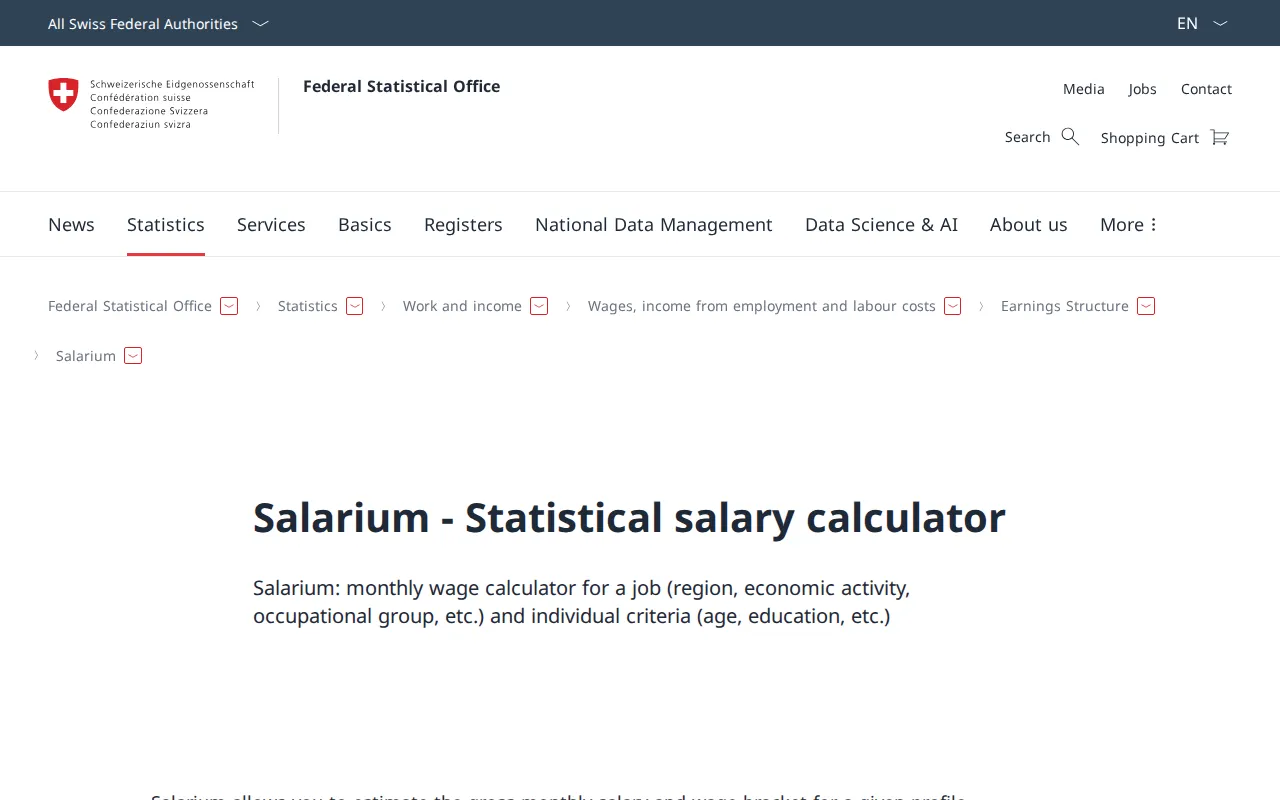
The same page says the pre-filled defaults are the most frequent values in the 2024 survey. It estimates gross monthly pay with a model of 14 variables, such as sector, company size, age, education, gender and occupation. It stresses that the result comes from a simplified model and is not a salary recommendation.
The State Secretariat for Economic Affairs (SECO) runs a separate national wage calculator at nlr.seco.admin.ch. The FSO page says both tools use Earnings Structure Survey data but differ in their models, because they were built for different purposes. Use Salarium for an estimate, and treat any figure as a range to question, not a number to quote in a negotiation.
Cantonal minimum wages
This section covers the five cantons with a minimum wage that we checked; we did not check the others. All figures are gross per hour, from the cantons' pages, which we read on 12 October 2026.
| Canton | CHF per hour, 2026 | Source |
|---|---|---|
| Geneva | 24.59 | ge.ch press release of 1 October 2025 |
| Basel-Stadt | 22.20 | bs.ch FAQ on the minimum wage law |
| Jura | 21.40 | jura.ch, "Salaires minimaux" |
| Neuchâtel | 21.35 | ne.ch minimum wage memo 2026 |
| Ticino | 20.00 to 20.50, by sector | ti.ch, "Salario minimo cantonale" |
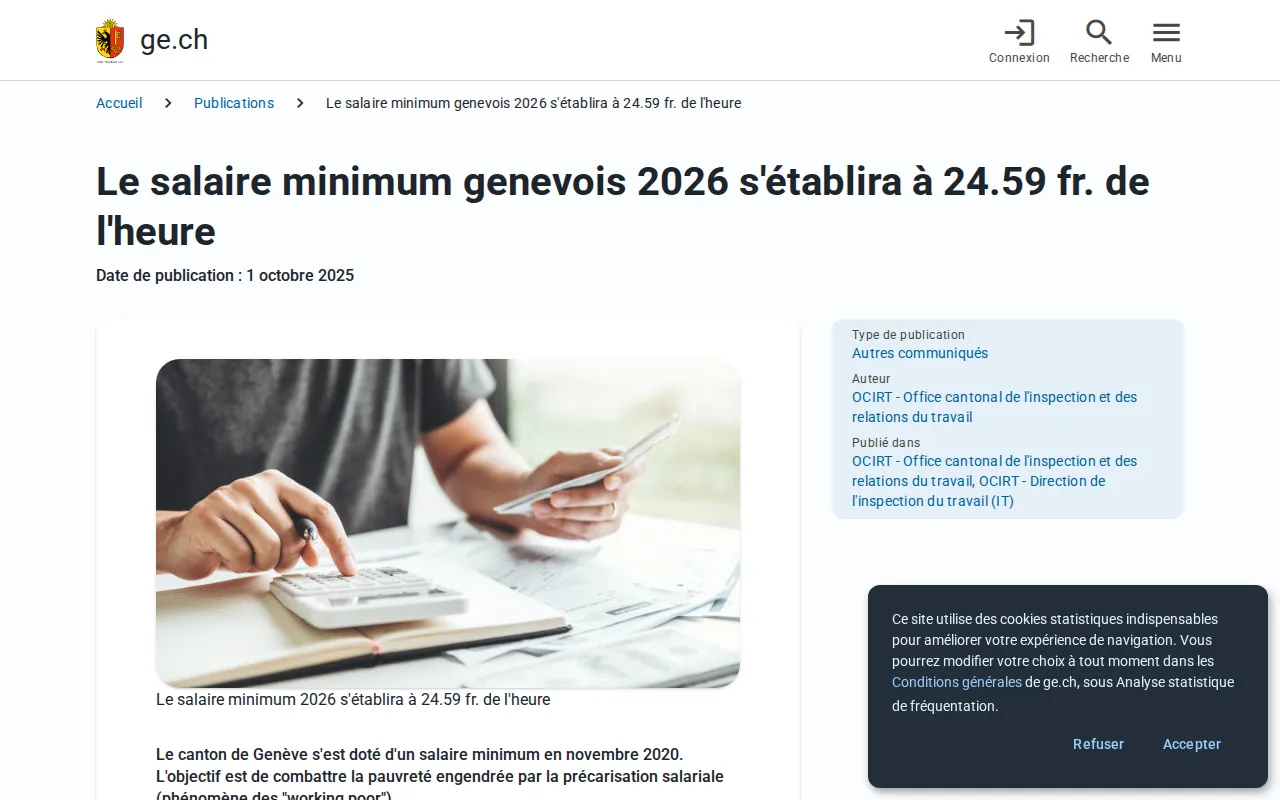
The details differ, so read each cantonal page.
- Geneva. The release says the minimum applies to all sectors and is indexed every year to the Geneva consumer price index. It was CHF 24.48 in 2025. A separate, lower rate of CHF 18.07 applies in agriculture and floriculture from 2026.
- Basel-Stadt. The minimum has applied since 1 July 2022, and was CHF 22.00 in 2025. It does not apply in branches with a generally binding collective labour agreement. It also applies to workers posted from abroad whose habitual workplace is not in Basel-Stadt.
- Jura. The page says CHF 21.40 has applied since 1 July 2024, without holiday and public-holiday supplements. It does not apply to branches under an extended collective agreement with a numeric minimum.
- Neuchâtel. The memo says the base minimum is CHF 21.35 for 2026 (CHF 21.31 in 2025), adjusted to the August consumer price index. If a 13th salary is in the contract, the base is CHF 19.71 plus one twelfth, which gives CHF 21.35. Agriculture, viticulture and horticulture have their own CHF 18.15.
- Ticino. The canton's page says the minimum is 55% of the national median wage for each economic sector, held between a lower limit of CHF 20.00 and an upper limit of CHF 20.50 an hour. The sector table on the page runs from CHF 20.00 (food industry) to CHF 20.50 (forestry, for example).
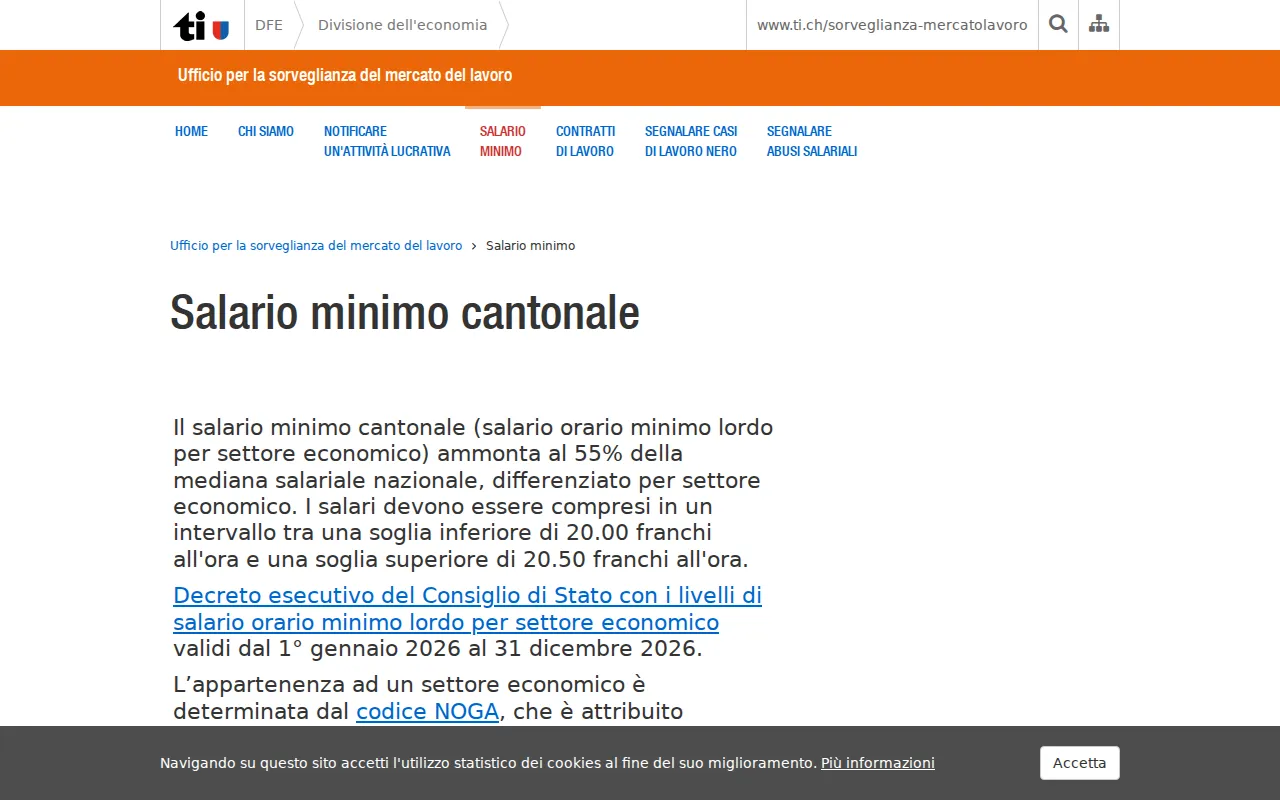
Ticino is the one to watch. A Grand Council committee report dated 30 March 2026 proposes raising the band to CHF 20.50 to 21.00 from 2027, 21.00 to 21.50 from 2028 and 21.75 to 22.25 from 2029. Press reports say parliament adopted this on 20 April 2026. We read the report but not the final law, so check ti.ch before you rely on it. The same report also notes a federal bill that could give collective agreements priority over cantonal minimums.
A collective labour agreement for your branch may also set its own minimums, so check that too.
How we put this together
We read the FSO's press release of 25 November 2025 (the German full text and the English summary), the FSO's Salarium page, the federal synoptic table of social insurance rates, and the cantonal pages cited above, all on 12 October 2026. We did not test Salarium or any other tool, and we did not use any salary-comparison site or job board for a figure. Where a number is not in the sources we read, the text says so.
Häufige Fragen
- What is the average salary in Switzerland?
- The Federal Statistical Office publishes the median, not the average. For 2024 the gross median was CHF 7,024 a month for a full-time position. Half of employees earn more and half earn less, and the median is not the same as the average, which the Office calculates differently.
- What is the median salary in Zürich?
- The Office's 2024 Earnings Structure Survey gives CHF 7,502 gross a month for the Zürich major region, against CHF 7,024 for Switzerland as a whole. The top tenth of earners in that region made more than CHF 13,970. These are full-time, standardised monthly figures.
- How much of my gross salary is deducted?
- For 2026 the federal tables list 5.3% of your wage for AHV/AVS, IV and EO combined, and 1.1% for unemployment insurance on the part of the wage up to CHF 148,200 a year. Pension fund contributions and non-occupational accident premiums are deducted as well and differ by employer. Income tax is separate and depends on your canton, municipality and situation.
- Is there a minimum wage in Switzerland?
- Several cantons set their own: Geneva (CHF 24.59 an hour in 2026), Basel-Stadt (22.20), Jura (21.40), Neuchâtel (21.35) and Ticino, which sets a band of CHF 20.00 to 20.50 by sector. Collective labour agreements can replace the cantonal rule in some cases.
- Do Swiss salaries include a 13th month?
- Often, yes. In 2024, 75.9% of employees received a 13th monthly salary according to the Federal Statistical Office. The Office's gross wage figures include one twelfth of it, so a contract can state a monthly salary and the annual total is still higher.
Weitere Beiträge
Alle Beiträge
How to apply for a job in Switzerland: the 2026 guide
What a Swiss application file contains, why the work reference matters, when a foreign diploma needs recognition, and how the RAV job registration rule works.

Swiss work permits in 2026: L, B, C and G explained
Which Swiss permit you need to work: L, B, C or G, how EU/EFTA and non-EU/EFTA rules differ, who applies, and what changes when you switch job or canton.