Dieser Artikel ist nur auf Englisch verfügbar.
Swiss work permits in 2026: L, B, C and G explained

Four permits cover almost every foreigner working in Switzerland: L for stays of up to a year, B for longer residence, C for settlement and G for cross-border commuters. Your passport and the length of your contract decide which one you get. EU/EFTA nationals qualify through the job itself; everyone else needs an employer to apply, within annual quotas.
Why there are two systems
Switzerland admits foreign workers through what the State Secretariat for Migration (SEM) calls a dual system. SEM's page "Working in Switzerland", read on 12 October 2026, describes one route for EU/EFTA nationals, who have easier access under the Agreement on the Free Movement of Persons, and a second, limited route for everyone else, with priority for managers, specialists and other qualified workers.
The permits themselves are issued by the cantons. SEM's page "Residence", read the same day, says that anyone who works in Switzerland or stays longer than three months needs a permit, and that cantonal migration offices issue it. It sorts permits by length of stay: short-term (under one year), annual (limited) and permanent (unlimited).
So two questions decide almost everything: which passport you hold, and how long the job lasts.
The permits at a glance
The letters are shorthand used on the card. The table below uses SEM's EU/EFTA permit pages (L, B, C, G, all read on 12 October 2026, each marked "last modification" in 2021 or 2022) and the Foreign Nationals and Integration Act, FNIA (in German AIG, in French LEI), in the English text on Fedlex, read on 12 October 2026.
| Permit | What it is | EU/EFTA nationals | Non-EU/EFTA nationals |
|---|---|---|---|
| L | Short stay | Contract of 3 to 12 months; valid as long as the contract | Up to one year, extendable by up to two years (FNIA art. 32) |
| B | Residence | Contract of 12 months or more, or open-ended; valid 5 years, renewable | Stays of more than a year, time-limited, renewable (art. 33) |
| C | Settlement | After 5 or 10 years of residence, no time limit | Unlimited duration, no conditions (art. 34) |
| G | Cross-border commuter | Live in the EU/EFTA, work in Switzerland; 5 years or contract length | Neighbouring-state residents, border-zone work (arts. 25, 35) |
Two details are easy to miss. First, the FNIA's short-stay permit is for "limited periods of stay of up to one year" and "may be extended by up to two years" (art. 32). Second, the settlement permit is not a long B permit: it has no time limit and no conditions attached (art. 34 para. 1).
Who gets a C permit, and when
For non-EU/EFTA nationals, art. 34 FNIA sets the general rule: at least ten years in Switzerland in total, the last five of them on a residence permit without interruption, and no grounds for revocation, and the person has to be integrated. Para. 4 allows five years if you also communicate well in the national language of your place of residence. Para. 3 allows a shorter period "if there is good cause".
For EU/EFTA nationals, SEM's C permit page, read on 12 October 2026 and marked as last modified on 1 March 2021, says the Free Movement Agreement contains no settlement provisions, so the FNIA and bilateral settlement treaties apply. Nationals of fourteen listed EU states (including Germany, France, Italy, Spain and Portugal) plus Iceland, Liechtenstein and Norway may get a C permit after five years of regular, uninterrupted residence. For nationals of other EU states, SEM's page says no such treaties exist.
EU/EFTA nationals: free movement, with paperwork
Free movement does not mean no permit. It means the permit follows from the job rather than from a quota or a test of the labour market.
Short jobs: the online notification
SEM's page "Online notification", read on 12 October 2026, says a Swiss company may employ EU/EFTA nationals for up to three months through the online procedure. Longer employment requires a Swiss residence permit or a cross-border commuter permit. For this short-term case the employer files, and the page says the notification must be made no later than one day before the first day of work. Posted workers from an EU/EFTA company are covered up to 90 effective working days per calendar year, and those have to be entered at least eight days before work starts.
Longer jobs: L or B
The canton of Zürich's page for EU/EFTA nationals, read on 12 October 2026 (no update date shown on the page), ties the permit to the contract. L is for contracts over three months and under one year, B for open-ended contracts or those longer than a year, in both cases with an average of more than 15 hours a week. The residence permit application goes through the municipal residents' office, which forwards it to the cantonal migration office. You register in person within 14 days of arriving, and the same 14 days apply to a move within the canton or to another canton.
SEM's B permit page says the permit is valid for five years and can be renewed for five more if you still meet the requirements. The first renewal can be cut to one year if you have been involuntarily unemployed for more than twelve consecutive months.
Looking for work
The same Zürich page says job seekers from the EU/EFTA may stay without a permit for three months to look for work, and may apply for a permit for non-employed residence if they show sufficient money and health and accident insurance. SEM's L permit page adds that a permit for job seekers gives no entitlement to social assistance. Our post on applying for jobs in Switzerland covers what happens after the permit question.
Non-EU/EFTA nationals: employer first, quotas, priority
The third-country route starts with the employer, not with you. SEM's FAQ on working, read on 12 October 2026, puts it flatly: a job offer alone does not make you eligible, and your employer must submit the application to the competent cantonal authority. SEM's page on the procedure, read the same day and last updated on 22 December 2020, then describes five steps.
- The employer submits the application documents to the cantonal employment or immigration authority. If a visa is needed, the employee also applies at the Swiss representation abroad.
- The canton screens the application and takes a preliminary decision.
- SEM reviews approved files against nationwide criteria, and the employer pays a fee. The decision alone does not allow entry.
- Where a visa is required, the canton sends an electronic authorisation to the Swiss representation, and the employee collects the visa.
- The employee registers within 14 days of arriving and can start work only after registering.
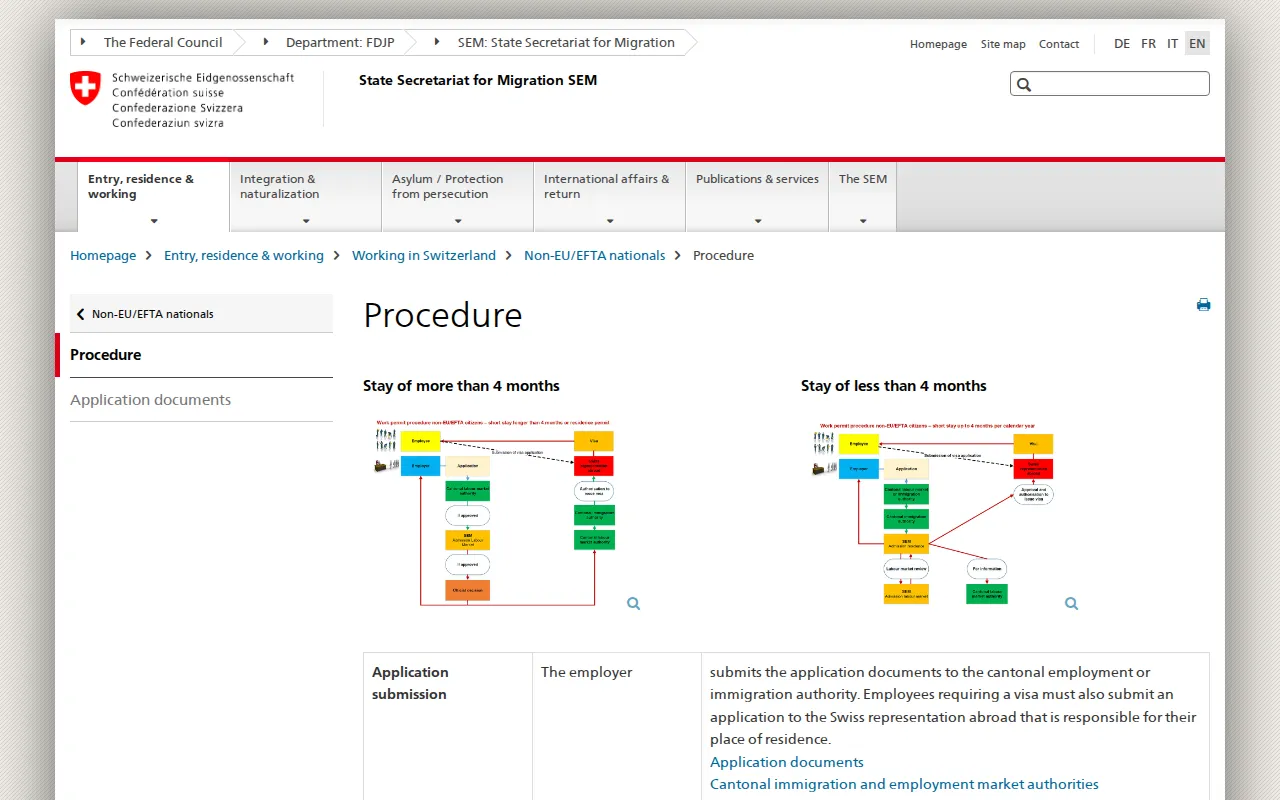
SEM's FAQ says to expect six to eight weeks for a file to be processed, longer for complex cases or a company's first application. The canton of Geneva says something similar from the employer's side: its page for third-state nationals, read on 12 October 2026 and marked as updated on 16 February 2026, asks employers to file about six to eight weeks before the person enters Switzerland. On that page the OCPM issues the permit only after prior approval from the OCIRT's foreign labour division. If you have a start date in mind, ask the employer when it filed.
The priority rule
FNIA art. 21 para. 1 says foreign nationals may be permitted to work "only if it is proven that no suitable domestic employees or citizens of states with which an agreement on the free movement of workers has been concluded can be found for the job". Para. 2 counts Swiss nationals, settlement permit holders, residence permit holders who may work, and certain temporarily admitted persons as domestic employees.
SEM's page on the basis for admission, read on 12 October 2026 and marked as updated on 5 July 2026, says employers must show genuine recruitment efforts, including registering the vacancy with the regional employment centres (RAV) and advertising via EURES. The canton of Geneva's page adds the requirement to report the vacancy to the cantonal employment office.
Art. 21 para. 3 has one exception that matters to students: foreign nationals with a Swiss university degree may be admitted despite the priority rule if their work is of high academic or economic interest, and for six months after finishing their studies to look for suitable work. SEM's FAQ gives the same six months.
Who qualifies
Art. 23 FNIA limits short-stay and residence permits for work to "managers, specialists and other qualified workers". For a residence permit, qualifications, professional and social adaptability, language skills and age must also point to lasting integration in the Swiss job market. Para. 3 lists exceptions, such as intra-company executive transfers and persons with special professional knowledge where there is a need for their admission. Art. 22 requires pay and conditions customary for the location, profession and sector, and art. 24 requires suitable accommodation.
Geneva's page lists full-time work among the conditions. We did not see that on the SEM pages we read, so ask the canton whether it applies in yours. Full-time roles are the ones to browse first.
Quotas for 2026
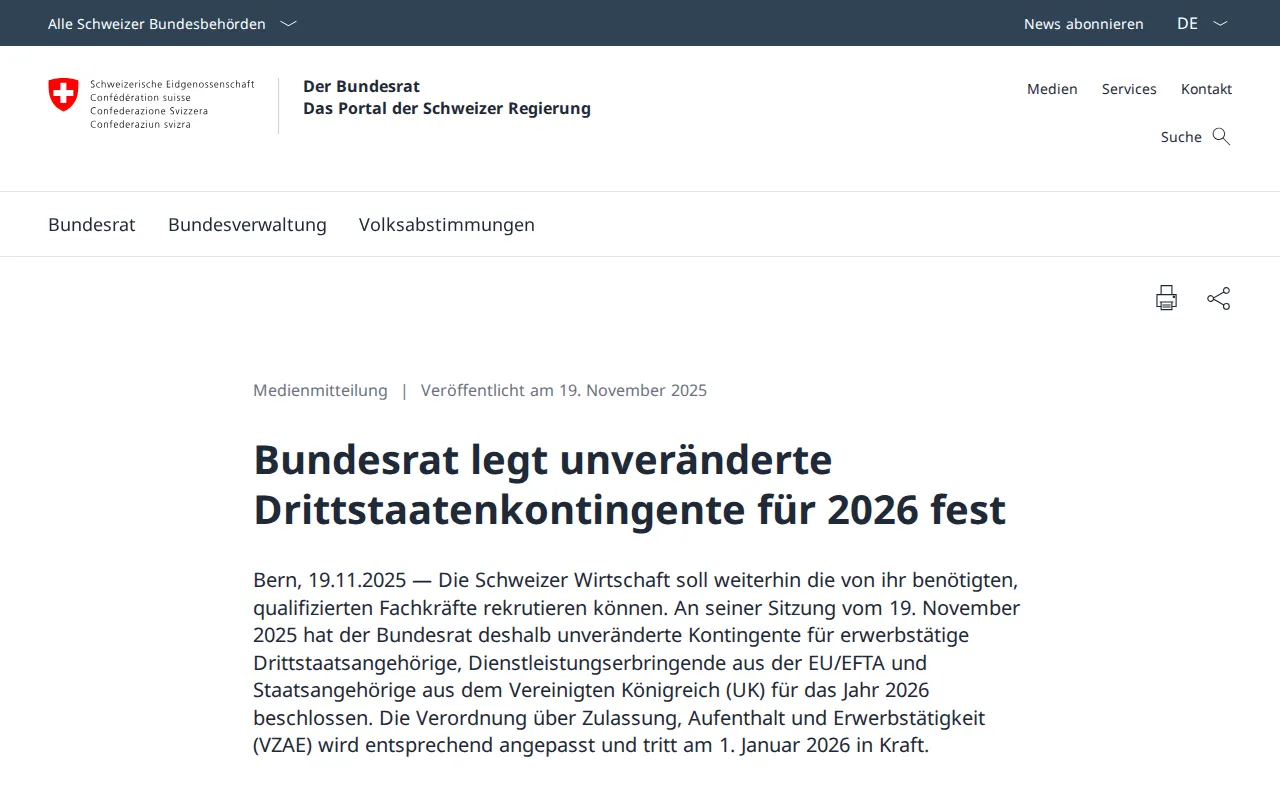
Art. 20 FNIA lets the Federal Council cap first-time L and B permits for work. The Federal Council's press release of 19 November 2025 ("Bundesrat legt unveränderte Drittstaatenkontingente für 2026 fest"), read on 12 October 2026, left the 2026 figures unchanged and took effect on 1 January 2026.
| Quota for 2026 | L | B | Total |
|---|---|---|---|
| Third-country workers and specialists | 4,000 | 4,500 | 8,500 |
| EU/EFTA service providers (over 120 days a year) | 3,000 | 500 | 3,500 |
| UK nationals | 1,400 | 2,100 | 3,500 |
The same release says companies used 74 percent of the third-country quotas for 2024 by 31 December 2024. We did not find a published utilisation figure for 2025 or for 2026 so far, so we cannot say whether the ceiling bites this year. Art. 20 speaks of first-time permits, and the release gives national totals only.
Cross-border commuters and the G permit
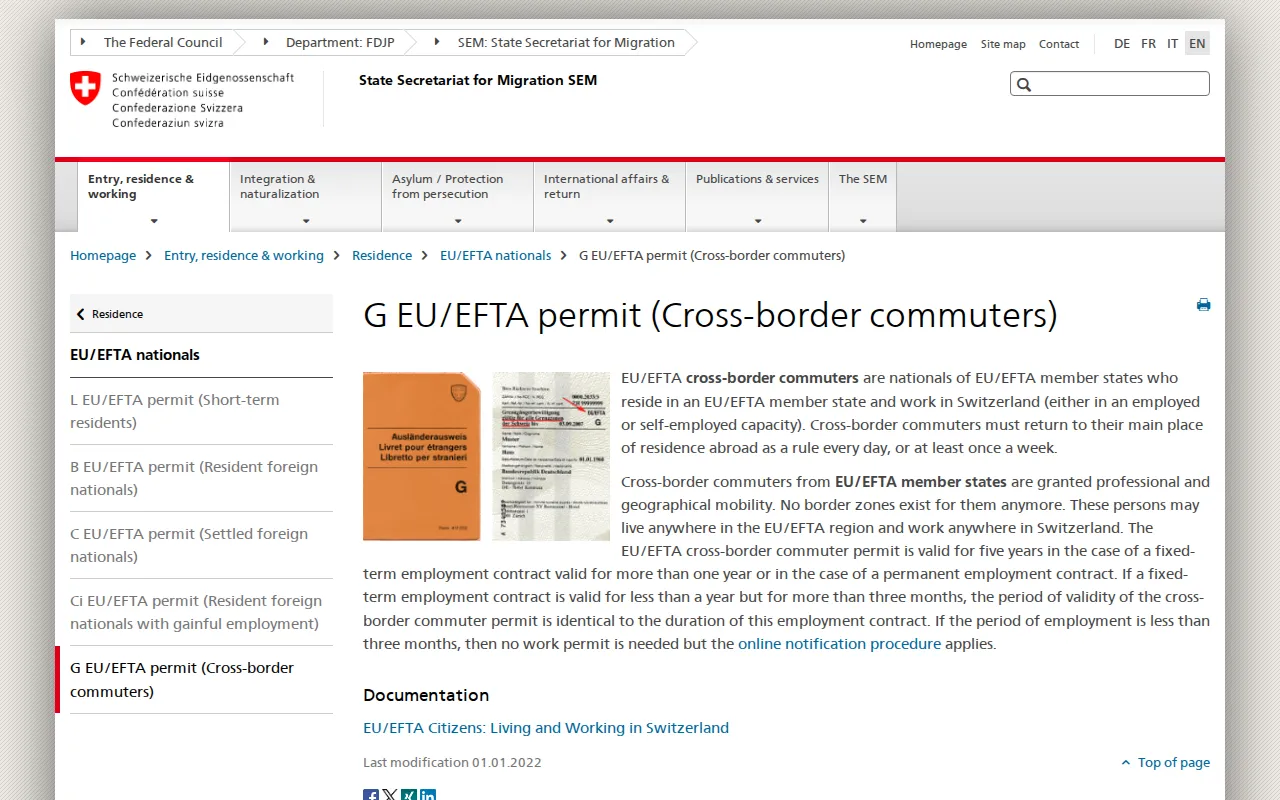
A G permit lets you live abroad and work in Switzerland. For EU/EFTA nationals, SEM's G permit page, read on 12 October 2026 and last modified on 1 January 2022, says you must return to your main place of residence abroad as a rule every day, or at least once a week. The permit is valid for five years with an open-ended or longer-than-one-year contract, and equals the contract length for contracts between three months and a year. The page says the border zones no longer exist for EU/EFTA cross-border commuters: you may live anywhere in the EU/EFTA region and work anywhere in Switzerland.
For third-country nationals the old limits remain in the FNIA. Art. 25 requires a permanent right of residence in a neighbouring state, at least six months of residence in the neighbouring border zone, and work within the Swiss border zone. Art. 35 repeats the weekly return and adds that after five uninterrupted years of employment the holder has a right to extension.
Basel and Geneva both sit directly on the frontier, so they are where daily commuting is easiest to picture.
Changing jobs, changing cantons
What you can change without asking depends on the permit, according to FNIA arts. 37 to 39 and 32.
| Permit | Change employer | Move canton |
|---|---|---|
| L | Only for good cause (art. 32 para. 3, art. 38 para. 1) | Apply to the new canton first (art. 37 para. 1) |
| B | No additional authorisation (art. 38 para. 2) | Entitled if not unemployed (art. 37 para. 2) |
| C | Free (art. 38 para. 4) | Entitled (art. 37 para. 3) |
| G | Possible if arts. 21 and 22 are met; a right after five uninterrupted years (art. 39 para. 2) | New canton's permit first when the focus of work moves; a right after five years (art. 39 para. 1) |
This is the FNIA's text, written for people outside the free movement agreement. For EU/EFTA nationals, the Zürich page says a move must be reported to the new municipality within 14 days. SEM's FAQ also says a B holder may change jobs without further authorisation unless the permit is tied to a specific job, and an L holder only within the same sector and profession. That wording is narrower than the law text above, so for a real case, ask the cantonal office rather than relying on either summary. We describe rules here and cannot assess individual cases.
For a B holder moving to Zürich, art. 37 gives the entitlement as long as you are not unemployed and no ground for revocation applies. The permit then comes from the new canton.
What we read and how
We read SEM's pages on working, residence, notification, permits and procedure, the Federal Council's press release of 19 November 2025, the English text of the FNIA on Fedlex, and the pages of the cantons of Zürich and Genève. All were read on 12 October 2026. Several SEM permit pages are marked as last modified in 2021 or 2022, and the procedure page in 2020, so check the current wording before you plan around a date. We read the pages; we did not apply for a permit, and we are not a migration office.
Where to ask for your own case: the cantonal migration office of the canton you will work in. SEM publishes the addresses on its "Residence" pages.
Häufige Fragen
- Can I work in Switzerland without a permit?
- Usually not. The one common exception is a job of up to three months with a Swiss employer for EU/EFTA nationals, which the employer reports online instead of applying for a permit. Anything longer needs a permit, and non-EU/EFTA nationals need one from the first day.
- What is the difference between a B permit and an L permit?
- An L permit is the short-term permit, tied to a stay of up to one year. A B permit is the residence permit for stays of more than a year. For EU/EFTA nationals the contract decides: three to twelve months gives an L permit, twelve months or more or open-ended gives a B permit valid for five years.
- Who applies for a work permit, me or my employer?
- For non-EU/EFTA nationals the employer applies, and the canton and the State Secretariat for Migration decide. For EU/EFTA nationals the process is lighter and runs through the municipality of residence and the cantonal migration office, with details that differ by canton.
- Do I need a new permit if I change jobs or move canton?
- Under the Foreign Nationals and Integration Act a B permit holder may change jobs without extra authorisation, while an L permit holder needs approval for good cause. Under the FNIA, L and B holders must apply to the new canton before moving, and EU/EFTA nationals must report the move to the new municipality within 14 days in Zürich.
- Can I cross the border every day to work in Switzerland?
- Yes, with a G permit. You live in a neighbouring country and return home daily, or at least once a week. For non-EU/EFTA nationals the law adds that they must have lived in the neighbouring border zone for at least six months and work in the Swiss border zone.
Weitere Beiträge
Alle Beiträge
How to apply for a job in Switzerland: the 2026 guide
What a Swiss application file contains, why the work reference matters, when a foreign diploma needs recognition, and how the RAV job registration rule works.

Salaries in Switzerland: what the official figures say
The official median salary in Switzerland is CHF 7,024 gross a month. See how region, sector and education move it, what gross includes, and minimum wages.