13th month salary in Switzerland: who is owed it and when

The short answer
No Swiss law makes a 13th month salary compulsory. You are owed one when your contract, a collective agreement (GAV) that covers your job, or a settled company practice says so, and three in four employees get one. Once promised, it is salary, not a gift: owed in a bad year too, and pro rata if you join or leave mid-year.
That last part is where most disputes start. The line between a 13th salary, which you have earned month by month, and a bonus, which your employer may decide to skip, is drawn by the Federal Supreme Court, case by case. The rest of this guide follows those rulings and three collective agreements that many newcomers work under: hotels and restaurants, construction and temporary work.
Is a 13th month salary mandatory in Switzerland?
No, not by statute. The Code of Obligations says only that an employer must pay the salary that was agreed, that is customary, or that a collective or standard employment contract sets (CO art. 322). A 13th salary fits all three routes, so you can be owed one without the word appearing in your own contract.
In practice it is the norm. In 2024, 75.9% of employees received a 13th month salary, according to the Federal Statistical Office. Of the firms surveyed, 46.4% paid one to nearly all their staff and only 27.9% paid none. A bonus is far rarer: 32.6% of employees received one, at an average of CHF 11,967 a year.
The surest route is the written contract. Your employer must tell you in writing, within a month of your start, what your salary is and any additional benefits (CO art. 330b). If the offer letter says "CHF 6,000 × 13", the 13th payment is part of your salary. If it says "CHF 78,000 a year", splitting that into 12 or 13 payments only changes when the money arrives, not how much it is.
One trap for English speakers: the official English text of the Code translates the German Gratifikation as "bonus", and that article (CO art. 322d) gives the employer much more freedom than the salary rules do. So an English contract that promises "a bonus of one month's salary" can mean two very different things. We come back to that test below.
The second route, a collective agreement, is where a 13th salary stops being negotiable at all.
Where a collective agreement makes it compulsory
When the Federal Council declares a collective agreement generally binding, it applies to every employer in the sector, member or not. Three agreements on the list kept by the State Secretariat for Economic Affairs require a full 13th month salary, and each one handles the details differently.
Hotels and restaurants
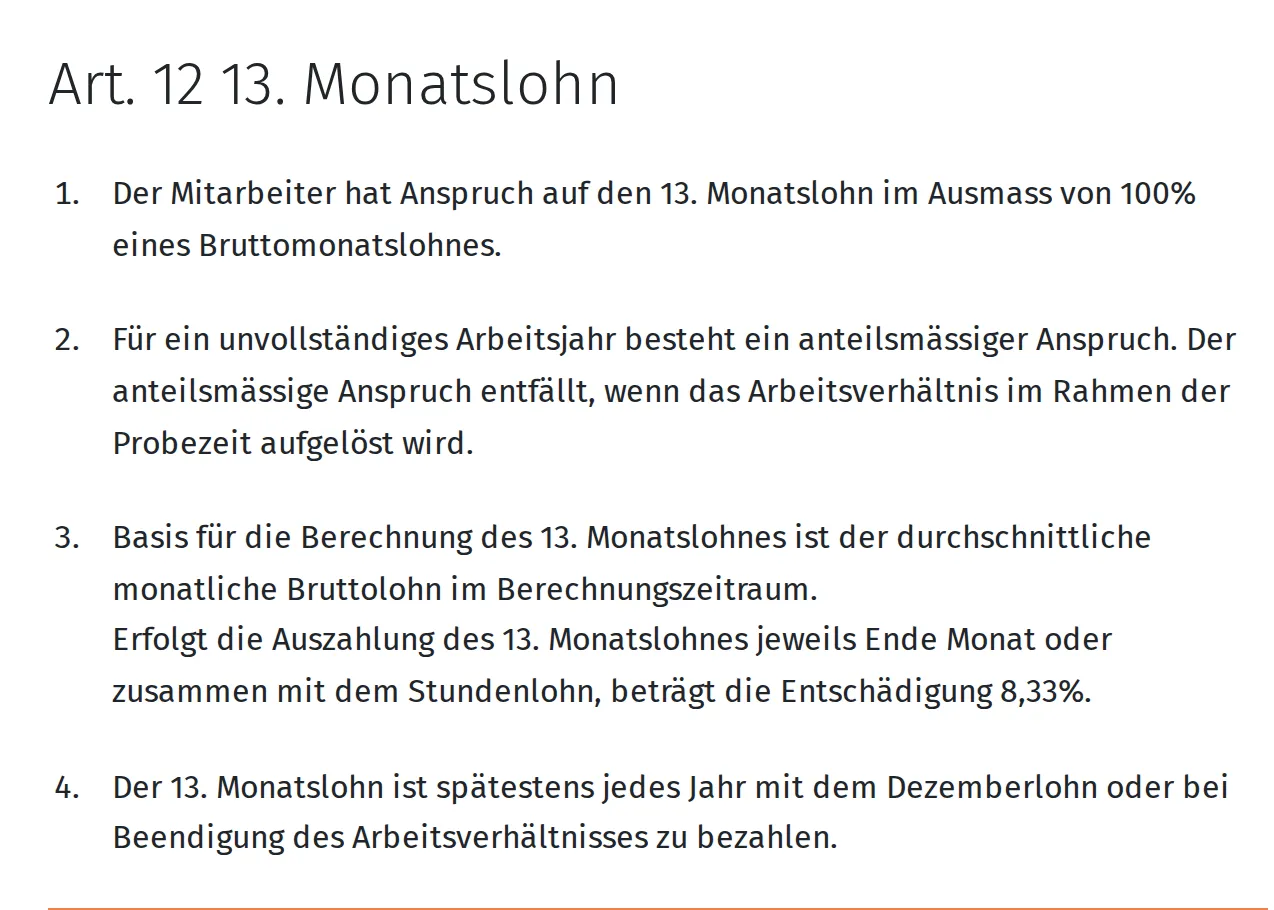
The hospitality agreement (L-GAV) gives every employee a 13th salary of 100% of a gross monthly salary. In an incomplete year you get a proportional share, with one exception that catches newcomers: if the job ends during the probation period, the share is lost. The base is your average gross monthly pay over the period, and if the 13th is paid out monthly or with an hourly wage, it is 8.33% on top. It is due with the December salary at the latest, or when the job ends.
Construction
In the main construction trades, the national agreement (LMV), extended until the end of 2031, takes the opposite line on probation. You are entitled to a 13th salary from your first day (art. 45), and if you don't work a full calendar year you get a pro rata share, with no probation exception. Monthly paid workers receive an average monthly salary at the end of the year; hourly paid workers get 8.3% of the year's relevant wages. With a written agreement it can be paid half-yearly, and staff taxed at source can agree to receive it monthly. Either way, the payslip must show it as its own line (art. 46). Apprentices in the trade are covered too.
Temporary work
If you work through a staffing agency, your contract usually falls under the staffing agreement, and there the 13th salary is built into every hour you work. Outside Geneva, Ticino and the higher-wage areas, the 2026 minimum for unskilled staff is CHF 3,867.45 a month, paid 13 times, or CHF 21.22 an hour. On an hourly contract the agreement then adds public holiday pay, holiday pay and the 13th month share, so for staff aged 20 to 49 the real hourly minimum is CHF 25.70.
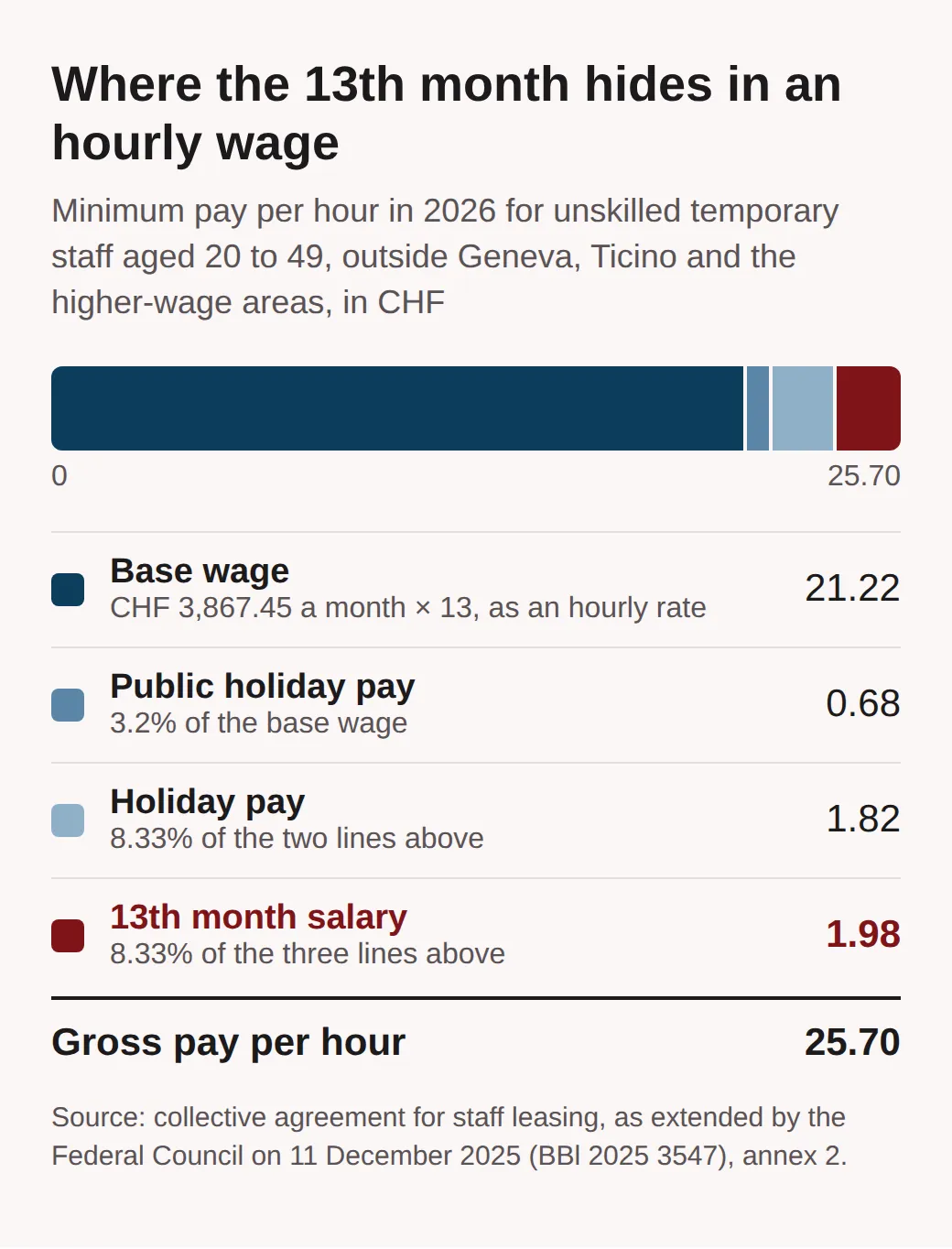
At the minimum, the 13th month share is CHF 1.98 of every hour. If your agency quotes a flat hourly rate, ask how it breaks down, so you can see that holiday pay and the 13th salary are in it and not missing.
When is the 13th salary paid?
Your contract or collective agreement sets the date; the law fixes no month. The hospitality agreement says the December salary at the latest, the construction agreement the end of the year. Under the Code, salary is due at the end of each month unless other terms are agreed or customary (CO art. 323), and a once-a-year 13th is exactly such a term.
The hospitality agreement's commentary lists the options: once a year, in two halves, at the end of the season, or a twelfth added to every salary, which is how the agreements above handle hourly pay. Geneva's tax office uses two halves, June and December, in its example. The total for a full year is the same. What differs is when the money arrives and, if you are taxed at source, how the tax is withheld, which we cover below.
What changes everything is a job that doesn't last the whole calendar year.
Joining or leaving mid-year: the pro rata share
A 13th salary builds up month by month, so for a part year you are owed the matching share. The formula is simple: your monthly salary times the months you worked, divided by 12. If you earn CHF 6,000 a month, started before January and leave on 30 September, your share is 6,000 × 9 ÷ 12, or CHF 4,500. If you are paid by the hour, the share is 8.33% of what you earned in the year. Part-time staff get the same share of their own, lower, salary.
The Federal Supreme Court applied exactly that arithmetic in a case decided in 2010 (BGE 136 III 313). A man started on 1 June 2007 without a written contract; an email confirmed CHF 6,500 a month "plus Gratifikation". His employer paid late, he stopped working just before Christmas, and he was dismissed by a letter of 27 December. No bonus followed, and the employer blamed poor work and the days he had refused to work. The court disagreed: the email had promised the payment, and late wages were the employer's own doing. It treated the payment as an agreed bonus but fixed its size the same way, one monthly salary pro rata: 7/12 of his net monthly pay for the seven months he had worked, CHF 3,435.90.
When a job ends, the share is due with your final pay, because every claim from the employment falls due on the last day (CO art. 339). Your employer can't hold it back until December. And if the final payslip shows nothing, write to ask for it, in the language of your workplace:
My employment ended on 30 September. My contract provides a 13th month salary of one monthly salary, CHF 6,000. For nine months of this year I am owed CHF 4,500 gross. Please pay this amount with a corrected final payslip by 31 October.
The probation catch is worth repeating. Under the hospitality agreement you lose the share if either side ends the job during probation, which by law is the first month unless a written contract or a collective agreement sets another length, at most three months (CO art. 335b). Under the construction agreement you keep it. Outside a collective agreement, your contract decides, which is why the label on the payment matters so much.
13th salary or bonus: how courts tell them apart
A 13th salary is salary: a fixed amount you have earned. A bonus is a special payment on top, and whether you are owed one depends at least partly on the employer's goodwill. The Federal Supreme Court drew exactly that line, naming the 13th month salary as the example of what a bonus is not (BGE 131 III 615, consid. 5.2). The label in your contract doesn't decide it; what was actually agreed does.
A case from Zurich shows how far that goes. An English contract promised a "13th Month Annual Bonus Payment" of up to one month's basic salary, subject to a satisfactory performance review and to being employed on 23 December. The employer gave notice, the job ended in November 2006, and the employee claimed her share for the year. She lost at every level (4A_28/2009): whatever its name, the payment depended on the employer's view of her work, so it was a bonus, and a bonus may require you to still be employed on the payment date. The Zurich court, relying on an earlier Federal Supreme Court ruling, noted that a payment with the character of salary could not be tied to such a date.
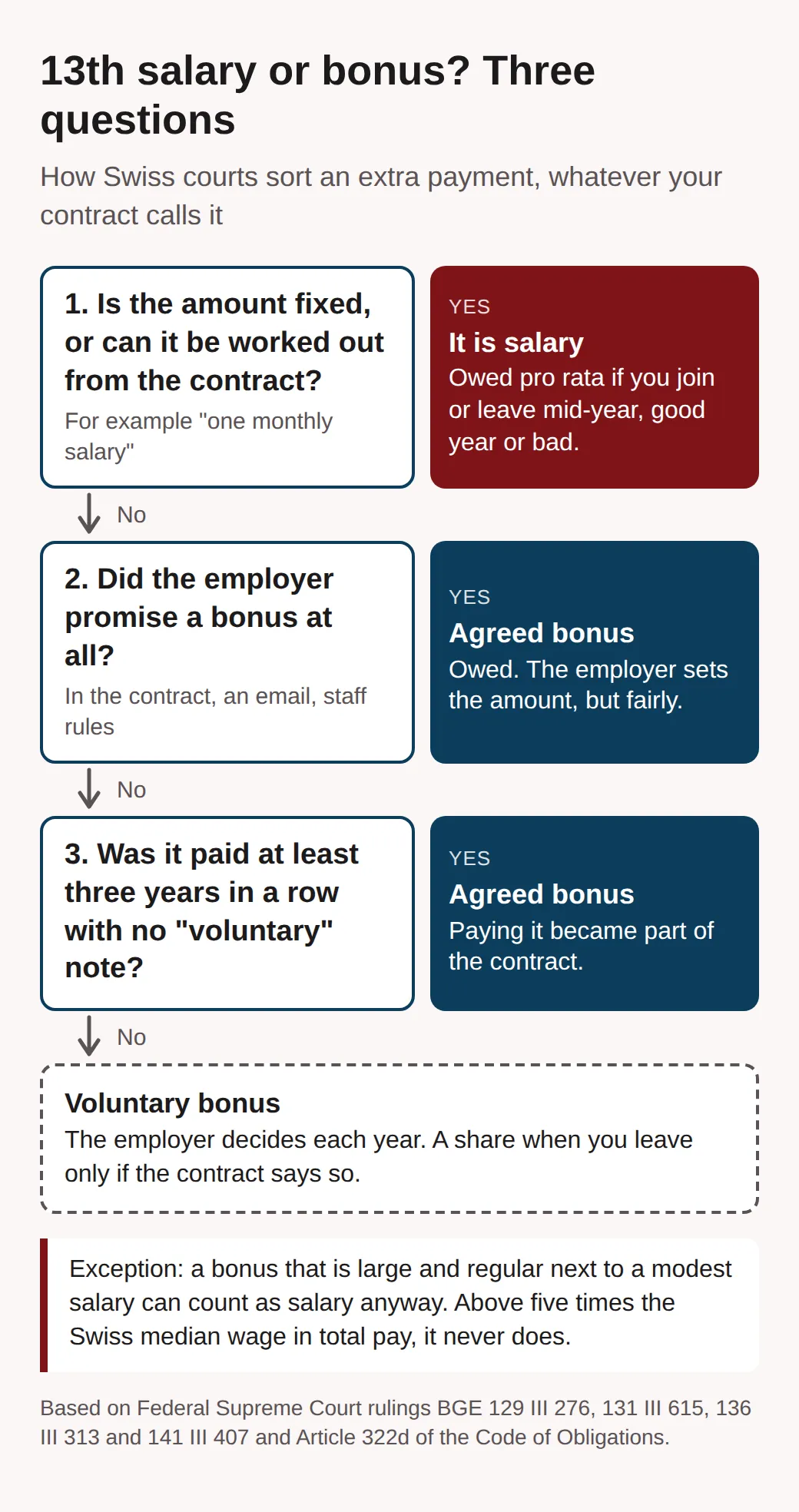
A fixed amount is always salary. An amount set and agreed in advance can't be a bonus (BGE 129 III 276, consid. 2). "One monthly salary", "CHF 5,000 in December" or "8.33% of wages" leaves the employer no choice, so it is a 13th salary whatever the clause is called, owed in a bad year as in a good one.
A promised bonus is owed, but its size can move. If your contract or an email says you will get a bonus without fixing the amount, the employer must pay one and set it fairly. It can lower it for poor results or performance, if you could see those were the criteria, but not for reasons of its own making. That was the 2010 case above: the employer's late wages were no ground to cut the payment.
Three years can turn a habit into a promise. A bonus paid at least three years in a row with no reservation counts as agreed, the same 2002 ruling says. Its own case, from the Basel courts, shows the other side. Over almost twelve years, a bank employee's annual payment had grown from CHF 3,600 to CHF 30,000, on a salary that reached about CHF 132,000. When he resigned for the end of 2000, the bank paid nothing for that year. He sued for the CHF 30,000 and lost, because the bank had marked the payment as voluntary every year but one, and a single missed note was not enough.
Size can make a bonus salary anyway. A bonus must stay secondary to the salary. If it regularly matches or exceeds your base pay, courts can treat part of it as salary even with a "voluntary" note, and on a modest wage a smaller bonus can already tip it. That protection stops at the top: once your total pay reaches five times the Swiss median wage in the private sector, a discretionary bonus stays a bonus (BGE 141 III 407). For 2009, the year at issue in that case, the court put the threshold at CHF 354,000.
For a bonus that is truly voluntary, the Code adds one more rule: if you leave before the payment date, you get a pro rata share only where the contract provides for it (CO art. 322d). So if your contract mentions a "13th month salary/bonus", ask for the plain version in writing, for example: "a 13th month salary of one gross monthly salary, paid with the November salary, pro rata in an incomplete year."
How the 13th month salary is taxed
It is taxed and insured like the rest of your pay. The federal guideline on contributory wages lists the 13th month salary as salary, so AHV, disability and loss-of-income contributions come off it, and the same goes for a bonus. If you file an ordinary tax return, it is simply part of your annual income and nothing about it is special.
The difference shows up if you pay tax at source, deducted by your employer from each payslip. The cantons use one of two methods, and they treat the 13th salary differently:
| Method | How the 13th salary is handled | Effect on your payslip |
|---|---|---|
| Monthly model | Added to the pay of the month it is paid in, and that month's rate is read from the higher total | A bigger deduction in the month it is paid |
| Annual model, for example Geneva and Vaud | The rate is set on your expected yearly income, 13th salary included | The same rate all year |
Both rules come from the cantons' joint FAQ on source tax. Geneva's own example shows the annual model at work: on CHF 5,000 a month plus a 13th salary, the rate is read for CHF 65,000 a year and applied to every payment, the larger June and December ones included. Vaud tells employers that a 13th salary known at the start of the year can be counted from January. In a monthly-model canton, a big December deduction is the method working as designed, not a payroll error.
Before you sign: compare the yearly total
The cleanest way to compare offers is the yearly total. CHF 6,000 × 13 is CHF 78,000, the same as CHF 6,500 × 12. Salary statistics do this for you: the federal median wage counts one twelfth of the 13th salary in the monthly figure. So an offer of CHF 6,000 × 13 should be set against a statistic as CHF 6,500. Minimum wages work the same way; Geneva, for example, accepts a lower monthly base when a 13th salary is paid, as we explain in our guide to minimum wages by canton.
Then check three lines of the contract. Does it say "13th month salary" or name a fixed amount? Does it say what happens in an incomplete year? And does a collective agreement cover the job, and which one? With those answers you know what you are owed, when it is due, and what to ask for if it doesn't arrive.
Common questions
- Do I still earn my 13th salary while I am off sick or on maternity leave?
- Under the hospitality agreement, yes: its commentary says the claim continues during illness, accident, pregnancy, maternity and military service, and the daily allowance insurance has to cover it. The construction agreement also requires the 13th month share to be insured with the sickness allowance. Outside a collective agreement, read your contract and staff rules, because the Code of Obligations has no rule written for this case.
- Is the 13th AHV pension the same thing as a 13th month salary?
- No. The 13th AHV pension is an extra payment to people who draw an old-age pension, paid for the first time in December 2026 with the December pension. It equals one twelfth of the old-age pension paid during the year and comes automatically. It has nothing to do with your salary or your employer.
- Can I give up my 13th salary in a settlement when I leave?
- Not if it comes from a collective agreement. While you are employed and for one month after the job ends, you cannot waive claims that come from mandatory law or the mandatory rules of a collective agreement. A 13th salary that only your own contract promises can be part of a negotiated settlement, so check what a settlement covers before you sign it.
- How long can I claim an unpaid 13th salary?
- Five years. Wage claims from employment fall under the five-year limitation period of the Code of Obligations, and a 13th salary is wage. The clock runs from the date the payment was due, which for a share owed when you leave is the last day of the job.
More posts
All posts
Minimum wage in Switzerland 2026: official rates by canton
Switzerland has no national minimum wage. The official 2026 rates in five cantons and Lucerne, per hour and per month, who is left out and what changes next.