Minimum wage in Switzerland 2026: official rates by canton

The short answer
Switzerland has no national minimum wage. Five cantons set one by law: in 2026 the minimum is CHF 24.59 an hour in Geneva, 22.20 in Basel-Stadt, 21.40 in Jura, 21.35 in Neuchâtel and 20.00 to 20.50 in Ticino, by sector. The city of Lucerne adds its own 22.75. Zurich and Winterthur voted for one, but neither applies yet.
All of these are gross amounts, meaning before social insurance contributions and tax come off. They are a floor for every hour you work, and the details decide whether a real job offer clears it. Take Marta, 26, who has cooked in restaurants in Porto but has no Swiss diploma. She has two offers for kitchen work, both full time at 42 hours a week. A hotel in Geneva offers CHF 4,000 a month, paid 13 times a year (a 13th month's pay is common in Switzerland). A restaurant in Lugano offers CHF 3,713 a month, also 13 times. One of these offers breaks the law, and it isn't the lower one. We'll follow Marta through each section.
Where Switzerland has a minimum wage in 2026
In Switzerland, minimum wages set by law come from cantons and cities. A national minimum of CHF 22 an hour went to a vote in May 2014, and 76% of voters said no. Five cantons and one city now have their own, and each publishes its rate on an official page:
| Where | 2026, per hour, gross | 2025 | Official page |
|---|---|---|---|
| Geneva | CHF 24.59 | CHF 24.48 | ge.ch |
| City of Lucerne | CHF 22.75 | none | stadtluzern.ch |
| Basel-Stadt | CHF 22.20 | CHF 22.00 | bs.ch |
| Jura | CHF 21.40 | CHF 21.40 | jura.ch |
| Neuchâtel | CHF 21.35 | CHF 21.31 | ne.ch |
| Ticino | CHF 20.00–20.50, by sector | CHF 20.00–20.50 | ti.ch |
If you have seen other numbers, they are mostly old ones. Neuchâtel's 21.31 was the 2025 rate. Basel-Stadt's 21.00 was the starting rate in 2022. Ticino's 19.50 dates from before 2025, and 20.50 on its own is only the top of the Ticino range. Some tables also list Zurich at 23.90 or say Valais voters approved a minimum. Neither is true yet, and we explain both below.
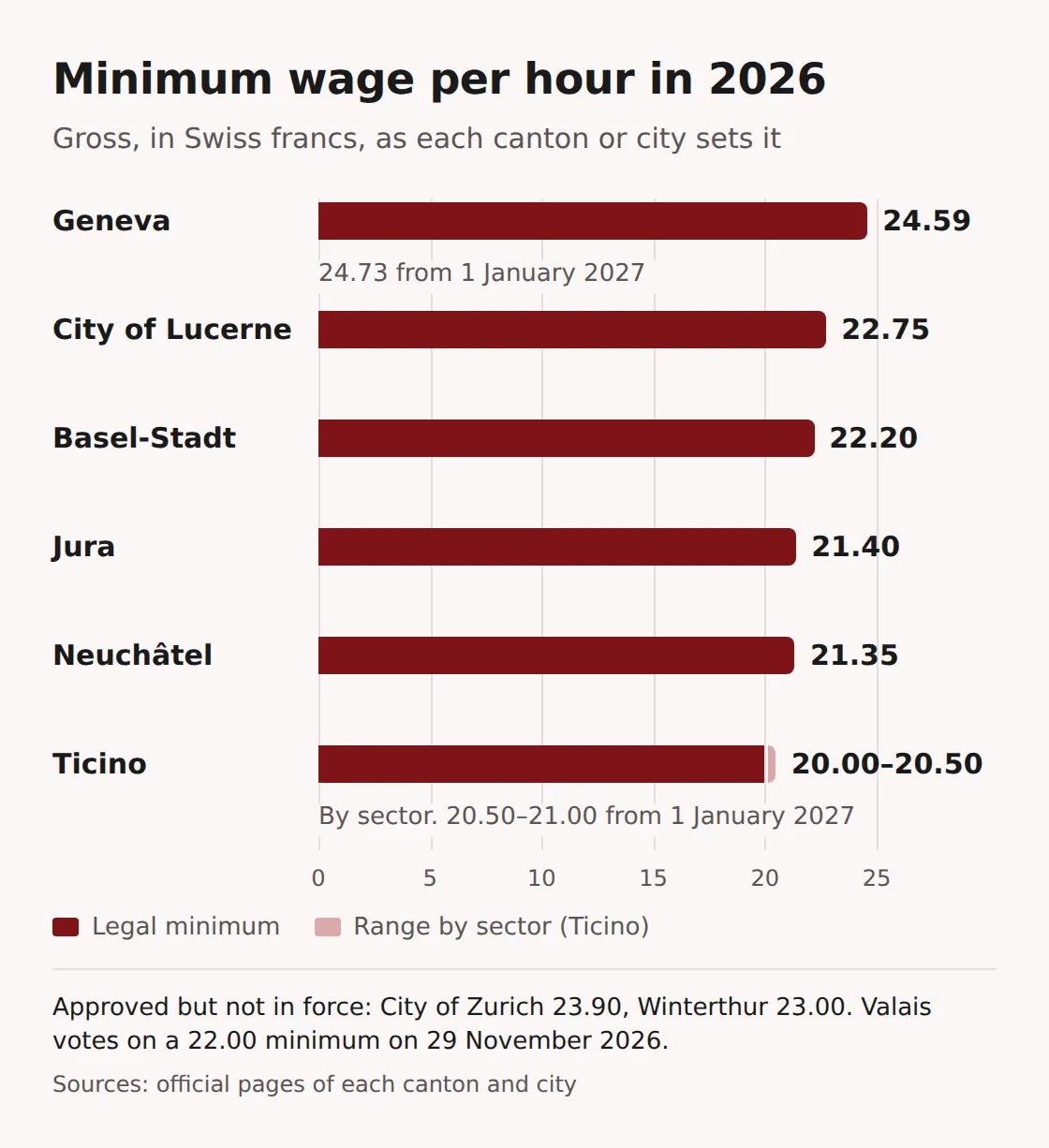
Everywhere else, including Zurich, Bern, Vaud and Valais, there is no general minimum wage in 2026. Many sectors still have a floor through a collective agreement, as we'll see. For scale, these minimums sit far below typical Swiss pay. The median full-time wage was CHF 7,024 a month in 2024, according to the Federal Statistical Office.
Canton by canton
Each canton wrote its own law, and the differences change what you're owed.
Geneva: CHF 24.59, and 24.73 from January
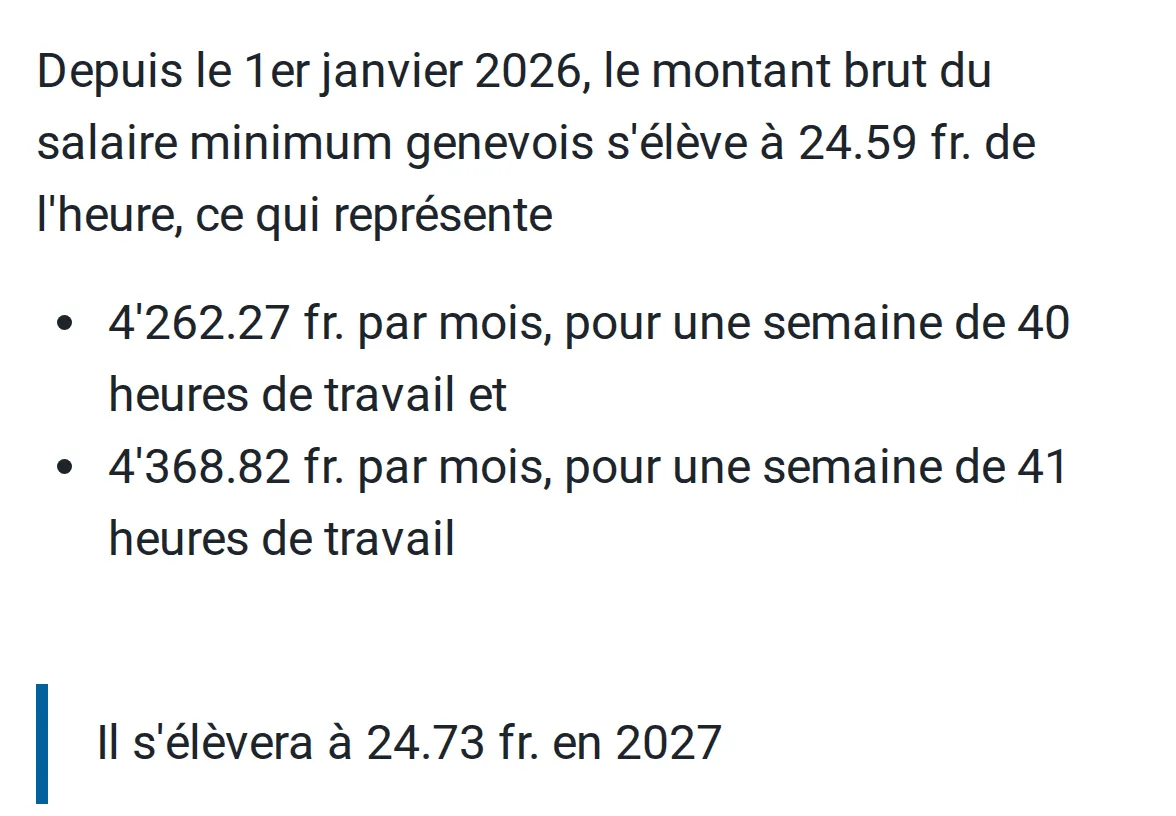
Geneva has the highest cantonal minimum: CHF 24.59 an hour since 1 January 2026, up from 24.48 in 2025. It is indexed, which means it rises each year in line with consumer prices in Geneva, and the canton has already set CHF 24.73 for 2027.
Two rules matter for Marta. First, Geneva's law says its minimum replaces any lower rate in a work contract or a collective agreement. A collective agreement (GAV in German, CCT in French) is a contract between unions and employers that sets pay and hours for a whole sector. Second, if your salary is paid 13 times a year, the hourly base must be at least CHF 22.70 in 2026, so that the 13th payment lifts the year to 24.59 an hour.
Marta's Geneva offer fails that test. A 42-hour week works out at 182 hours a month (42 × 52 ÷ 12). Her CHF 4,000 divided by 182 is 21.98 an hour, below 22.70. To be legal, the hotel has to pay at least CHF 4,131.40 a month, 13 times, which is CHF 1,708 a year more than it offered. The cantonal labour inspectorate, OCIRT, can fine an employer up to CHF 30,000 and publishes a list of companies that don't pay the minimum.
Basel-Stadt: CHF 22.20
Basel-Stadt's minimum is CHF 22.20 an hour in 2026. It started at 21.00 in July 2022 and is indexed every January. If you're paid by the hour, holiday pay comes on top, which brings the total to CHF 24.14 an hour with four weeks of holiday.
The catch is in one line on the canton's page: in a sector with a generally binding collective agreement, Basel's minimum doesn't apply. Generally binding means the government has extended the agreement to every employer in the sector, member or not. So if Marta moved to a Basel restaurant, the canton's 22.20 would not be her floor; hospitality has its own agreement, which we come to below.
Neuchâtel: CHF 21.35
Neuchâtel was the first canton with a minimum wage, in 2017. The 2026 rate is CHF 21.35 an hour; the 21.31 you may see elsewhere was the 2025 rate, according to the canton's own table of past rates. It is indexed each year to Swiss consumer prices, and the canton's working conditions office, ORCT, checks that employers pay it. Neuchâtel also has some of the widest exceptions, for small jobs and students' holiday work, which we list further down.
Jura: CHF 21.40
Jura's minimum has been CHF 21.40 an hour since 1 July 2024, so it's the same in 2025 and 2026. Unlike Geneva's, it doesn't rise by itself: the government decides when to adjust it, as it did in 2024 after prices had risen 3.6% since the last change. A 13th salary counts toward the 21.40, but holiday pay and pay for the 1 August holiday must come on top.
Like Basel-Stadt, Jura leaves out sectors with a generally binding collective agreement that sets a minimum wage, and also companies that signed such an agreement themselves. The canton adds that the standard contracts for shop sales, agriculture and domestic work may set different figures. A standard contract (NAV in German, CTT in French) is a set of minimum terms the government fixes for a sector that has no collective agreement.
Ticino: CHF 20.00 to 20.50, by sector
Ticino doesn't have one rate. Its minimum is 55% of the national median wage in each sector, but never less than CHF 20.00 or more than 20.50 an hour in 2026. Building construction sits at the top, at 20.50, while food manufacturing and work for private households sit at 20.00. The canton's page has a calculator by sector.
The range rises every year from here: 20.50 to 21.00 from 1 January 2027, 21.00 to 21.50 in 2028 and 21.75 to 22.25 in 2029, under a change to the law passed in April 2026. From 2030 it follows consumer prices, according to the canton's FAQ. If you're paid by the hour, Ticino adds holiday pay and 3.60% for public holidays on top.
This is where Marta's Lugano offer comes in. In 2026 Ticino's law doesn't apply to jobs covered by a generally binding collective agreement, and hospitality has one. So the restaurant's floor is the hospitality agreement, not the canton's range. From 2027 the cantonal minimum takes priority over lower collective agreements, but agreements signed before 2026 have until the end of 2029 to catch up.
The city of Lucerne: CHF 22.75
The city of Lucerne has had its own minimum wage since 1 January 2026: CHF 22.75 an hour for work done in the city. On 27 September 2026 the city's voters rejected a proposal to scrap it, 67.6% to 32.4%. Checks will be run by an outside body the city has yet to name, and a minimum wage commission, still being set up, will take reports of possible underpayment. Until then, the city sends workers to the labour court or the conciliation board.
Zurich and Winterthur: voted, not yet in force
If you work in Zurich, there is no legal minimum wage yet. Voters in the cities of Zurich and Winterthur approved one on 18 June 2023: CHF 23.90 an hour in Zurich and 23.00 in Winterthur. The canton's administrative court struck both down, but on 12 May 2026 the Federal Supreme Court ruled for the cities.
Neither city has set a start date. Zurich says it will announce one at least six months ahead, and Winterthur plans a one-year transition once its rule starts. Zurich's rule leaves out workers under 25 who don't have at least a two-year federal vocational certificate (EBA), which matters for young newcomers. Until a start date comes, an employer in Zurich owes you what your contract, a collective agreement or a standard contract says, and nothing more.
Does a collective agreement beat the cantonal minimum?
Often it does, and that's the part most rate tables leave out. In Basel-Stadt and Jura, and in Ticino in 2026, a generally binding collective agreement replaces the cantonal minimum even when its rate is lower. In Geneva and Neuchâtel, the cantonal minimum wins. Either way, for many jobs the agreement is the number that counts, so here is the one Marta will meet.
The hospitality agreement, known as the L-GAV, covers hotels, restaurants and bars across Switzerland. Its minimum monthly wages for full-time staff aged 18 or over depend on training:
| Level | Training | 2026 | 2027 |
|---|---|---|---|
| Ia | No vocational training | CHF 3,713 | CHF 3,735 |
| II | Two-year certificate (EBA) | CHF 4,070 | CHF 4,094 |
| IIIa | Three-year certificate (EFZ) | CHF 4,528 | CHF 4,555 |
| IV | Federal professional exam | CHF 5,293 | CHF 5,325 |
The normal L-GAV week is 42 hours, or 43.5 in seasonal businesses and 45 in small ones. Staff get a full 13th month's salary, and part-time staff are paid pro rata. One clause hits newcomers: for someone who has never worked four months in a Swiss hospitality business, the level Ia minimum can be cut by up to 8% for the first 12 months, if the contract says so in writing.
Now Marta's two offers can be compared. In Lugano her floor is level Ia: CHF 3,713 × 13, or CHF 48,269 a year, which the restaurant has offered. By our arithmetic that is about CHF 22.10 an hour over a 42-hour week, above Ticino's range, so in Lugano the agreement, not the canton, sets her floor, and it is the higher of the two. With the 8% starting cut it could legally pay about CHF 44,400 in her first year. In Geneva the cantonal minimum lifts her to at least CHF 53,708. At the legal floor, Geneva pays her about CHF 5,400 more a year, before rent and other costs.
Outside Geneva, people working in private homes have a floor of their own: a federal standard contract that applies to anyone working at least five hours a week for the same household. In 2026 it requires CHF 20.35 an hour for unskilled staff, 22.30 with four years' experience or a two-year certificate, and 24.55 with a three-year certificate. Childminders and babysitters are not covered. For other sectors, the State Secretariat for Economic Affairs keeps a list of generally binding agreements with their wage rules.
How much is the minimum wage per month?
It depends on your hours, and that is why the monthly figures online disagree. The method is the same everywhere: the hourly minimum times your weekly hours times 52, divided by 12. Geneva publishes CHF 4,262.27 a month for 40 hours a week and 4,368.82 for 41. Basel-Stadt publishes 3,847.93, 3,944.27 and 4,040.40 for 40, 41 and 42 hours. Neuchâtel, Jura and Ticino publish no monthly amount.
Many comparison sites give Geneva's monthly minimum as about CHF 4,475. That is 24.59 for a 42-hour week. It's the right figure for Marta, who works 42 hours, but it isn't the canton's own, and it's too high for someone on 40 hours.
A 13th salary changes the monthly number, not the yearly one. Every canton here lets it count toward the minimum, so a lower monthly salary paid 13 times can be legal. Geneva, Basel-Stadt and Neuchâtel publish the base they accept in 2026: CHF 22.70, 20.49 and 19.71 an hour, which is the minimum times 12 divided by 13. Basel-Stadt counts the 13th salary only if it's paid in monthly shares with each salary, as its FAQ explains.
If you're paid by the hour, holiday pay is never part of the minimum. It is added on top:
- 8.33% if you get four weeks of holiday a year, the legal minimum from age 20
- 10.64% for five weeks, the legal minimum if you're under 20
- 0.39% for the 1 August holiday in Basel-Stadt, or 3.60% for public holidays in Ticino
In Ticino, for example, an hourly minimum of CHF 20.50 becomes about 23.00 with four weeks of holiday and public holidays, as the canton's FAQ works out. On your payslip, holiday pay should appear as its own line.
Who the minimum wage does not cover
The exceptions differ more than the rates do. These are the main groups left out, and where:
- Apprentices: everywhere, including the city of Lucerne.
- Interns whose internship is part of their training: Geneva, Neuchâtel, Ticino if it leads to a recognised qualification, Basel-Stadt and Lucerne for up to six months, Jura for two weeks of job tasting or six months on an exchange.
- Young people: Geneva excludes everyone under 18; Basel-Stadt and Lucerne exclude school pupils under 18 in holiday jobs; Ticino excludes under-18s doing light work.
- Students in holiday jobs: in Geneva they get 75% of the minimum for up to 60 days a year; Neuchâtel excludes students under 25 for up to three months a year.
- Family members in a family business: Basel-Stadt, Jura and Ticino.
- Au pairs: Neuchâtel, Basel-Stadt, Ticino and Lucerne.
- People on job-integration schemes run by unemployment insurance, disability insurance or social aid: all except Geneva.
- Very small jobs: in Neuchâtel, work paying CHF 2,500 a year or less; in Basel-Stadt, on-call work of up to 70 hours a year for one employer.
Marta, at 26 and in a regular job, fits none of them.
What changes next
Several dates are already fixed, and two decisions are still open.
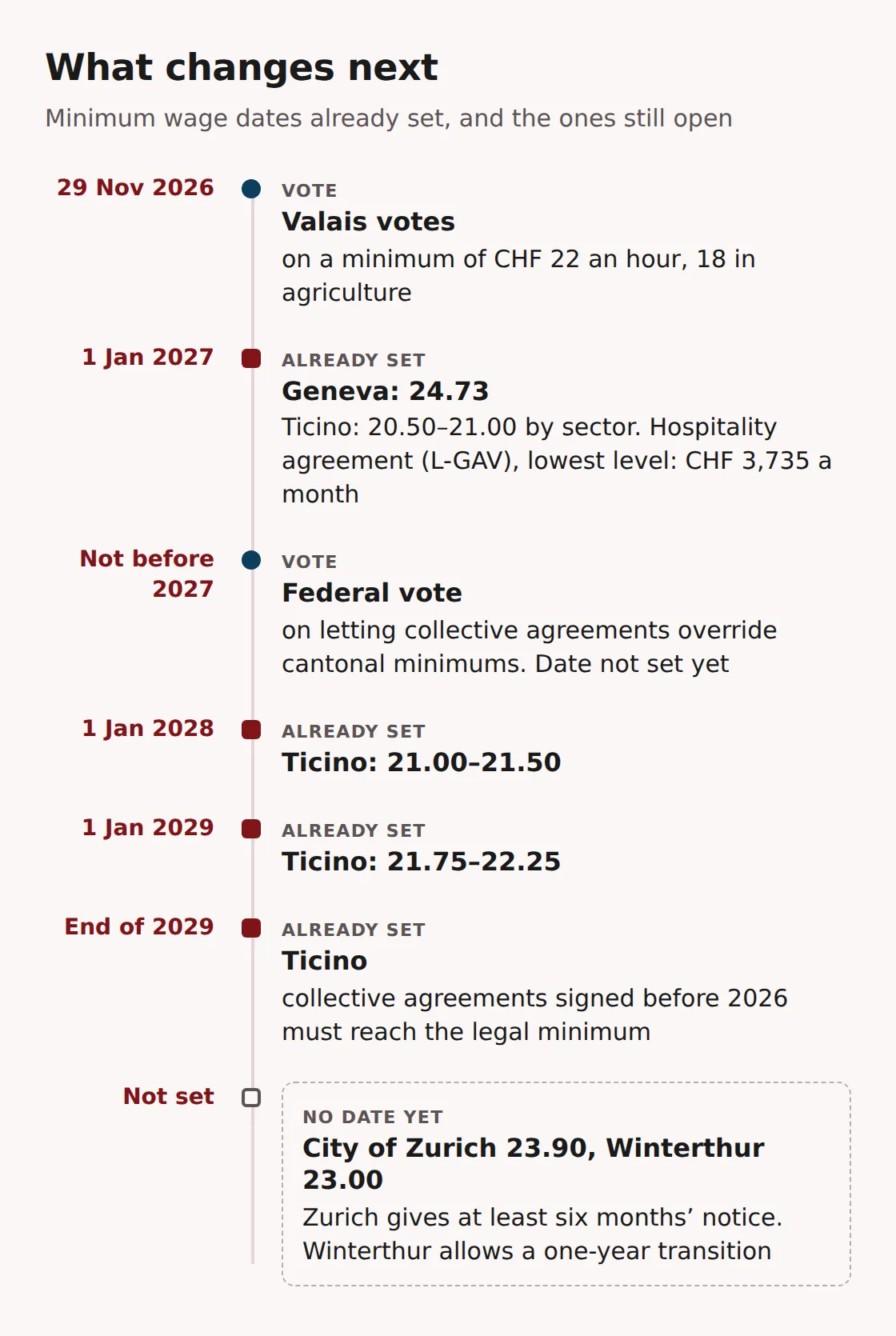
Valais votes on 29 November 2026 on a popular initiative for a minimum of CHF 22 an hour, with 18 for agriculture. The cantonal government and parliament, by 93 votes to 33, recommend a no. Until a law is in force, Valais has no minimum. In Vaud, voters put the principle of a minimum wage into the cantonal constitution in June 2026 but rejected both bills that set an amount, so nothing applies there yet.
The larger change could come from Bern. In June 2026 the federal parliament passed an amendment to the law on generally binding collective agreements. It says a generally binding agreement's minimum wage overrides cantonal rules. In cantons where the cantonal minimum wins today, mainly Geneva and Neuchâtel, workers in those sectors would keep the cantonal rate in force on the day the law starts, frozen at that level, until the agreement's own minimum rises above it. For Marta in Geneva, that would mean her floor stops rising each January until the L-GAV catches up.
The amendment is not in force. Unions and left-wing parties handed in more than 100,000 signatures against it on 7 October 2026, twice the 50,000 needed for a referendum, SRF reported. Once the Federal Chancellery has confirmed the signatures, the law goes to a national vote, which SRF expects in February or June 2027. According to SRF, city minimums such as Lucerne's would be affected too.
What if you are paid less than the minimum?
Then you're owed the difference, and you can claim it. Start by working out your real hourly rate with the method above, counting a 13th salary if you get one. If it falls short, ask your employer in writing to correct it, in the language of your workplace. For Marta in Geneva, it could read:
Dear Sir or Madam, my contract pays CHF 4,000 a month, 13 times a year, for 42 hours a week, which is CHF 21.98 an hour. Geneva's minimum wage for 2026 is CHF 24.59 an hour. With a 13th salary, the base must be at least CHF 22.70 an hour. Please pay me at least CHF 4,131.40 a month from now on, and the difference since my first day. I would be grateful for your answer by 15 December.
If nothing changes, these are the offices that check the minimum wage:
| Where | Who checks | What they can do |
|---|---|---|
| Geneva | OCIRT, the labour inspectorate | Inspect, fine up to CHF 30,000, publish the employer's name |
| Basel-Stadt | Arbeitsmarktaufsicht, at the AWA | Inspect, fine up to CHF 30,000 |
| Neuchâtel | ORCT, the working conditions office | Inspect employers |
| Jura | Labour court (Conseil de prud'hommes), Porrentruy | Rule on your wage claim |
| Ticino | Labour inspectorate | Inspect, fine 160% of the unpaid wages, up to CHF 30,000 |
| City of Lucerne | Minimum wage commission, being set up | Take reports; until then, the labour court or conciliation board |
Ticino also has an online form for reporting underpayment, and Neuchâtel gives its inspection office's contact details on its working conditions page. The offices check and fine employers, but your back pay is your own claim, made in the end before a labour court if your employer refuses. Two rules from federal law help. Wage claims last five years, so you can still claim after you've left the job. And a labour court case worth up to CHF 30,000 costs no court fees.
Before you sign a contract
Ask for three things in writing: the gross pay, the weekly hours and the number of salary payments a year. With those, you can check any offer against the tables above in two minutes. Then ask whether a collective agreement covers the job and which level you're on. In hospitality, a foreign diploma can count as equivalent to a Swiss certificate, which moves you from CHF 3,713 to as much as 4,528 a month, so make sure the level is written into the contract.
Marta sent her numbers back to the Geneva hotel and asked for CHF 4,131.40, 13 times a year, rising with Geneva's rate in January. If you're weighing a move for a job like hers, the hospitality jobs in Geneva are a good place to start comparing what employers actually offer.
Common questions
- Does the minimum wage apply to cross-border commuters?
- Yes. What counts is where you usually work, not where you live. Geneva's law covers everyone who usually works in the canton, and Ticino's covers every job done in the canton, including temporary agency staff and workers sent by foreign companies. A commuter from France working in Geneva is owed at least CHF 24.59 an hour in 2026.
- Is the minimum wage before or after deductions?
- Before. Every rate in this article is gross, so social insurance contributions come off it, and so does tax at source if you pay tax that way. The amount that reaches your bank account is lower than the minimum, and that is legal.
- Can I agree to work for less than the minimum wage?
- No. Ticino's law says the minimum cannot be waived to the worker's disadvantage, and Geneva's law replaces a lower rate in a contract with the legal minimum. Signing a contract with a lower rate does not cancel your claim to the difference.
- What is the minimum wage for farm work?
- Lower, where there is one. Geneva sets CHF 18.07 an hour for agriculture and flower growing in 2026 and 18.17 in 2027, and Neuchâtel 18.15 for farming, wine growing and horticulture. Ticino's law does not cover farm workers at all, and the Valais initiative proposes 18 francs for agriculture.
More posts
All posts
13th month salary in Switzerland: who is owed it and when
No Swiss law requires a 13th month salary, yet three in four employees get one. Who is owed it, when it is paid, pro rata rules, tax and bonuses.