Notice period in Switzerland 2026: when does yours end?

In Switzerland the legal notice period is one month in your first year of service, two months in years two to nine and three months from year ten, ending on the last day of a month. In probation it is seven calendar days. The count starts on the day your notice arrives, not the day you post it.
How long is the notice period in Switzerland?
One, two or three months, depending on how long you have worked for the employer, and seven days in probation. The rule is art. 335c of the Code of Obligations: one month's notice "during the first year of service", two months "in the second to ninth years of service" and three months after that, "all such notice to expire at the end of a calendar month". Probation has its own rule in art. 335b: seven days' notice, given at any time.
| Situation | Notice | Ends | CO article |
|---|---|---|---|
| Probation | 7 calendar days | Any day | 335b |
| 1st year of service | 1 month | Month-end | 335c |
| 2nd to 9th year | 2 months | Month-end | 335c |
| 10th year and later | 3 months | Month-end | 335c |
| Fixed-term contract | None | Agreed end date | 334 |
Probation is the first month unless your contract sets a longer one, up to three. A year of service runs from your start date, not from January. If you started on 1 March 2025, your second year began on 1 March 2026.
This is what the law and the official guidance say. Your contract and any collective employment agreement (GAV in German, CCT in French) come first wherever the law lets them differ, and if you work for a public administration or a state company under public law, your own personnel law applies instead. We quote Fedlex's English translation, which has no legal force; the links lead to the binding German text.
What if my contract says something different?
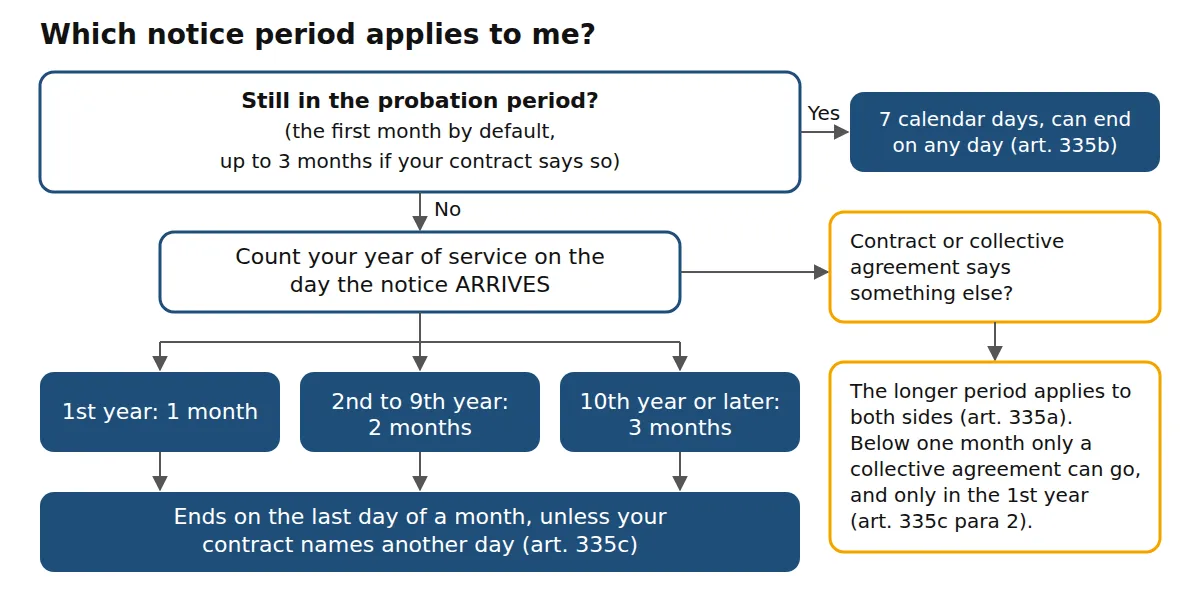
Then the contract applies, within limits. A written agreement, a standard employment contract or a collective agreement can change the periods, but they "may be reduced to less than one month only by collective employment contract and only for the first year of service" (art. 335c para. 2). A two-week notice clause after probation is valid only if a collective agreement sets it and you are in your first year. Longer periods are allowed.
Both sides also get the same period. If your contract gives your employer three months and you one, "the longer period is applicable to both parties" (art. 335a). The one exception runs in your favour: once your employer has given notice for economic reasons, or announced that it will, an agreement can give you a shorter period than the employer has.
When does my notice period end?
On the last day of a month, once the full period has run from the day your notice arrived. Count your one, two or three months from the arrival date, then go forward to the next month-end. Notice doesn't end at the end of the month in which you hand it in: the whole period has to pass first. The month-end is the default, and a contract can name any other day.
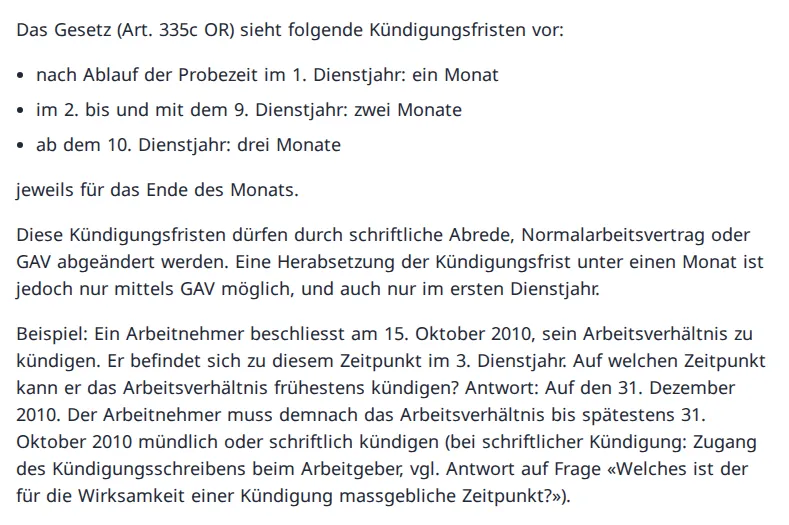
The State Secretariat for Economic Affairs (SECO) keeps a set of questions and answers on termination, a non-binding guide to practice. It works through one case. An employee in the third year of service decides on 15 October 2010 to resign. The earliest possible end is 31 December 2010, and the notice has to reach the employer by 31 October at the latest. Two months back from 31 December gives 1 November as the first day of the notice period, so anything that arrives on or before 31 October is in time.
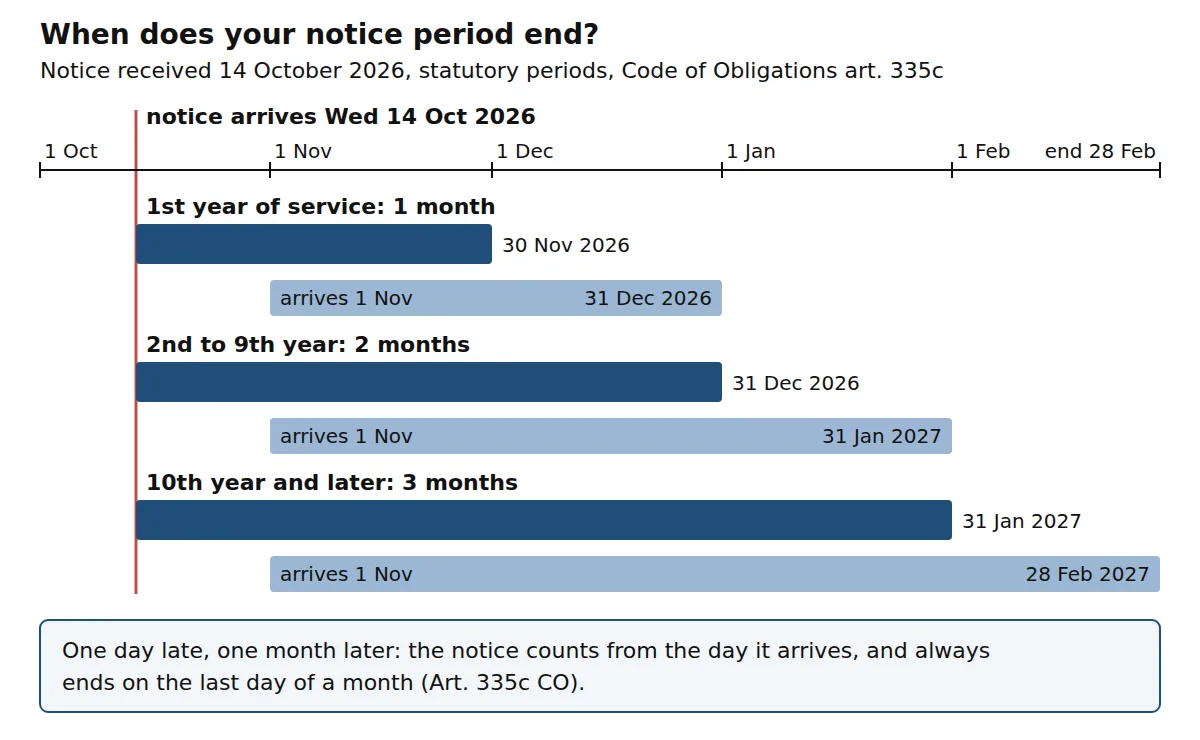
Say your notice arrives on Wednesday 14 October 2026. In your first year of service your last day is 30 November 2026. In years two to nine it is 31 December 2026, and from year ten 31 January 2027. Each of those dates holds for any arrival up to 31 October. If the letter arrives on 1 November instead, every end date moves a full month: 31 December, 31 January and 28 February.
Does the notice count from when I send it or when it arrives?
When it arrives. SECO's FAQ says notice takes effect only once the other side has received it, that the postmark doesn't count, and that whoever gives notice has to prove it arrived. If the post leaves a collection slip, the letter counts as delivered on the day collection could be expected in good faith, normally the day after the failed delivery, under a Federal Supreme Court ruling SECO cites. Another legal view waits until the seven-day collection period has run out, so SECO advises posting early enough for even that to end in time. For a 31 October deadline, that means posting around the 20th, not the 30th.
If you hand the letter over in person, the handover date counts. Ask for a signed receipt; if your employer refuses, SECO suggests a witness and a copy by post.
Which year of service counts?
The one you are in on the day the notice arrives. SECO's FAQ is explicit: notice delivered in your first year gets the one-month period even if it ends in your second year, and the same applies between the ninth and tenth year. So if you started on 1 November 2025, notice that arrives on 20 October 2026 still gives you one month, ending on 30 November 2026.
What is the notice period during the probation period?
Seven calendar days, and the job can end on any day of the week. Probation is the first month unless a written agreement, a standard employment contract or a collective agreement sets something else, and it "may not exceed three months" (art. 335b). SECO's FAQ adds that the seven days can be changed the same way, that a longer agreed probation still counts as three months, and that it must be the same for both sides.
The notice has to arrive while probation lasts, although the seven days may run past its end. If illness, an accident or a legal duty you did not volunteer for cuts into probation, it is extended by that time (art. 335b para. 3), according to SECO even beyond three months.
Periods counted in days leave out the day the notice arrives (art. 77). Notice that arrives during probation on a Wednesday therefore ends the job on the following Wednesday. The rule cuts both ways: if you have just started a job in Switzerland, your new employer can end it on the same seven days.
Do I have to resign in writing?
No, but you should. Spoken notice is valid unless your contract or a collective agreement requires writing; SECO's FAQ puts it plainly: "Nein, eine mündliche Kündigung reicht" (no, an oral notice is enough). The problem is proof. You have to show that your notice arrived and when, which is why SECO recommends a registered letter in every case.
You don't owe a reason. If your employer asks for one, you have to give it in writing (art. 335 para. 2), and the same goes for an employer who dismisses you.
The letter can be short: your name, a sentence saying you terminate your employment contract, the end date you counted, the date and your signature. It saves an email later to add a request for your work reference, which you can ask for at any time and which covers the nature and length of the job, the quality of your work and your conduct (art. 330a), and to ask your employer to confirm receipt.
A fixed-term contract needs no notice: it "ends without notice" on the agreed date (art. 334). If you keep working past that date without a new agreement, it becomes an open-ended contract, with the notice periods above.
What happens if I get ill after I resign?
Nothing changes: your notice ends on the date you counted. The blocking periods often quoted, 30 days in the first year of service, 90 days in years two to five and 180 days from year six, come from art. 336c, and that article opens with "the employer may not terminate". They protect you from your employer's notice, not from your own.
SECO's FAQ says so directly: "Kündigt der Arbeitnehmer selbst, kann er sich nicht auf eine Sperrfrist berufen." An employee who resigns cannot rely on a blocking period, and neither can one who ends the contract by mutual agreement. You will read that notice "pauses" when you fall ill. That describes only the case where your employer gave notice: the period then stops while you can't work, for no longer than the blocking period, resumes afterwards and runs on to the next month-end (art. 336c paras 2 and 3).
Whether you are paid while ill is a separate question, which SECO leaves to the rules on continued pay of wages. One blocking period does bind employees: after probation, you may not resign while your superior or your employer is away on Swiss military or civil service and you have to stand in for them (art. 336d).
Can I take my holidays during the notice period?
Yes, and you can insist on it. SECO's FAQ says holidays should be taken as time off during the notice period too, that you can ask to use your remaining days after giving notice, and that the employer may refuse only in an operational emergency.
It works the other way as well. If you resigned, SECO considers it reasonable for your employer to have you take your open days during the notice period, though holidays can't be ordered from one day to the next. Pay instead of time off is not allowed while the job lasts (art. 329d para. 2). SECO's guidance, written mainly for notice from the employer, says courts accept a payout where the notice is short and the open holiday long, case by case.
Check what you are owed before you plan the weeks. The minimum is four weeks a year, five until you turn 20, and a part year is counted pro rata (art. 329a): eleven months of a four-week entitlement is just over 18 working days on a five-day week. Separately, once notice has been given your employer must allow you "the time required to seek other employment" (art. 329 para. 3). The law sets no number of hours.
Can I quit without a new job?
You can, but unemployment insurance will treat it as your own fault. The unemployment insurance ordinance (AVIV) counts unemployment as self-inflicted when you ended the job yourself without another job having been assured, unless staying could not reasonably be expected of you (art. 44 para. 1 let. b). Giving up a suitable job without the promise of a new one, with no excusable reason, is serious fault, and serious fault means 31 to 60 suspension days (art. 45 paras 3 and 4).
A suspension day is a day without benefit. Under the unemployment insurance act (AVIG), a suspension is at most 60 days per ground and counts against your maximum number of daily allowances (art. 30 para. 3). It starts the day after your job ends (AVIV art. 45 para. 1). Five daily allowances are paid per week (AVIG art. 21), so 60 days is twelve weeks, and the unemployment insurance FAQ adds a standard waiting period of five days before the first payment. By our count, the worst case is about three months with no benefit and no salary.
Whatever you decide, sign on early. You must register with the regional employment centre (RAV) no later than the first day you want benefit for, you can use the RAV's support during your notice period, and a first consultation follows within 15 days, according to the sign-on page on arbeit.swiss. You need your AHV number.
Does quitting affect my residence permit?
With a B permit for work, changing jobs needs no new permit: holders "require no additional authorisation to change jobs" (AIG art. 38 para. 2). With an L permit, a change of job may be approved only for good cause (para. 1). For EU and EFTA citizens, the AIG's rule on when a right of residence expires (art. 61a) is written for a job that ends involuntarily, so it doesn't settle what a resignation does. Ask your canton's migration office before you resign without a new job.
What if I just walk out?
Then you owe your employer money. You may leave with immediate effect only for good cause, meaning circumstances in which continuing cannot be expected in good faith (art. 337). Leaving without one entitles your employer to "one-quarter of the employee's monthly salary", with no need to prove a loss, plus damages for any further losses (art. 337d). SECO's FAQ on immediate termination names the extra cost of a replacement as the typical one. A court can reduce the quarter if the employer lost less. The employer has 30 days to claim it by legal action or debt enforcement, unless it simply deducts it from wages it still owes you.
What to do next
Work through this in order before you send anything. The dates assume a two-month notice period and a last day of 31 December 2026.
- Get the new contract signed first. Unemployment insurance asks whether a new job was assured when you resigned (AVIV art. 44), and a signed contract answers that.
- Read your contract and any collective agreement for the notice period, the probation length and any end date other than the month-end (CO art. 335b and 335c).
- Count your year of service on the day the notice will arrive, not on your last day (SECO).
- Work back from the month-end. For 31 December 2026, the letter has to arrive by 31 October 2026.
- Post it registered around 20 October, or hand it over against a signed receipt.
- Give your new employer 1 January 2027 as your start date, the day after your last day.
- Ask for your work reference (CO art. 330a) and agree your remaining holiday. Your final salary and every other claim fall due on your last day (CO art. 339).
- No new job yet? Sign on at the RAV during your notice, at the latest on the first day you want benefit for (arbeit.swiss).
Where to look while your notice runs
A start date on the first of a month fits the month-end rule, so when an ad names one, check it against the last day you counted. Other regions have their own boards, such as canton Bern and Lausanne. If the next job is in another language region, our post on whether you need German to work in Switzerland shows which language the ads are written in, canton by canton.
By field
Before you sign the new contract, read its probation clause too: until probation ends, either side can end the job on seven days' notice unless the contract sets another period.
Common questions
- How much notice do I have to give when I resign in Switzerland?
- If your contract says nothing else, one month in your first year of service, two months in years two to nine and three months from year ten. The notice always runs to the last day of a month. During probation it is seven calendar days, and the job can end on any day.
- Does my notice period start when I post my resignation letter?
- No. It counts from the day the letter reaches your employer, and the postmark is irrelevant. If the post leaves a collection slip, the letter usually counts as delivered the next day, though one legal view waits for the seven-day collection period. Post it well before the deadline.
- Does sick leave extend my notice period if I resigned?
- No. The blocking periods of 30, 90 and 180 days only interrupt a notice your employer gave. If you resigned yourself, or agreed the end date with your employer, your last day stays where it was.
- Can my employer make me use my holidays during my notice period?
- If you resigned, usually yes: SECO's guidance calls it reasonable, as long as the holiday is not ordered from one day to the next. You can also ask to take your remaining days yourself, and the employer may refuse only in an operational emergency.
- Will I get unemployment benefits if I quit my job without a new one?
- Usually, but later. Quitting without an assured new job counts as serious fault, which means 31 to 60 suspension days without benefit, after a standard waiting period of five days. Sign on with the RAV during your notice period, at the latest on the first day you want benefit for.
More posts
All posts
Do you need to speak German to work in Switzerland? (2026)
78% of 179,108 live Swiss job ads are written in German and 3% in English. The split by canton and by field, and the language levels permits require.