Average salary in Switzerland: what CHF 7,024 really means

The number in brief
The average salary in Switzerland is CHF 7,024 gross a month for a full-time job, or about CHF 84,300 a year. It is a median, from the Federal Statistical Office's 2024 Swiss Earnings Structure Survey, the latest official count: half of all employees earn more than this, and half earn less.
On its own, that number says little about your own pay. One employee in ten earns less than CHF 4,635 a month, one in ten earns more than CHF 12,526, and the median in banking is about CHF 6,000 higher than in hotels. We take the figure apart below, using the Federal Statistical Office's own tables, and end with a way to hold a job offer up against the parts that actually apply to you.
What the CHF 7,024 counts
It is a standardised gross monthly wage: what a job pays for a 40-hour week, before deductions, with a share of the yearly extras folded in. The Federal Statistical Office (FSO) runs the survey every two years by asking employers, not workers. For 2024 it used the answers of about 34,000 companies covering some 2.9 million employees, in the private and public sectors together, according to its press release (the full text is in German, French and Italian; the English summary is a single page). It covers industry and services; farming is not part of it.
The FSO takes each employee's pay for October 2024 and converts it to 4⅓ weeks of 40 hours. A part-time salary is scaled up to what the same job would pay full time. The result includes:
- your own social insurance contributions, which is why the figure is gross
- benefits in kind, regular premiums and commission
- pay for shift, night and Sunday work
- one twelfth of a 13th month's salary and one twelfth of yearly bonuses
Family and child allowances are left out. Because the yearly extras are already spread over the months, multiplying by 12 gives the yearly figure: 7,024 × 12 is CHF 84,288. The median was CHF 6,788 in the previous survey, for 2022, so it rose by about 3.5% in two years. If a page quotes 6,788 as today's average, it is working from the older survey.
The FSO adds a warning in the same release that many pages repeating the number leave out: this figure is not an average.
Median or average: why the word matters
The median is the salary in the middle. Line up every full-time salary from lowest to highest, and the median is the one where half the line is below and half above. An average, or mean, is the total of all salaries divided by the number of employees. The FSO says plainly that the two should not be confused.
In Switzerland they drift apart because pay is lopsided. The top 10% start CHF 5,502 above the median, while the bottom 10% end only CHF 2,389 below it. A few very high salaries pull an average up a long way and hardly move the median, so the median describes a typical employee much better. The FSO's published tables for the survey give the median and the bands around it, not an average for all employees. When you see "the average Swiss salary" quoted as a single figure, it is usually this median under another name, or a number from an older or different survey.
You can watch the two measures diverge in the FSO's own figures on men's and women's pay. Measured at the median, women earned 8.4% less than men in 2024. Measured with the mean, which the FSO uses for its separate pay gap analysis, the gap was 15.7%. The same survey helps explain why: 74.9% of the employees earning more than CHF 16,000 a month were men, and 62.0% of those earning less than CHF 4,500 were women. Those very high salaries lift the men's mean far more than their median. For judging your own pay, the median and the bands around it are the figures to use, so here they are.
The bands: where the 10%, 25%, 75% and 90% stand
Half of all employees in Switzerland earn between CHF 5,524 and CHF 9,326 gross a month, counted on a full-time basis. That middle half is the core of the pay scale, and the national bands show how far pay stretches on either side of it.
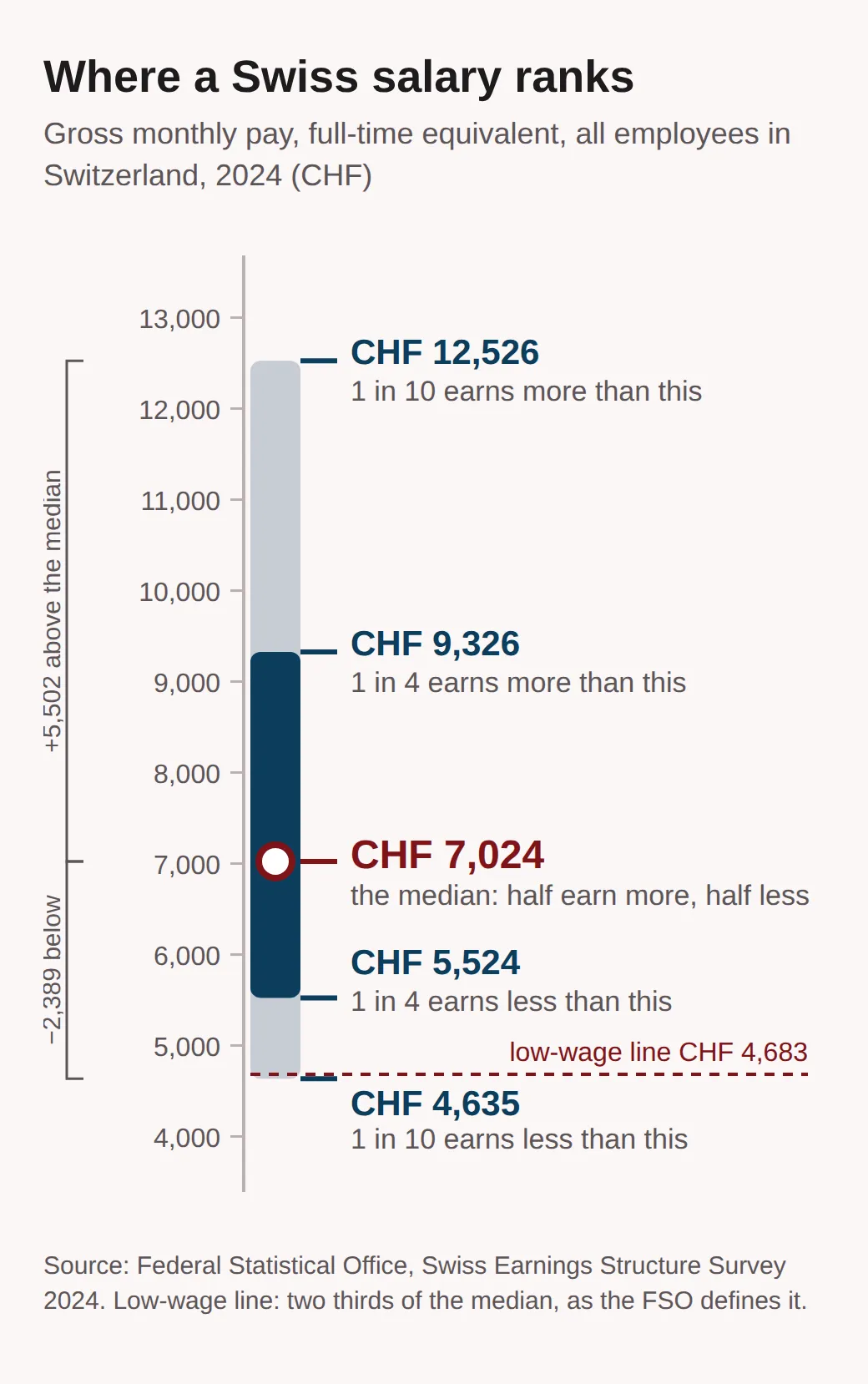
At the bottom, the FSO counts a job as low-paid when its full-time salary is below two thirds of the median, which in 2024 meant under CHF 4,683. That applied to 10.8% of jobs, against 10.5% in 2022, and the share has stayed between 10.2% and 11.7% since 2008. This is a statistical line. A legal minimum wage exists only in a few cantons and cities, and those rates are lower again, as our guide to minimum wages by canton shows.
The FSO also defines a statistical middle class: everyone earning between 70% and 150% of the median. By our arithmetic that is CHF 4,917 to 10,536 a month in 2024. Between 2008 and 2024, pay grew fastest for the lowest-paid 10% (+18.1%), a little less for the best-paid 10% (+16.8%) and slowest in that middle group (+15.4%). So the spread has not widened over 16 years, and where you sit in it depends above all on the sector you work in.
Average salary by sector
Your sector moves your pay a long way: in the cross-section below, the median runs from CHF 4,496 in personal services to 10,723 in banking. Next to each median is the range the middle half of that sector earns.
| Sector | Median, CHF | Middle half earns, CHF |
|---|---|---|
| Banks and financial services | 10,723 | 7,993–14,505 |
| Pharmaceuticals | 10,159 | 7,840–14,395 |
| IT services | 9,874 | 7,613–12,741 |
| Insurance | 9,351 | 7,240–11,870 |
| Public administration | 8,872 | 7,306–10,850 |
| Education | 8,745 | 6,942–10,774 |
| Architecture and engineering firms | 7,853 | 6,510–9,860 |
| Health care | 7,214 | 5,983–8,841 |
| Building construction | 6,707 | 5,979–7,908 |
| Warehousing and transport services | 6,033 | 5,054–7,632 |
| Staffing agencies | 5,931 | 5,065–6,986 |
| Retail | 5,214 | 4,689–6,380 |
| Restaurants | 4,744 | 4,218–5,537 |
| Hotels | 4,715 | 4,191–5,570 |
| Personal services, such as hairdressing | 4,496 | 3,953–5,552 |
The figures come from the FSO's tables by sector and its online database, which also gives the 10% and 90% lines for each sector. The share of low-paid jobs shows the same divide. It was 56.3% in personal services, 48.7% in hotels, 47.8% in restaurants and 24.6% in retail, but 0.6% in banks, 0.8% in insurance and 1.4% in public administration.
The shape of each sector differs too. In IT services, one employee in ten earns CHF 20,000 a month or more. Building construction has a much higher floor and a lower ceiling: its lowest-paid tenth still earns at least CHF 5,293, well above the national 4,635, while its top tenth starts at 10,052. Once you know your sector, the next filter is where in the country the job is.
Average salary by region
The FSO splits Switzerland into seven large regions, and Zurich leads with a median of CHF 7,502, while Ticino trails at 5,708. The other five sit within about CHF 400 of the national figure.
| Region | Cantons | Median, CHF | Top 10% earn over, CHF |
|---|---|---|---|
| Zurich | ZH | 7,502 | 13,970 |
| Northwestern Switzerland | BS, BL, AG | 7,156 | 12,918 |
| Central Switzerland | LU, UR, SZ, OW, NW, ZG | 7,092 | 12,856 |
| Lake Geneva region | VD, VS, GE | 6,998 | 12,636 |
| Espace Mittelland | BE, FR, SO, NE, JU | 6,964 | 11,734 |
| Eastern Switzerland | GL, SH, AR, AI, SG, GR, TG | 6,623 | 11,030 |
| Ticino | TI | 5,708 | 10,012 |
The gaps are much wider at the top than at the bottom. The line for the best-paid tenth is almost CHF 4,000 higher in Zurich than in Ticino, but the line for the lowest-paid tenth differs by less than CHF 1,000 (4,761 against 3,783). The FSO puts most of the regional difference down to where the high-value sectors, such as banking and pharmaceuticals, are concentrated. So a Zurich median partly reflects Zurich's mix of jobs, and comparing a nursing offer in Lugano with the Zurich figure tells you very little. Your age and role narrow the comparison further.
Age, education and a management role
Pay climbs steeply in your twenties and thirties and flattens after 40. The median is CHF 5,623 for employees aged 20 to 29, 7,055 in their thirties and peaks at 7,820 between 50 and retirement, according to the FSO's table by age.
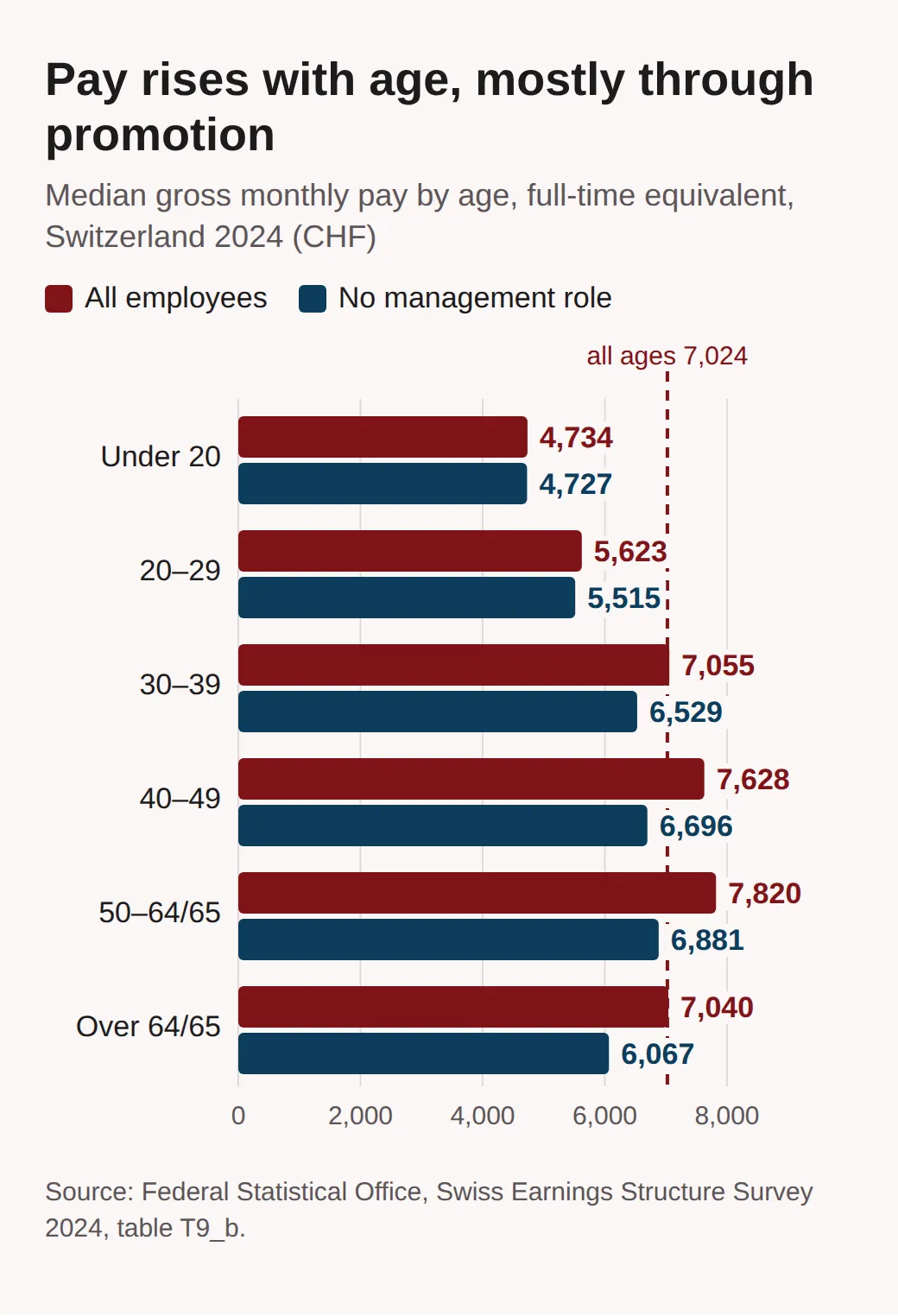
The second bar in each pair matters more. For employees without a management role, the median rises only from CHF 5,515 in their twenties to 6,881 in their fifties. Much of the climb in the overall figure comes from people moving into management, where the median for upper and middle managers is CHF 11,174 against 6,368 for staff without a management function. If you are 26 and not managing anyone, the national 7,024 is the wrong benchmark: the median for your group is CHF 5,515, about 1,500 lower.
Education sets the starting level. The median is CHF 10,533 with a university degree, 9,288 with a degree from a university of applied sciences and 6,390 with a federal vocational certificate (EFZ, the three or four-year apprenticeship). Within the same education, the role then decides: a graduate with a high level of responsibility earns a median of CHF 14,409, one without any 8,645. For an EFZ holder the same comparison gives 8,252 and 6,162.
The gap between women and men is narrower than it was. The median for women was CHF 6,666 in 2024 and for men 7,276, a difference of 8.4%, down from 11.5% in 2018. Compare an offer with the figure for everyone in your group, not with the figure for your sex, or you carry the gap into your own expectations. One more part of the number needs unpacking before you compare: the extras.
Bonuses and the 13th salary are already inside the number
The median already contains one twelfth of each employee's 13th salary and yearly bonus, so you should compare it with your yearly pay divided by 12, not with your base monthly salary. In 2024, 75.9% of employees received a 13th month's salary, as our guide to the 13th salary explains in detail.
Bonuses are less common and very unevenly spread. 32.6% of employees received one in 2024, down from 33.6% in 2022, and those who did got CHF 11,967 a year on average. That is an average of bonus payments, not a median. Staff without a management role who got a bonus received CHF 4,601 on average, while upper management received 4,364 on average in public administration, 58,747 in IT and 147,796 in banking.
In practice, an offer of CHF 6,400 paid 13 times is worth 6,400 × 13 ÷ 12, or CHF 6,933 a month on the survey's basis. That is close to the median, although each monthly payslip shows only 6,400. A bonus that your contract promises in a fixed or calculable amount belongs in the same sum. A bonus that depends on your employer's goodwill is a hope, and comparing a base salary plus a hope with a median that includes other people's real bonuses flatters the offer. Once the yearly total is right, you can check where an offer really lands.
Is your salary good? How to place an offer
An offer is good or not against the right comparison, which is rarely CHF 7,024. Bring the offer onto the survey's basis first, then compare it with the narrowest group you belong to:
- Add up the yearly gross pay, including a 13th salary and any bonus your contract guarantees, and divide by 12.
- If the contract is not for 40 hours a week, multiply by 40 and divide by your weekly hours.
- If the job is part time, divide by your percentage: CHF 4,100 at 60% is CHF 6,833 full time.
- Compare the result with your sector in your region, then with your age group and role.
Take an IT job in Geneva with no management role, paying CHF 7,400 gross 13 times a year for 40 hours, offered to someone aged 29. On the survey's basis it is worth 7,400 × 13 ÷ 12, or CHF 8,017 a month. Against the national median that looks generous: 14% above 7,024, and far above the CHF 5,623 median for people in their twenties.
Now use the narrow comparison. For IT services in the Lake Geneva region, staff without a management role had a median of CHF 8,652 in 2024, and the middle half earned between 6,907 and 10,333. The same offer sits about CHF 635 below the middle of its own market, in the lower half of that range. It is a decent salary by Swiss standards and a below-median one for the job, and only the second fact matters when you reply.
To go one step further, the FSO's Salarium calculator combines sector, region, age, education, role and other details into one estimate. It uses the private sector part of the same 2024 survey, about 1.7 million employees. Its estimate is a model, not a promise, but it gives you a figure to bring to the table; our guide to negotiating your salary covers when and how to name it. Remember too that every number here is gross; our gross to net guide walks through what comes off it.
The survey is two years old
All these figures describe October 2024, and pay has moved since. The FSO's wage index (press release in German) shows nominal wages rose 1.8% in 2025, while prices rose 0.2%, so real wages gained 1.6%, the largest increase since 2009. The rise was uneven: 3.3% in public administration and 0.4% in health care and social work.
As a rough guide, 7,024 plus 1.8% would be about CHF 7,150 for 2025. That is our own sum, not an official figure, and the index measures contract base pay, so it is not quite the same thing as the survey's median. The next survey records wages for October 2026. If the FSO keeps to the timing of the last round, results will follow about 13 months later.
Until then, the 2024 bands are the best official yardstick there is. Run the four steps on any offer you get, then compare it with what employers in your field are advertising now: our listings of full-time jobs and part-time jobs are a good place to start.
Common questions
- Is the CHF 7,024 median before or after tax?
- Before. It is a gross figure that still includes your own social insurance contributions, and neither tax nor pension fund contributions have come off it. What reaches your account depends on your age, your employer's pension plan, your canton and whether you pay tax at source, so two people with the same gross pay can see quite different net amounts.
- What counts as a low salary in Switzerland?
- The Federal Statistical Office calls a job low-paid when a full-time salary is below two thirds of the median, which in 2024 meant less than CHF 4,683 gross a month. About 10.8% of jobs were below that line. It is a statistical line, not a legal one: a minimum wage set by law exists only in a few cantons and cities.
- Do foreign workers earn less in Switzerland?
- It depends on the job. In roles without a management function, the 2024 median was CHF 6,765 for Swiss employees, 6,034 with a C permit, 5,950 for cross-border commuters with a G permit and 5,421 with a B permit. In jobs with a high level of responsibility the order flips: B permit holders had a median of CHF 13,090, against 10,989 for Swiss employees.
- How often is the Swiss average salary updated?
- The earnings survey behind the CHF 7,024 runs every two years and records October wages. The 2024 results came out on 25 November 2025, so if the timing holds, figures for 2026 will follow around the end of 2027. In between, the federal wage index reports each spring how much pay rose in the year before.
More posts
All posts
Jobs in Switzerland for English speakers: fields and cities
One worker in four speaks English on the job in Switzerland, yet only 4% work in English alone. The fields and cities where English is enough, with data.

Gross to net salary in Switzerland 2026: every deduction
Gross to net salary in Switzerland for 2026: every payslip deduction and who sets its rate, from AHV to tax at source, with a worked CHF 6,500 example.

Salary negotiation in Switzerland: use the official data
Negotiate pay in Switzerland with the federal Salarium calculator and GAV minimums: when to name a figure, 12 or 13 payments, and what else you can ask for.