Gross to net salary in Switzerland 2026: every deduction

Gross to net, briefly
In 2026 an employee in Switzerland pays 5.3% of gross pay into AHV/IV/EO and 1.1% into unemployment insurance. On top come a pension fund share that depends on your age and your employer's plan, an accident premium and often a sickness insurance share. Without a C permit, tax at source comes off too. On CHF 6,500 a month in Zurich, our example keeps CHF 5,836, or CHF 5,363 after tax at source.
That is the short version, but the details decide whether your own payslip is right. Many gross to net tables online give a range such as 13 to 17% without saying where it comes from, or quote a withholding tax figure without naming the canton or the tariff. Below, each line has the rate from the office or the law that sets it. Where no law fixes a number, as with accident and sickness premiums, we say so and show you where to find yours.
What comes off a Swiss payslip in 2026
Six deductions can appear on a Swiss payslip, and only the first two are the same for everyone:
| Deduction | Your share in 2026 | Who sets it | Upper limit |
|---|---|---|---|
| AHV/IV/EO | 5.3% | Federal law | None |
| ALV, unemployment | 1.1% | Federal law | CHF 148,200 a year |
| BVG, pension fund | Depends on age and plan | Your pension fund | Legal minimum stops at CHF 90,720 |
| NBU, accidents outside work | Set per employer | The accident insurer | CHF 148,200 a year |
| KTG, sickness benefit | Usually up to half the premium | Your employer's policy | Set by the policy |
| Tax at source | Depends on canton, tariff and income | The canton | None |
Your employer also pays its own share of most of these, which never shows up in your gross: another 5.3% for AHV/IV/EO, another 1.1% for unemployment insurance, at least half of the pension contributions, the premiums for accidents at work and the contributions for family allowances. The sections below go through your side, line by line.
AHV/IV/EO: 5.3%, with no ceiling
The first line is the state pension and its two siblings, and it is fixed by federal law. AHV is the old-age and survivors' insurance, IV the disability insurance and EO the loss of earnings scheme, which pays during military service and maternity leave. Together they take 10.6% of your salary: 8.7% for AHV, 1.4% for IV and 0.5% for EO. Your employer deducts half of it, 5.3%, from your pay and adds the other half.
There is no upper limit. On CHF 4,000 you pay CHF 212 a month, and on CHF 20,000 you pay CHF 1,060. Contributions start on 1 January after your 17th birthday and are due on almost every kind of pay, including the 13th salary, bonuses and pay for overtime.
The rates did not change for 2026, and the plan to fund the new pension leaves them alone. Financing for the 13th AHV pension, paid for the first time in December 2026, goes to a federal vote on 29 November 2026 as a VAT increase of 0.4 percentage points from 2028 at the earliest. In its final vote, Parliament dropped the idea of raising salary contributions for it.
ALV: 1.1%, up to CHF 148,200
Unemployment insurance is the second fixed line. The total is 2.2% of salary, split equally, so you pay 1.1%. It stops at an annual salary of CHF 148,200 per job, which payroll applies as CHF 12,350 a month. Since January 2023 no unemployment contribution at all is due on pay above that limit, so if you have an old payslip with a "solidarity" line on top, that line no longer exists.
So on a salary of CHF 15,000 a month, the ALV line shows CHF 135.85, which is 1.1% of 12,350, not of 15,000. If yours shows 165, the limit was not applied.
The pension fund: the line that varies most
The pension fund line, called BVG in German and LPP in French, is where two payslips with the same gross part ways. The law only sets a minimum, and your pension fund's own rules decide what you actually pay.
The minimum works like this. You join the fund if you earn more than CHF 22,680 a year with one employer. From 1 January after your 17th birthday you are insured for death and disability; from 1 January after your 24th birthday you also save for retirement. The savings are calculated on a slice of your pay called the coordinated salary: the part between CHF 26,460 and CHF 90,720 a year. The federal social insurance office confirms those limits are unchanged for 2026.
Each year the fund credits a percentage of that slice to your account, and the percentage rises with age:
| Age | Yearly credit, % of coordinated salary | Half of it per month at CHF 6,500 |
|---|---|---|
| 25–34 | 7% | CHF 150.33 |
| 35–44 | 10% | CHF 214.75 |
| 45–54 | 15% | CHF 322.13 |
| 55–65 | 18% | CHF 386.55 |
These credits come from Article 16 of the BVG. The last column is our calculation for a gross of CHF 6,500 paid 12 times (78,000 minus 26,460 gives a coordinated salary of 51,540) and assumes the costs are split down the middle.
Two things make your real line differ from this table. First, the law says the employer must pay at least as much as all its employees together, which allows a fund to charge you less than half, but not more than half across the staff. Second, a fund may insure more than the minimum: a smaller coordination deduction, pay above CHF 90,720 or higher credits. On top come its charges for death and disability cover and running costs. So a BVG line above the legal minimum is normal, and the savings part of it stays yours. The fund's rules, called the Reglement, and your yearly pension certificate show the exact split.
Accident insurance: the employer's insurer sets the rate
Every employer in Switzerland must insure staff against accidents. Accidents at work are paid for by the employer. Accidents in your free time, called NBU in German, are paid for by you: the accident insurance law puts that premium on the employee unless the employer agrees to cover it. The cover applies from eight hours a week with one employer; below that, your own health insurance has to cover accidents.
There is no national NBU rate. The insurer sets one for each company: Suva for the businesses the law assigns to it, a private insurer, health insurer or public accident fund for the rest. The premium is charged on pay up to CHF 148,200 a year, the same limit as unemployment insurance. Your employer must deduct it from the pay of the month it covers or the month after; it cannot collect several months at once later on. Suva says it cut its NBU premiums by 4.3% on average for 2026, but the rate that counts is the one printed on your own payslip.
Daily sickness benefit: only if your employer has a policy
Sickness insurance for lost pay, called KTG or Krankentaggeld, is not compulsory. Without it, the Code of Obligations makes your employer keep paying you for a limited time when you're ill, once the job has lasted more than three months: three weeks in the first year, longer after that. An employer can instead buy an insurance policy that pays for much longer, and ask you to share the premium.
That swap is only allowed if it leaves you at least as well off, and it needs to be in writing. In practice, a policy paying 80% of salary for 720 days, with two or three waiting days and half the premium paid by the employee, is treated as equivalent. The Zurich high court applied that benchmark in a 2014 judgment. If your KTG deduction is more than half the premium, or the policy pays less than that, ask your employer to show you the policy.
Tax at source: who pays it and how the rate is read
Tax at source, Quellensteuer in German, is income tax that your employer deducts from each payslip and sends to the canton. It applies to foreign employees living in Switzerland without a C permit, unless you are married to a Swiss national or a C permit holder. Cross-border commuters and other people living abroad pay it too, under their own rules. Everyone else gets their full net pay and a tax bill later.
The rate comes from a table published by your canton each year. You are given a code: a letter for your situation (A for single, B for a married sole earner, C for a married couple who both work, H for a single parent) and a number for your children, plus a separate table if you pay church tax. The rate then depends on your gross monthly pay, which Zurich's table reads in steps of CHF 50. Zurich publishes its tables as PDFs on its tax office page:
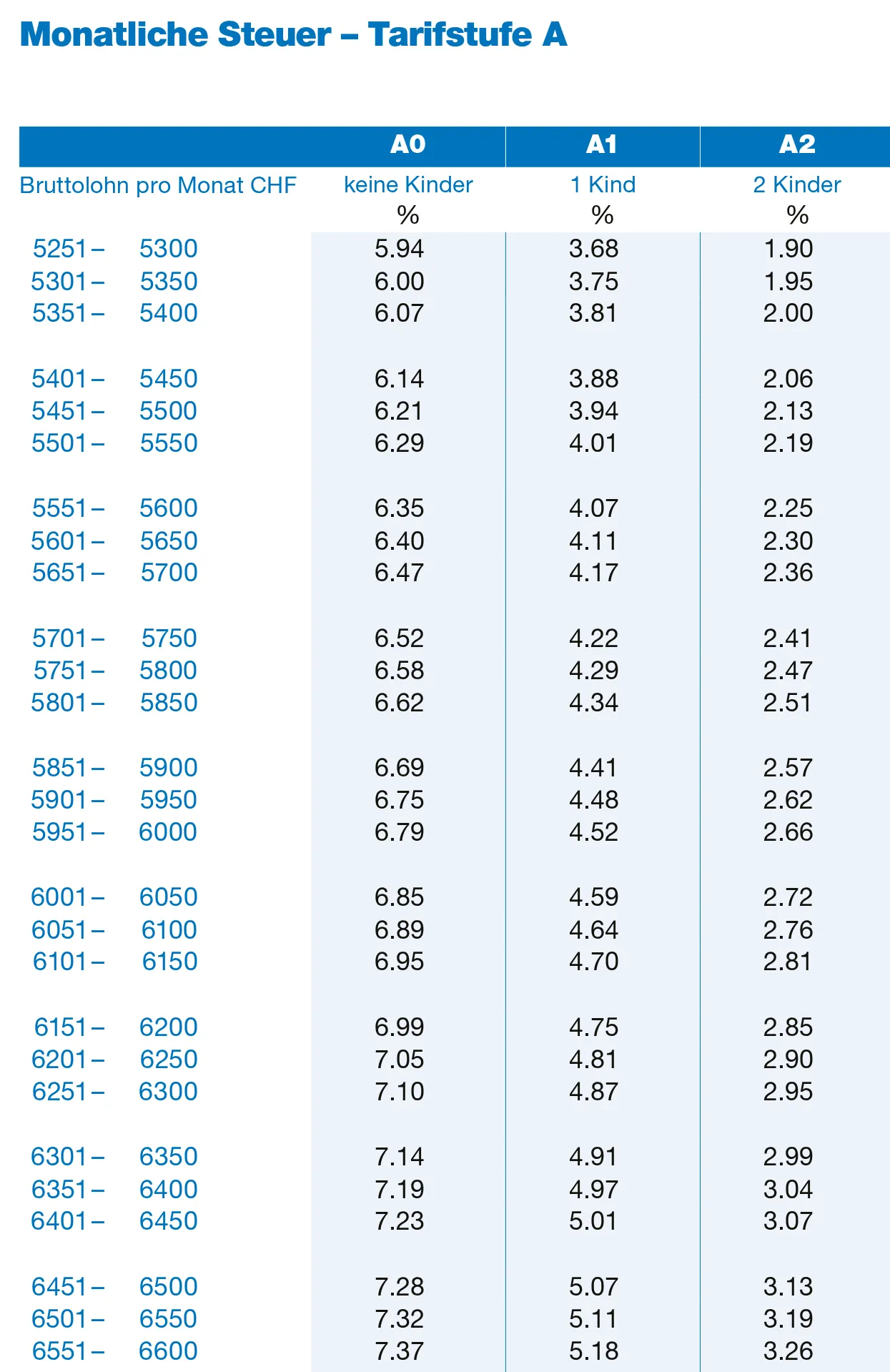
The percentage applies to your gross monthly salary, as the table's heading says, not to what is left after social contributions. Church tax adds a little: Zurich's A0 rate for the same row is 7.47% with church tax. Other cantons publish their own tables, and the rates differ widely, so a figure from a calculator that doesn't name the canton and the code tells you little.
Tax at source is not always the final word. If you earn CHF 120,000 or more a year, you must file a regular tax return, and the tax already withheld is credited against it. Below that, you can ask for a return by 31 March of the following year, which lets you claim deductions such as pillar 3a payments. Miss that date and the withheld tax is final. Once you have asked, you file a return every year for as long as you pay tax at source.
A worked example: CHF 6,500 in Zurich
Here is how the lines add up for one person: age 30, single, no children, no church, living and working in the canton of Zurich, earning CHF 6,500 a month, paid 12 times. For accident and sickness insurance we had to pick rates, because no law sets them; we used 1.0% and 0.5%, and your payslip will show your employer's own.
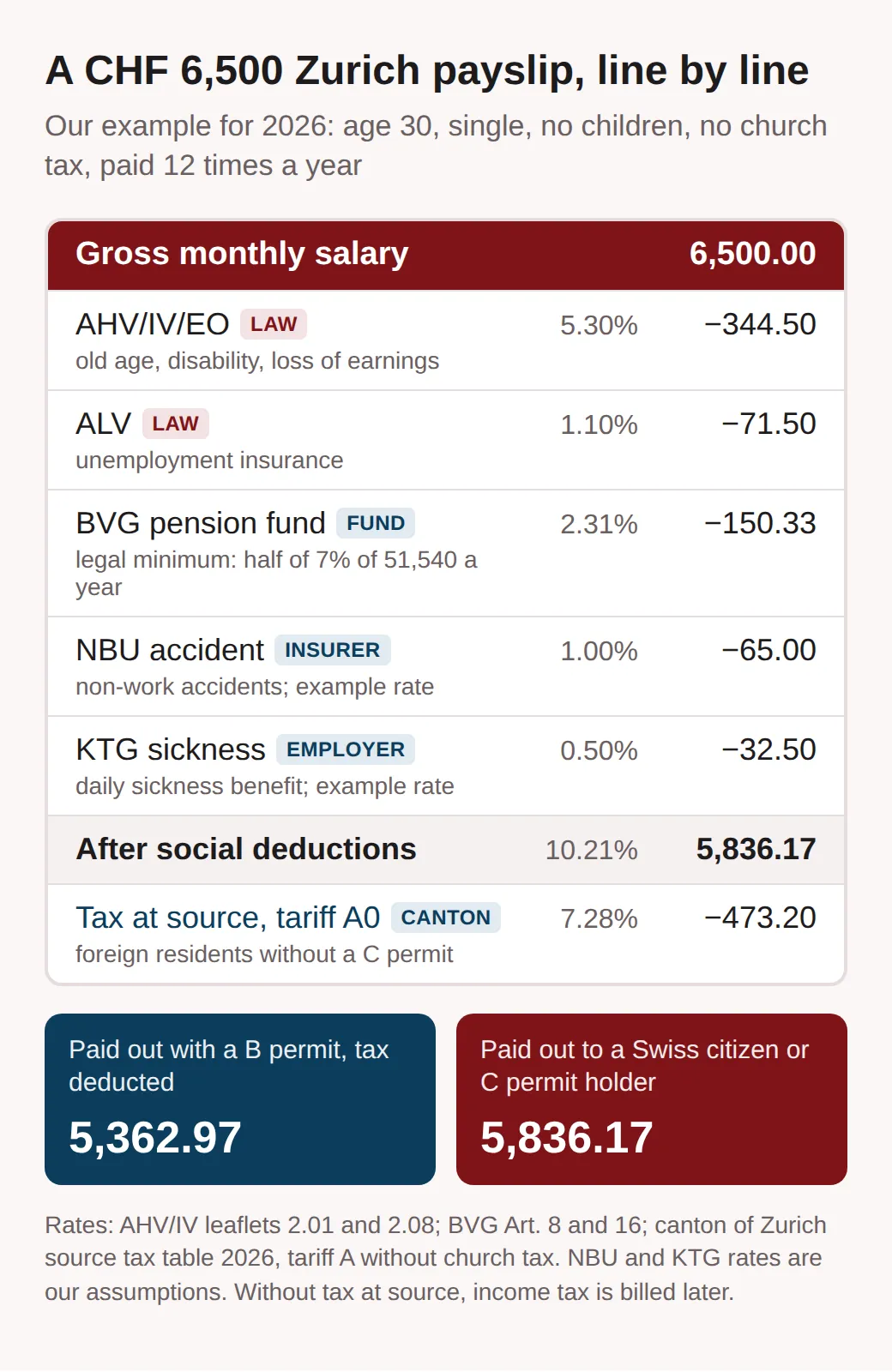
The social deductions come to CHF 663.83, or 10.2% of gross. A Swiss citizen or C permit holder receives CHF 5,836.17 and pays income tax later through a tax return. Someone with a B permit receives CHF 5,362.97, because CHF 473.20 of tax at source is already gone, and usually owes nothing more for that income.
Paid 13 times instead of 12, the same yearly salary would be CHF 6,000 a month, and the AHV/IV/EO and ALV percentages would apply to each of the 13 payments. Our 13th month salary guide explains the two ways cantons handle the extra month for tax at source.
Why the share rises with your salary
The social deductions stay between about 7.5% and 9% of gross at every level, but tax at source climbs steeply. We ran the same person through four salaries, leaving out accident and sickness premiums because they vary by employer:
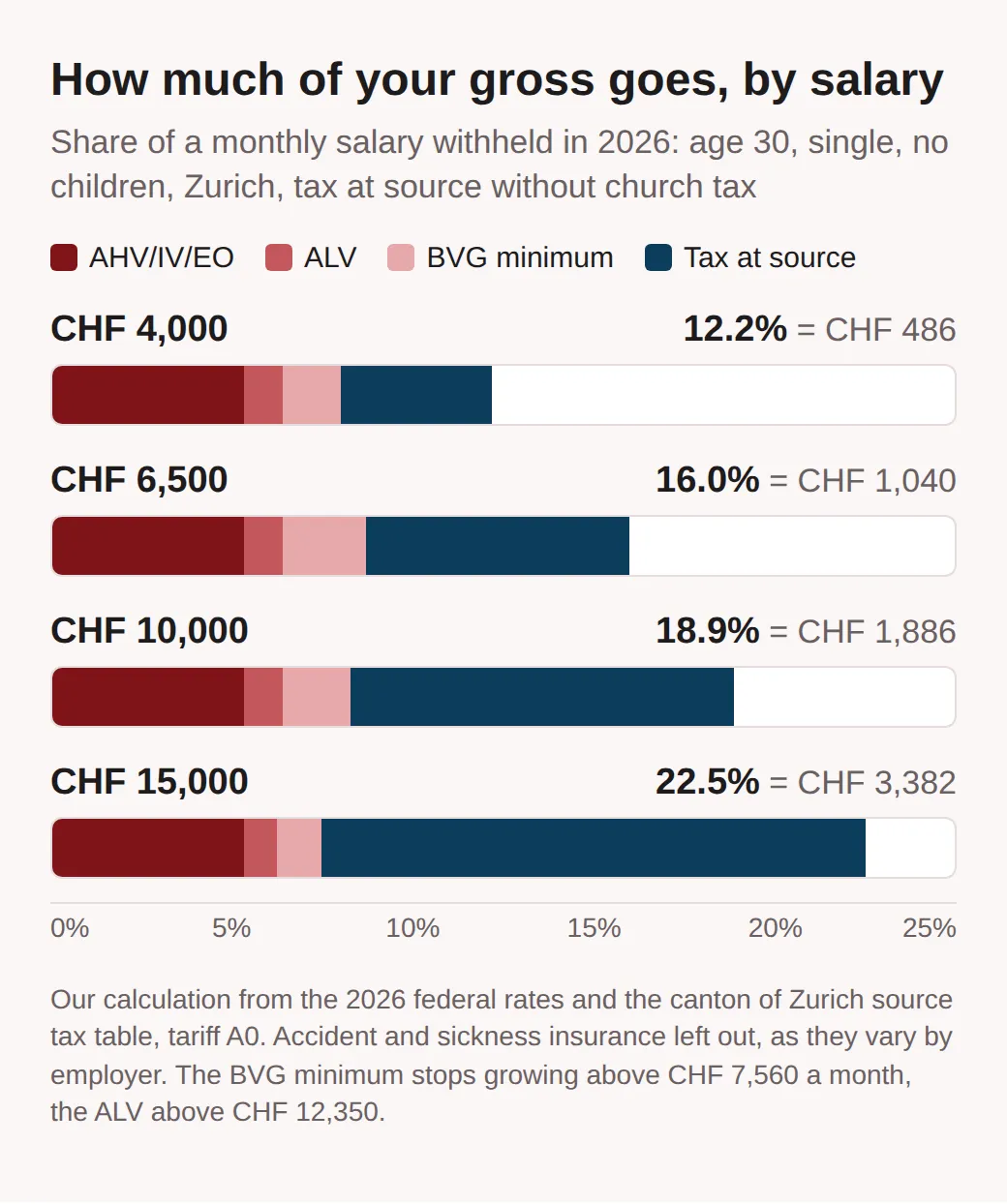
Two caps flatten the social part at the top. The legal pension minimum stops growing once your pay passes CHF 90,720 a year, about CHF 7,560 a month, and unemployment insurance stops at CHF 12,350 a month. AHV/IV/EO never stops. At CHF 15,000 a month, tax at source takes 15.09%, but that person earns more than CHF 120,000 a year and will file a tax return anyway, so the withheld amount is a down payment rather than the final bill.
If you compare offers between cantons, run each one through that canton's own table. If you are weighing two offers, our guide to negotiating salary is the next step.
What is not on your payslip
Some of the biggest costs of living in Switzerland never appear as a deduction. Health insurance is compulsory but private: you choose an insurer within three months of arriving or starting work, and you pay the premium yourself, every month, from your net pay. Budget for it separately, because a net figure that looks generous before health insurance can look very different after.
Income tax for Swiss citizens and C permit holders is not deducted either. It arrives as a bill after you file your tax return. If your net pay is CHF 5,836 and you're not taxed at source, set aside part of it each month.
Family allowances work the other way. They are added to your pay, not deducted: at least CHF 215 a month per child and CHF 268 for a child in education, with many cantons paying more. Your employer pays the contributions that fund them, so they don't reduce your gross, except in Valais, where employees contribute too.
Minimum wages, where a canton has one, are also gross amounts. A cantonal minimum is a floor before deductions, so a net amount below it is not a breach.
Part-time work and second jobs
The thresholds matter most when you work part time or hold several small jobs, because each one is checked per employer.
Below eight hours a week with one employer, there is no NBU deduction, but also no cover for accidents in your free time from that job, so keep accident cover in your health insurance. Below CHF 22,680 a year with one employer, there is no compulsory pension fund, even if two jobs together earn more than that. In that case the law lets you insure yourself voluntarily with the substitute pension fund or, if its rules allow, with one of your employers' funds, and each employer then pays half of the contributions on its share of your pay. Below CHF 2,500 a year per job, AHV contributions are only collected if you ask, except for work in private households and for employers in culture and media. Tax at source has no lower limit: Zurich's table starts at 0.25% for pay of up to CHF 800 a month.
If you keep working past the reference age, you get an allowance of CHF 1,400 a month per job before AHV/IV/EO applies, and pay no unemployment contribution at all.
How to check your own payslip
Your employer must give you a written pay statement, and it should let you redo the sums yourself. Take your gross and check the lines in this order:
- AHV/IV/EO is exactly 5.3% of gross, and ALV exactly 1.1%, or 1.1% of CHF 12,350 if you earn more.
- The pension line matches the contribution on your pension certificate, divided by 12 or 13.
- NBU and KTG show a percentage. Ask HR for the rate and the policy if they don't.
- Tax at source shows your code, such as A0, and the rate matches your canton's table for your gross.
A wrong tariff code is an expensive mistake: in the same Zurich row for CHF 6,500, the rate is 7.28% with no children in the code and 5.07% with one, a difference of CHF 143.65 a month. Report any change in your situation to your employer straight away; in Zurich the new code applies from the month after. At the end of the year, your salary certificate, the Lohnausweis, sums up every deduction, and it is the document you will need for a tax return or for a request to have your tax at source recalculated.
Common questions
- Are contributions taken from my 13th salary and from a bonus?
- Yes. A 13th salary and a bonus count as salary for AHV/IV/EO and unemployment insurance, so the same percentages come off them. Whether your pension fund insures them depends on its rules. If you pay tax at source, how the extra pay is taxed depends on your canton's method.
- Can I lower my tax at source with pillar 3a payments?
- Only through an ordinary assessment. Below CHF 120,000 a year you can ask for one by 31 March of the following year, and then pillar 3a payments and other deductions count. Without that request, the tax withheld is final and no extra deductions are granted later. Once you have asked, the ordinary assessment stays for as long as you pay tax at source.
- What changes on the payslip if I keep working after 65?
- Unemployment insurance stops at the reference age, which is 65 for men and for women born from 1964. AHV/IV/EO contributions continue, but only on pay above an allowance of CHF 16,800 a year, or CHF 1,400 a month, per job. You can ask your employer to skip the allowance if you want to pay on everything, for example to fill gaps in your contribution record.
- My side job pays under CHF 2,500 a year. Do I still pay AHV?
- Usually only if you ask for it. Contributions on pay of up to CHF 2,500 a year per job are collected only at the insured person's request. Two exceptions remain: work in a private household, and work for employers in culture and media such as theatres, orchestras, radio, TV, the press and museums. There, contributions are due on every franc.
More posts
All posts
Switch health insurance in Switzerland: 2027 checklist
Switching Swiss health insurance for 2027: the 30 November deadline, the new premiums, and the accident cover you can drop if you work 8 hours a week.

Jobs in Switzerland for English speakers: fields and cities
One worker in four speaks English on the job in Switzerland, yet only 4% work in English alone. The fields and cities where English is enough, with data.

Work permit in Switzerland 2026: L, B, C and G compared
Which Swiss work permit a job offer gets you: L, B or G by contract length for EU/EFTA citizens, and the test, quota and employer filing for everyone else.