Salary negotiation in Switzerland: use the official data

In one minute
Negotiate with the federal government's numbers rather than a feeling. Look up your profile in Salarium, the Federal Statistical Office's free salary calculator, and check whether a collective agreement sets a minimum for the job. Once you have an offer, name one yearly gross figure between the median and the upper quartile, say whether it assumes 12 or 13 payments, then move on to the rest of the package.
That sounds simple, and most advice stops there. The details are where the money is: which fields in the calculator move the estimate, why the monthly figure it shows already contains part of a 13th salary, and which parts of a Swiss contract have a legal floor. To keep it concrete, we ran one real query through Salarium for an accountant in Zurich and use its numbers throughout. Every figure below comes from that query or from an official source we link.
Find your number in Salarium
Salarium estimates the gross monthly salary for a profile you describe, with a range around it. It is built on the 2024 Swiss Earnings Structure Survey, which the Federal Statistical Office runs every two years among companies. For the calculator it uses complete records from the private sector only, about 1.7 million employees, and a model with 14 factors such as sector, company size, age, education and occupation. The office says plainly on its Salarium page that the results are estimates from a simplified model, not salary recommendations. That is a fair warning, and it is also why the figure works well in a negotiation: nobody wrote it to win an argument.
You start with three fields: the economic sector, one of seven regions and your occupation, which you can type in plain words. We chose the sector "Legal and accounting activities", the region Zurich and the job title "Accountant", which Salarium files under business and administration associate professionals.
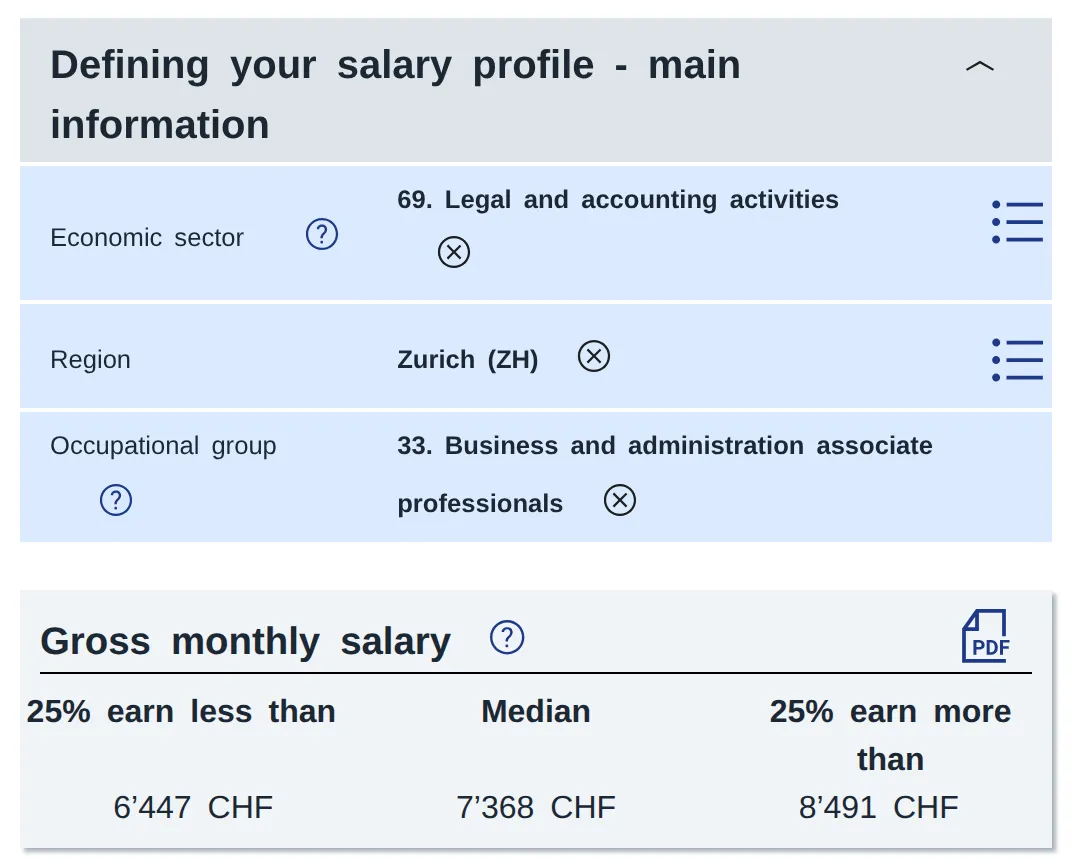
The three numbers are a range, not a verdict. A quarter of comparable employees earn less than CHF 6,447 a month, half earn less than 7,368, and a quarter earn more than 8,491. Where you belong inside that range is exactly what the negotiation is about. Before you trust any of it, though, look at the second half of the form, because Salarium has already filled it in for you.
Set every field, because each one moves the figure
Below the result, Salarium lists eleven more fields: position, education, age, years of service, weekly hours, sex, nationality or permit, company size, 13th salary, one-off payments and type of contract. Each starts on a default, the most common value in the survey for that sector and occupation. For our accountant the defaults describe a 30-year-old woman with an apprenticeship, no managerial role and no years at the firm, working full time in a company of 50 or more. If that isn't you, the estimate isn't yours either.
So we changed one field at a time and wrote down the median each time:
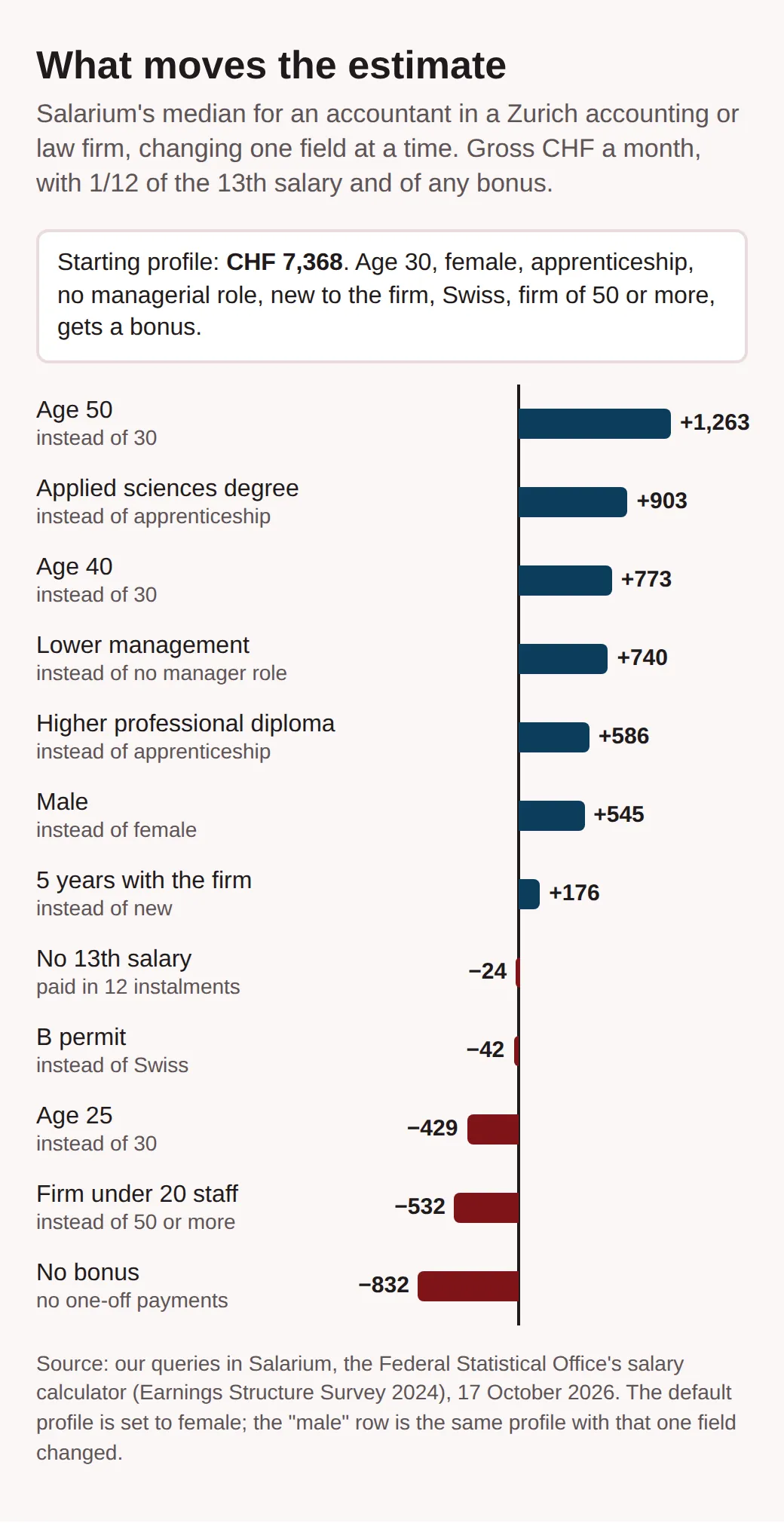
What you bring counts more than you might expect. Higher professional education, such as a federal diploma taken after an apprenticeship, adds CHF 586 a month to the median, and a degree from a university of applied sciences adds 903. If you have a foreign qualification, pick the Swiss level it matches and be ready to explain why.
The size of the employer matters too. The same profile in a firm with fewer than 20 staff comes out CHF 532 lower. That doesn't make a small firm's low offer fair, but it tells you which argument the employer is likely to make.
Leave "years of service" at zero when you're changing jobs. It counts years with the company, so a new hire starts at zero, whatever your experience. Your experience shows up through age and position instead, and through how you describe your work.
The sex field needs a word. Salarium's model includes it because the survey still finds a gap, and switching our profile from female to male raises the median by CHF 545. The Gender Equality Act forbids paying someone less because of their sex, and it names pay explicitly. If you're a woman, run the profile both ways and treat the higher figure as the fair one for the same job.
Residence status works differently from what the raw statistics suggest. In the survey, employees with a B permit and no managerial role earned a median of CHF 5,421 a month in 2024, against 6,765 for Swiss employees without a managerial role, according to the FSO's press release. In Salarium, with everything else held equal, switching our profile from Swiss to a B permit lowers the median by just CHF 42. So in the model, almost none of the raw gap is down to the permit itself. It is not a discount you have to accept for the same work. Now that the estimate fits you, the next step is to make sure you and the employer mean the same thing by "monthly salary".
Is the 13th salary extra money?
In the statistics, no. Salarium's own help text says its monthly figure includes one twelfth of a 13th salary and, if selected, one twelfth of one-off payments such as bonuses. It also says that to get a yearly salary you multiply the monthly figure by 12, not 13. The method note in the FSO's press release defines the survey's standard monthly wage the same way.
Our accountant's median of CHF 7,368 is therefore worth CHF 88,416 a year (7,368 × 12). Paid in 13 instalments, that is CHF 6,801 a month. When we switched the 13th salary field to "No", the median barely moved, from 7,368 to 7,344. In other words, in Salarium's model people without a 13th salary earn about the same per year. They just get it in 12 larger payments.
Here is where newcomers lose money, or ask for too much without knowing it. Suppose you ask for "7,400 a month" because it sits next to the median, and the employer pays 13 salaries. You have asked for CHF 96,200 a year, about 9% above the median, which is defensible but not the modest figure you thought. The reverse trap costs you: an offer of CHF 6,800 × 13 looks almost 600 francs below the median, yet it is the median. Over three quarters of employees (75.9%) received a 13th salary in 2024, so you will meet this often. Our guide to the 13th month salary explains when it is owed and how it is paid in an incomplete year.
One-off payments are a different matter, and they move the figure a lot. Our default profile assumes the person also gets a bonus, a profit share or a similar irregular payment, because that is the most common case for this sector and occupation, and one twelfth of it sits in the monthly figure. Set the "One-off payments" field to "No" and the median drops by CHF 832, to 6,536 a month or CHF 78,432 a year. So check whether the offer includes a bonus, set the field to match, and compare a salary without one against the lower figure.
Either way, the fix is to talk in yearly gross figures and to say which split you mean and whether a bonus is in it. For our profile, bonus included, the useful range reads like this:
| Salarium, accountant in Zurich | Per year | 12 payments | 13 payments |
|---|---|---|---|
| Lower quartile | CHF 77,364 | CHF 6,447 | CHF 5,951 |
| Median | CHF 88,416 | CHF 7,368 | CHF 6,801 |
| Upper quartile | CHF 101,892 | CHF 8,491 | CHF 7,838 |
With the range worked out, check that the bottom of it isn't below what the law or a collective agreement already guarantees.
Check the floor: collective agreements and minimum wages
The Code of Obligations says an employer must pay the salary that was agreed, that is customary, or that a standard employment contract or a collective agreement sets (CO art. 322). A collective agreement, Gesamtarbeitsvertrag (GAV) in German and CCT in French, is a contract between unions and employers that sets pay and hours for a sector. When the Federal Council declares one generally binding, it covers every employer in that sector, member or not. SECO keeps the list of generally binding agreements, from hospitality and the main construction trades to building services, hairdressing and contact centres.
The official career guidance service, berufsberatung.ch, run on behalf of the cantons, advises checking that any offer meets at least the terms of the agreement or standard contract that applies, in its guide to negotiating pay. Two points make that more than a formality. Agreements often set minimums by wage class or training level, as the hospitality agreement does, so the class you're put in matters as much as the amount; a recognised qualification can move you up. And the minimum is a floor, not the going rate: the agreement doesn't stop you from asking for more. Five cantons and the city of Lucerne also set a legal minimum wage, listed in our guide to minimum wages by canton.
If you need a permit and come from outside the EU and EFTA, there is a further check. The law allows foreign nationals to be admitted for work only if the pay and conditions are customary for the place, the occupation and the sector (AIG art. 22). The authorities also check salary and working conditions, according to the State Secretariat for Migration's page on admission, and the canton of Zurich links to Salarium on its page of conditions for third-country nationals. An offer well below the usual range is a problem for the employer's application as much as for you, which is a point you can make politely. Knowing the floor and your range, the remaining question is when to say a number out loud.
When to name a figure
Name it when the employer asks, and make it count most when you have an offer in hand. Before that, a number mostly filters you in or out. After the offer, the employer has chosen you, and that is when a reasoned counter is most likely to move the result.
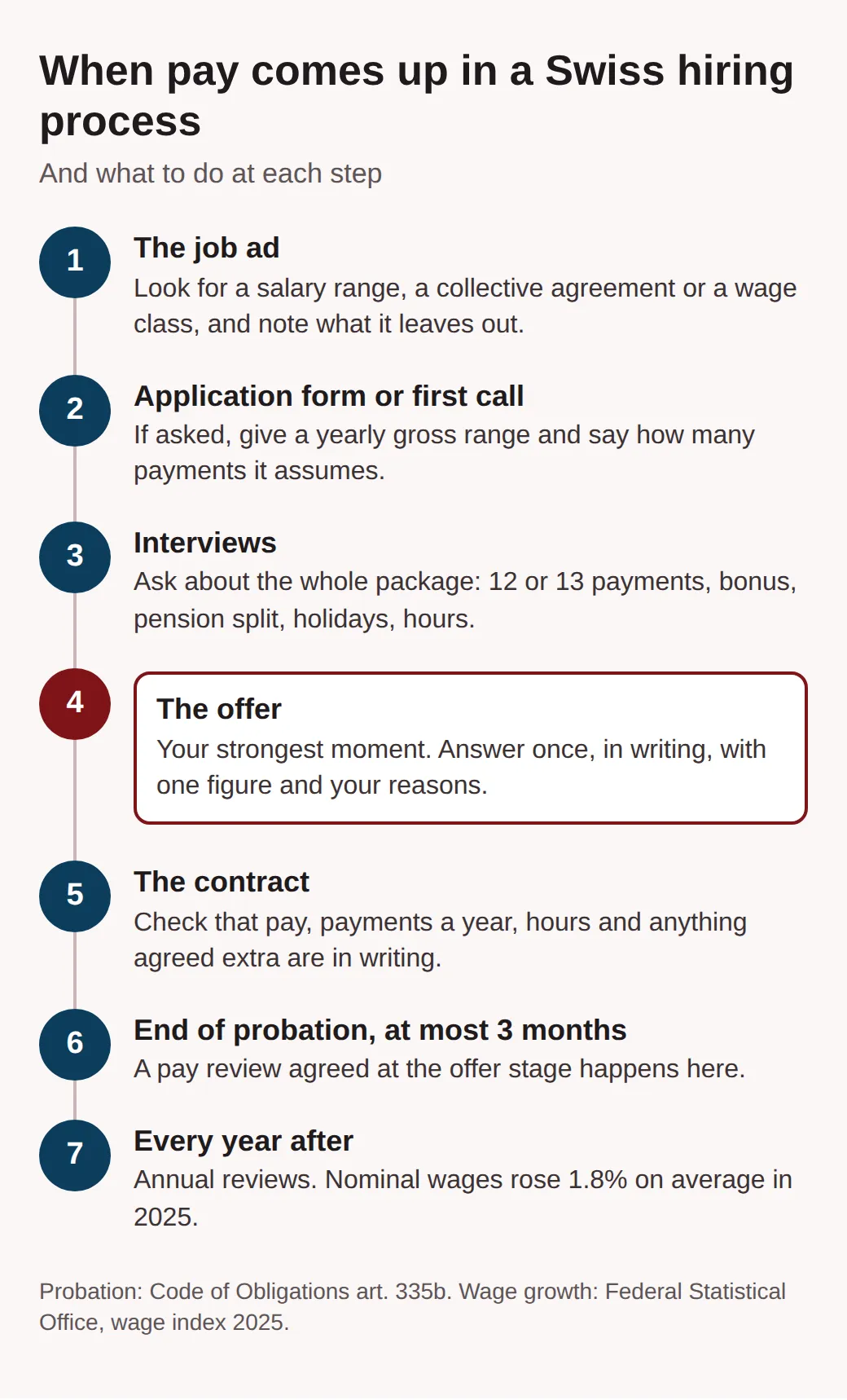
An application form or a recruiter may ask early for your salary expectation, the Lohnvorstellung. Give a yearly gross range and say how many payments it assumes, for example "CHF 88,000 to 96,000 a year, including a 13th salary". If a private employer asks what you earn now, you can answer with what you expect for this job instead; our guide to the Swiss job interview explains why and covers the salary question in the interview itself.
When you do give one figure, set it high in your range. berufsberatung.ch recommends starting at the upper end of a reasonable range, because employers tend to aim for the lower or middle value, and backing it with your experience, training and the tasks you will take on. For our accountant in a job that pays a bonus, CHF 95,000 a year, bonus included, sits between the median and the upper quartile. It is easy to defend with the diploma row from the chart, and it leaves room to settle near 90,000.
Put your counter in writing, briefly, once. Something like this works in English or in the language of the workplace:
Thank you for the offer of CHF 77,000 a year in 13 payments, plus a bonus of about CHF 7,500. Salarium, the federal salary calculator, puts the median for this role in a Zurich firm of your size at CHF 88,416 a year with bonuses included, and at CHF 95,448 for someone with my higher professional diploma. Given my five years of experience in audit preparation, I would ask for a base salary of CHF 87,500 in 13 payments, with the bonus as offered. I am happy to discuss the rest of the package.
Then wait. If the answer on the base salary is no, the conversation isn't over, because a Swiss offer has several other parts with a price.
What else you can negotiate
Most of the package has a legal minimum, and anything above it is open. This is what the law guarantees and what is worth asking for:
| Item | Legal minimum | What you can ask for |
|---|---|---|
| Holidays | 4 weeks a year, 5 under age 20 | A fifth or sixth week |
| Overtime | Paid with 25% extra, unless excluded in writing | Keep the 25%, or time off |
| Pension fund | Employer pays at least half | A plan where it pays more |
| Probation | 1 month; up to 3 by written agreement | One month, and a pay review at its end |
| Bonus | Owed only if agreed | A fixed amount or formula in writing |
The sources are short and worth reading yourself: holidays in CO art. 329a, overtime in art. 321c, probation in art. 335b and bonuses in art. 322d. The pension rule is in the occupational pensions act, which says the employer's contribution must be at least equal to the employees' and can be higher only with its consent. That is why a better split is something you negotiate rather than claim.
Put a price on each item before you trade it against salary. A week of holiday is roughly a fifty-second of your yearly pay in time: for our accountant at the median, about CHF 1,700. A pension split of 60/40 instead of 50/50 on, say, CHF 6,000 of yearly savings contributions leaves you CHF 600 more each year. An overtime clause matters most in jobs with busy seasons; accounting has year-end closing. berufsberatung.ch also names extras such as a paid training course, a travelcard paid by the employer, from a half-fare card to a GA, or flexible hours, and notes they are worth raising precisely when the room on salary is small.
One item is not up for negotiation at all. Your employer must pay all expenses the job makes necessary, and any agreement that you bear them yourself is void (CO art. 327a). Whatever you agree on, the next step is to see it written down.
Get the result in writing
Your employer must tell you in writing, at the latest one month after you start, your function, your salary and any supplements, and your weekly hours (CO art. 330b). Don't wait that long. Before you sign, check that the contract shows the gross salary, whether it is paid 12 or 13 times, the weekly hours and anything extra you agreed: the holiday week, the pension plan, the review date after probation. A promise made on the phone is hard to prove a year later.
Once you sign, the same contract governs how you leave, so read the notice clause too; our guide to notice periods explains the defaults. Agreed pay isn't fixed forever, though, and your first review is the next chance to move it.
Asking for a raise later
A raise is the same exercise with one new piece of evidence: what has happened to wages since. Nominal wages in Switzerland rose by 1.8% on average in 2025 while prices rose 0.2%, so real wages gained 1.6%, according to the FSO wage index. The spread between sectors was wide: 3.3% in public administration, 2.6% in professional, scientific and technical activities, which includes accounting, and only 0.4% in health and social work. In the main collective agreements, the agreed increase for 2025 was 0.9%.
Rerun Salarium with your new age, position and years of service, and bring the result together with what you have delivered. berufsberatung.ch suggests asking after a project has gone well or when your tasks have grown, and avoiding periods of heavy pressure or uncertainty. If the answer is no, ask for the reasons and agree on a date to talk again, in writing.
If you're weighing two offers at once, run each through Salarium on its own terms: the same hours, the same bonus setting and the same number of payments as the contract in front of you. Two offers that look far apart per month can end up close per year once the 13th salary and the bonus are counted. For accounting roles, the finance and accounting jobs on our board are a good place to try it.
Common questions
- Is Salarium the same as SECO's national wage calculator?
- No. Both use the federal Earnings Structure Survey, but SECO's calculator was built to show foreign companies that post workers to Switzerland the customary wages by canton, occupation and sector. Salarium works by major region and takes in more personal details, including sex, nationality and residence status. The two give different results for the same job.
- Does Salarium cover jobs in the public sector?
- Not directly. Salarium is built only on private sector data from the 2024 survey, about 1.7 million employees. For a public job, ask the employer which pay scale and wage class apply, because that is what sets the salary there.
- How do I compare a part-time offer with Salarium?
- Enter your contractual weekly hours in the Weekly hours field rather than leaving the default of 40. Salarium then estimates the pay for those hours: our accountant profile at 32 hours comes out at a median of 5,810 francs a month. The FSO's published wage figures work the other way and convert every salary to a 40-hour week, so to compare an offer with those, scale it up first: 5,600 francs for an 80% job is 7,000 at 100%.
- Should I accept a bonus instead of a higher base salary?
- Only with care. Under the Code of Obligations, a special payment beyond the salary is owed only if it was agreed, so a bonus left to the employer's judgement can shrink or disappear. In 2024 about a third of employees received a bonus, averaging 11,967 francs a year. Salarium can include or exclude one-off payments, so set that field to match the offer before you compare.
More posts
All posts
Jobs in Switzerland for English speakers: fields and cities
One worker in four speaks English on the job in Switzerland, yet only 4% work in English alone. The fields and cities where English is enough, with data.

Work permit in Switzerland 2026: L, B, C and G compared
Which Swiss work permit a job offer gets you: L, B or G by contract length for EU/EFTA citizens, and the test, quota and employer filing for everyone else.

Switch health insurance in Switzerland: 2027 checklist
Switching Swiss health insurance for 2027: the 30 November deadline, the new premiums, and the accident cover you can drop if you work 8 hours a week.