Jobs in Switzerland for English speakers: fields and cities

Where English works
English gets you furthest in data, software and senior international roles, in Zug, Basel, Zurich and Geneva. In 2024, 23.6% of people in work in Switzerland usually spoke English on the job, but only 4% spoke English alone. Healthcare, public service and most trades still require German, French or Italian.
So the honest answer to "can I work in Switzerland in English?" is yes, in a narrower band than the expat guides suggest. Most people who use English at work also use the local language, and the jobs that run entirely in English sit in a handful of fields and cities. We set out where that band is, using two sources: the Federal Statistical Office (FSO), which asks a large sample of residents every year which languages they usually speak at work, and our own count of which job ads on this board are written in English. Where the two agree, you can plan on it.
How many people in Switzerland work in English?
About one person in four. The FSO's Structural Survey found that 1.08 million of the 4.58 million people in work in 2024 usually spoke English at work, or 23.6%. In 2014 it was 18.8%, and in 2010 16.5%. No other language at work gained as many points over those ten years, while Swiss German fell from 65.9% to 60.8%.
If you count anyone who uses English at work even once a year, the figure rises to 38%, according to the FSO's 2026 report Languages at work, which is published in German and French. Most of them use it often: more than half speak English daily or almost daily, and 60% read it that often.
The catch is in the same report. English is rarely the only language in the room:
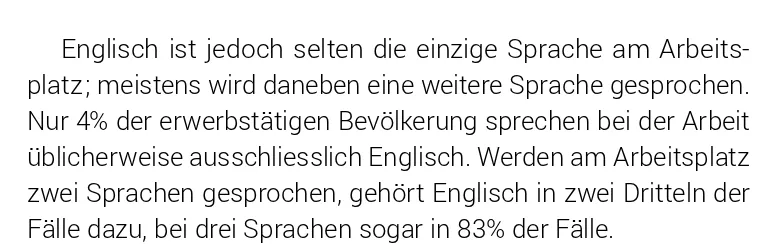
Only 4% of people in work usually speak English and nothing else on the job. Among people who use several languages at work, 44% combine the local language with English, and another 14% add English to two national languages. In practice, then, "English-speaking job" mostly means a team that works in English while the building, the clients and the canteen run in German, French or Italian. That shapes which fields come out on top.
The fields where English is enough
The fields that work in English are the ones built around international teams and university degrees. The FSO doesn't publish English use by industry, but it does by type of job, and the gap is wide. Among managers, 40% usually speak English at work. In the FSO's broader job groups, academic professions and senior staff reach 42.0%, and the liberal professions 38.9%. Then it drops: 16.2% in skilled non-manual jobs and 6.5% in skilled manual work, according to the FSO's table by socio-professional category. In farming and forestry the report finds 3%.
Our board shows the same split from the hiring side. Each listing carries the language the employer wrote it in, and when we counted on 20 October 2026, 5,109 of 163,942 live listings were written in English, or 3.1%. That share sits close to the FSO's 4% who work in English alone, which is probably no coincidence: an employer that writes its ad in English usually expects the job to run in English. Ranked by field, it looks like this:
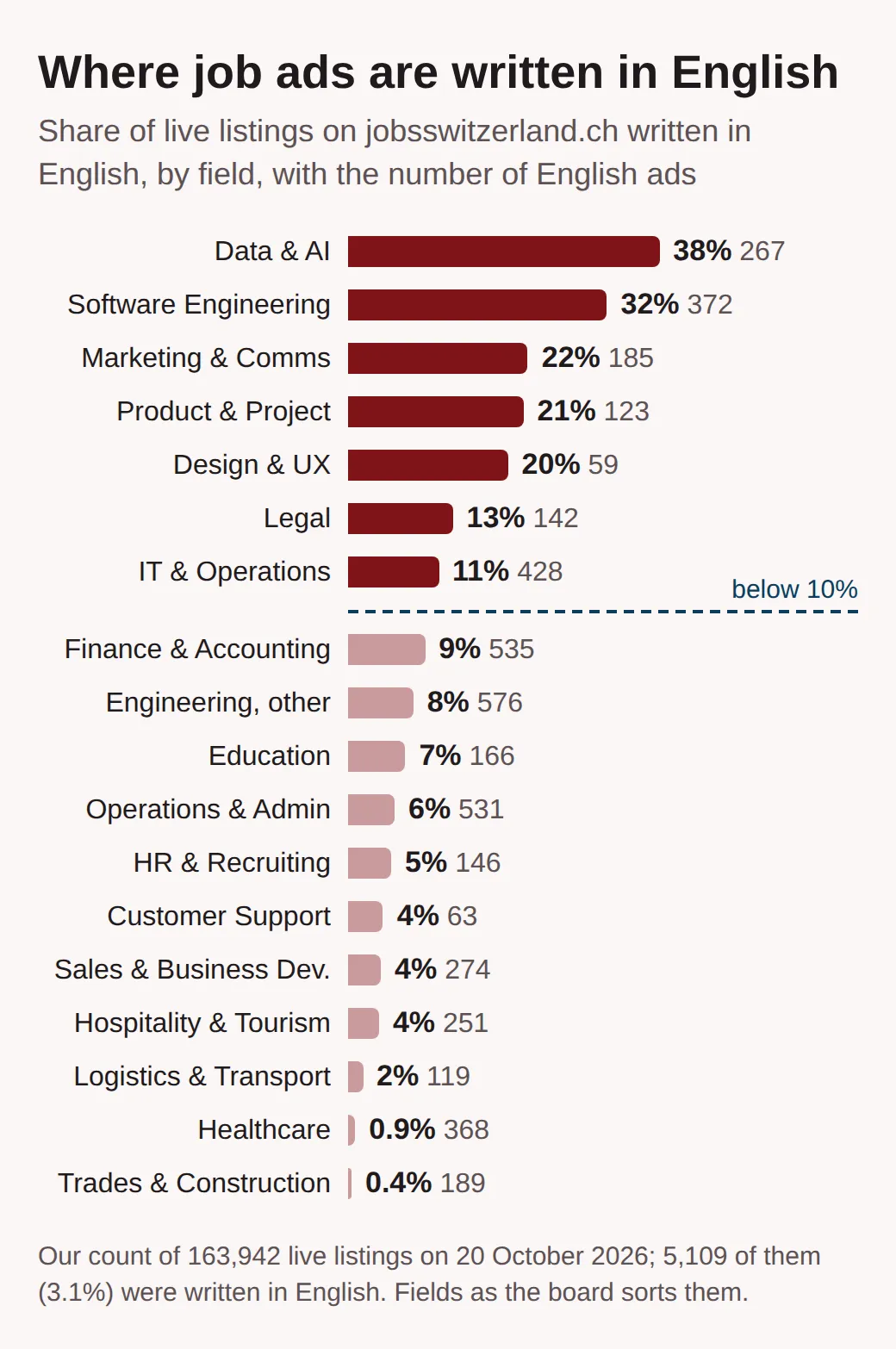
Two numbers matter for each field: the share tells you how normal English is there, and the count tells you how many openings you can actually apply to.
Data and AI
Data and AI has the highest share of English ads of any field on our board: 267 of 702, or 38%. Data science, machine learning and analytics teams work with tools, research papers and code written in English, and many recruit internationally. If you can choose your specialism, this is where English alone is most likely to be enough, even though the number of openings is modest.
Software engineering
Software engineering comes second, with 372 of 1,176 ads in English (32%). The FSO also finds that people in information and communication firms are the most multilingual of all service industries, 44% of them usually using more than one language at work. In our Zurich listings, the employers with the most English ads included Google, On, the University of Zurich, UBS and ETH Zurich. Company size matters here as everywhere: the FSO counts 26.7% of people in firms with 500 or more full-time posts who usually speak English at work, against 19.9% in firms with fewer than 50.
Finance
Finance looks weak by share, 9%, but it has 535 English ads, more than software. The category covers accounting and bookkeeping as well as banking and investment, and 5,120 of its 5,701 ads were in German or French. The FSO puts financial and insurance firms just behind information and communication for multilingual work, at 42%. In Geneva, the employer with the most English ads in our count was an asset manager, Pictet Asset Management.
Outside these three, marketing, product and design run at around one ad in five in English. A surprise sits further down: 368 English ads in healthcare. The employers with the most of them were Lonza, CSL, Roche and Novartis, so these are largely pharmaceutical and biotech jobs, not work with patients. Where the work is with patients, the picture changes completely, as we'll see after the map.
The cities and cantons where English is most common
English at work clusters in four cantons, and they are not the ones with the most jobs. In Zug, 41.7% of people in work usually speak English on the job. In Basel-Stadt it's 40.3%, in Zurich 36.0% and in Geneva 32.2%, against a national average of 23.6%. At the bottom, Jura sits at 7.8%. The FSO counts people by the canton where they live, not where they work, so a canton full of commuters can look higher than its own job market.
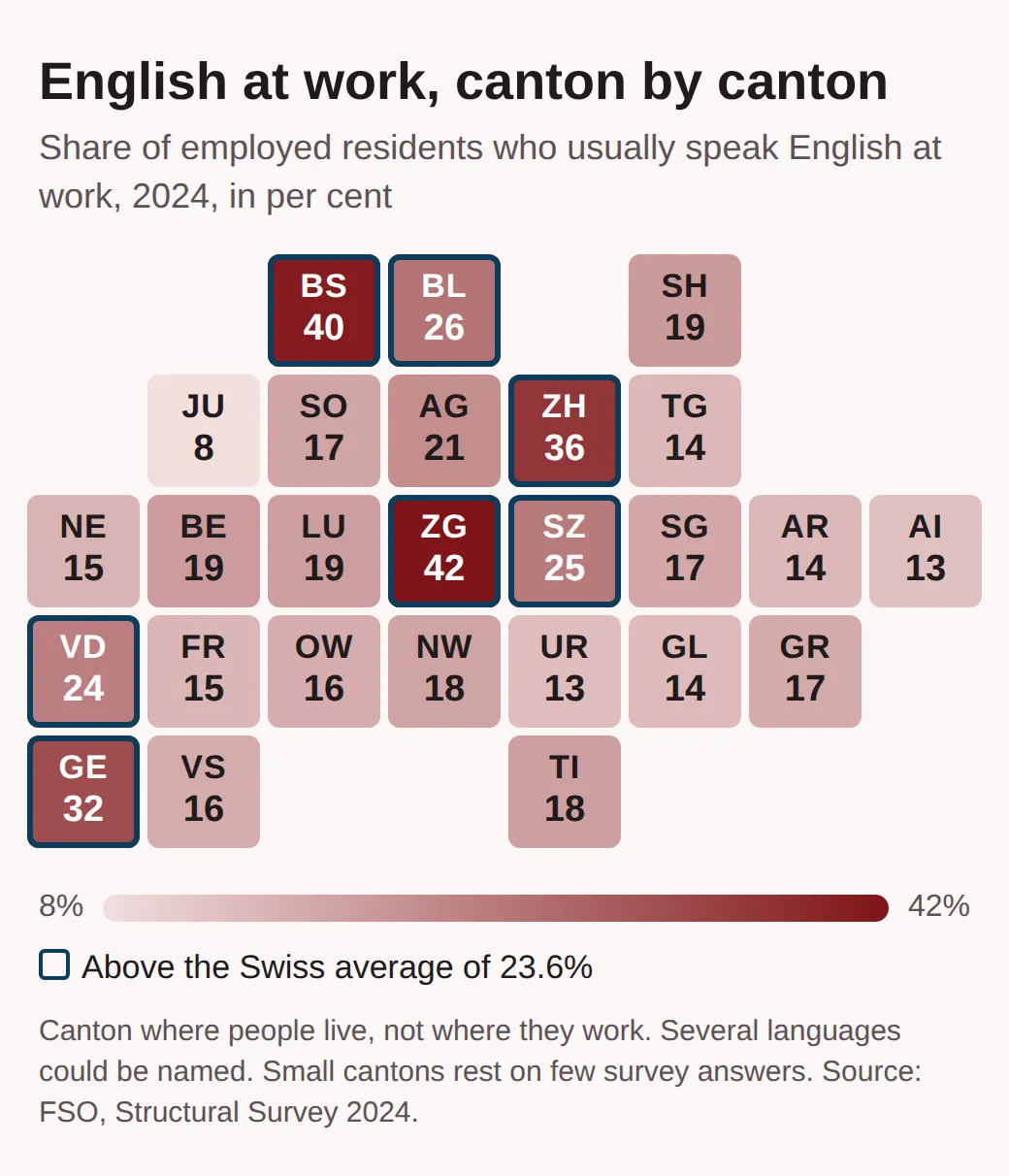
One more pattern from the FSO helps you aim. English is a city language: 27% of people in work in urban areas usually speak it on the job, 19% in intermediate areas and 14% in rural ones.
Our board adds the hiring view, city by city. The shares are lower than the FSO's, because an ad written in English is a stronger signal than English used alongside another language, but the order is telling:
| City | Ads in English | Share of the city's ads | Other ads mostly in |
|---|---|---|---|
| Geneva | 702 | 14.7% | French |
| Basel | 292 | 9.7% | German |
| Zurich | 929 | 9.1% | German |
| Lausanne | 230 | 6.3% | French |
| Winterthur | 54 | 2.0% | German |
| Bern | 95 | 1.8% | German |
| Lucerne | 16 | 0.7% | German |
Zurich has the most English ads in absolute terms, Geneva the highest share. Bern, home of the federal administration, and Lucerne barely register.
Zurich
Zurich is the deepest market for English speakers simply because of its size: 929 English ads out of 10,238 in the city itself, and 1,288 across the canton. Tech firms, banks and the two universities are among the biggest advertisers. Outside these, the city works in German, and in Swiss German once you leave the meeting room.
Basel
Basel-Stadt has the second-highest share of English at work in the country, and the reason shows in our listings. Roche, Novartis and Lonza were the employers with the most English ads in Basel, well ahead of the rest. If you work in chemistry, biology, clinical research or regulatory affairs, Basel is where English goes furthest. Away from the labs, Basel is a German-speaking city with French close by.
Geneva
Geneva had the highest share of English ads in our count, 14.7%, and it is the centre of what the federal government calls International Geneva: 40 international institutions and organisations in the city, 45 in the Lake Geneva region, and around 33,000 international civil servants, diplomats and civil society staff in the region, according to the Swiss mission in Geneva. After Pictet, the employers with the most English ads in our Geneva count were CERN and the encrypted email firm Proton. Still, 91.1% of Geneva residents in work usually speak French on the job, so French remains the language of almost everything around those offices, from your landlord to your child's school.
Zug deserves a word too. It tops the FSO's ranking, but it is a small canton with 3,612 live jobs on our board when we counted, 216 of them in English. Because the FSO counts people where they live, part of Zug's high share may come from residents who work elsewhere, Zurich included.
Where German or French is still a must
Some jobs require a national language by law, and others in practice. The three biggest groups are healthcare, the public sector and the trades.
Healthcare. Anyone working as a doctor, dentist, pharmacist, chiropractor or vet must have the language skills their work needs under article 33a of the Medical Professions Act. The ordinance describes that level in the language you practise in, and the Federal Office of Public Health says it equals level B2 of the Common European Framework. Your employer checks it when you work under supervision, and the canton when you work on your own responsibility. For nurses, physiotherapists, midwives and other health professions, a licence to practise on your own responsibility requires mastering an official language of the canton, under article 12 of the Health Professions Act. The listings reflect it: on our board, 38,145 healthcare ads were in German, 3,182 in French, and 0.9% in English, many of those in pharma.
The public sector. The federal administration requires every employee to have the spoken and written skills in a second official language that their job needs, and managers need good active skills in a second and a passive understanding of a third, under article 8 of the Languages Ordinance. That rules out English alone for federal jobs, and it helps explain Bern's 1.8%. Cantons and communes, for their part, work in their own official language.
The trades and client-facing work. Here it's customers and colleagues, not a federal law, that set the language. Only 0.4% of trades and construction ads and 2% of logistics ads on our board were in English, and the FSO finds that just 6.5% of people in skilled manual jobs and 6.1% of unskilled workers usually speak English at work. Hospitality does a little better, with 3.8% of its ads in English, which still leaves 96% in a national language.
English gets you in, the local language keeps you moving
Even in English-speaking teams, the local language decides how far you get. The FSO finds that 20% of people in work in the German-speaking region usually speak at least German and English on the job, against the 4% nationally who speak English alone. In other words, about four in five people who speak English at work in German-speaking Switzerland use German there too.
The spoken form matters as much as the language. In the German-speaking region, 81% of people in work usually speak Swiss German at work and 45% standard German. Written German in Switzerland is standard German, so a course covers your emails and contracts, while the dialect is what you hear at the coffee machine. Swiss German at work is falling nationally, by five points in ten years, and in firms with 500 or more full-time posts it dropped from 66% to 60%. Those large firms are also where English is most common, so a large employer is the gentlest place to start.
The pattern for your career is consistent across the data. English opens the door in data, software, finance, research and international organisations, mostly in Zurich, Basel, Geneva and Zug. A move to a smaller firm, to client work or to the public sector is where German or French starts to count.
How to find the jobs that work in English
Start by filtering for them. On our board, open "More filters" and set "Original language" to English: you'll see only ads the employer wrote in English, which is the most reliable sign that the team works in English. Combine it with a field and a city from the cards above, and save the search as a job alert so new ads reach you.
Then read the language line in each ad closely. "German is an asset" and "fluent German required" lead to very different interviews. If the ad says nothing, ask in the first call which language the team uses day to day, and whether German or French will be expected later.
Before you apply, check two things that catch English speakers out. Your permit depends on your passport and the contract, which our guide to Swiss work permits sets out. And your CV should follow Swiss habits, including a clear line on your language levels, as our Swiss CV guide explains. Put your German or French level on it honestly, even at A2: in a country where most English speakers also work in a second language, a starting level is a point in your favour, not a weakness.
Common questions
- Is English enough in Lausanne or Lugano?
- Less often than in Geneva. In Vaud, 24.0% of people in work usually speak English on the job, close to the Swiss average, and 6.3% of the Lausanne listings on our board were in English when we counted on 20 October 2026. Ticino sits at 18.3%, and Lugano had only 38 English ads that day, so Italian is the working language almost everywhere.
- If I learn standard German, will I understand my colleagues?
- In emails and documents, yes, because written German in Switzerland is standard German. Spoken German is another matter: in the German-speaking region, 81% of people in work usually speak Swiss German on the job and 45% standard German, according to the Federal Statistical Office. Standard German gets you through meetings, but the dialect at lunch takes extra listening.
- Are part-time jobs in English harder to find?
- Yes, a little. The Federal Statistical Office counts 26.5% of full-time workers who usually speak English at work, against 15.4% of people working less than half time. English is also most common in larger firms and in management and graduate jobs, so search there first if you want a reduced workload in English.
- How does a doctor prove their language level in Switzerland?
- The Federal Office of Public Health accepts an internationally recognised language diploma at level B2 or higher that is no more than six years old. A medical degree or further training taken in that language also counts, as do three years of work in the language within the last ten years. Each language is entered in the medical professions register for a fee of CHF 50 to 100.
More posts
All posts
Work permit in Switzerland 2026: L, B, C and G compared
Which Swiss work permit a job offer gets you: L, B or G by contract length for EU/EFTA citizens, and the test, quota and employer filing for everyone else.

Salary negotiation in Switzerland: use the official data
Negotiate pay in Switzerland with the federal Salarium calculator and GAV minimums: when to name a figure, 12 or 13 payments, and what else you can ask for.

Minimum wage in Switzerland 2026: official rates by canton
Switzerland has no national minimum wage. The official 2026 rates in five cantons and Lucerne, per hour and per month, who is left out and what changes next.