Job interview in Switzerland: rounds, rules and red lines

Before you go in
A Swiss job interview often takes two or three rounds: a first talk by video or phone, a meeting with the manager and team, and for some jobs a test, an assessment centre or a trial day. Be on time, expect a question about your salary, and know the legal line: an employer may only ask what shows whether you fit the job.
That rule is in the Code of Obligations, art. 328b, and it decides more than most interview advice lets on. Read with data protection law, it puts questions about pregnancy, health, debts or a criminal record off limits unless the job gives a special reason, and it keeps your former boss from talking about you until you consent. An unlawful question can even be answered with a polite untruth, without risk to the contract. Below, we follow an interview from the invitation to the answer, using the rules as the federal data protection commissioner, the law texts and the courts set them out.
How many interview rounds to expect
At the large employers we looked at, two or three conversations is the pattern, plus a test for some roles. The steps depend on the job, so the posting is the first place to look. SBB, the federal railways, publishes three typical routes on its careers pages, and they show how differently the same company can hire.
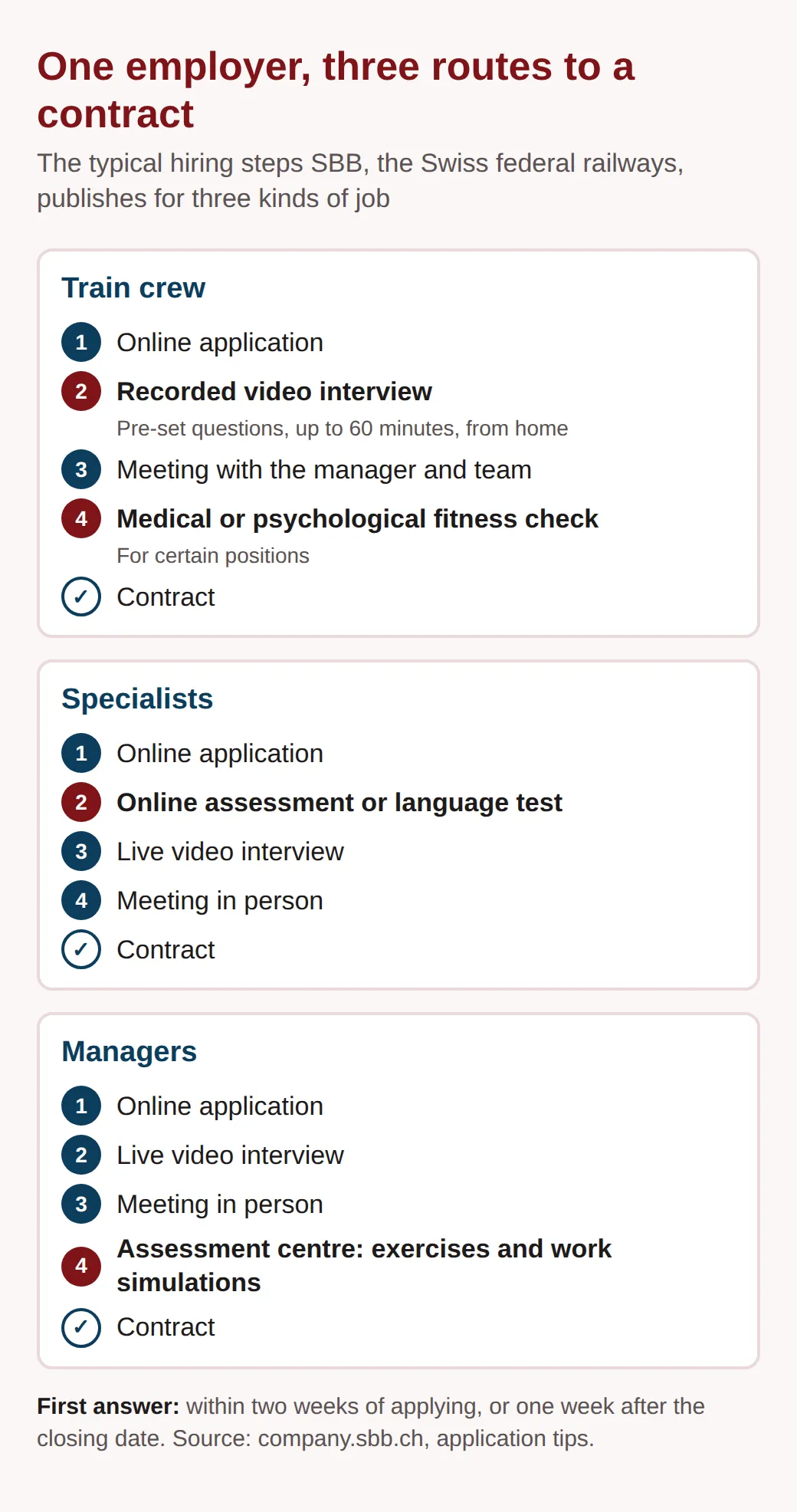
Train crew start with a recorded video interview: pre-set questions, up to 60 minutes, answered from home and recorded. Specialists sit an online assessment or a language test before they talk to anyone live. Managers go through an assessment centre with exercises and work simulations, after the interviews. SBB promises a first answer within two weeks of the application, or one week after the closing date.
The armaments agency armasuisse, part of the federal administration, describes a different sequence: a first interview in person or online, a second one for the candidates who fit, and for some functions assessments, practice days and trial days. Some departments add a third interview. Before you start, a personnel security check runs with your consent.
Whatever the employer, the stage you are invited to tells you what to prepare, which is where we go next.
Preparing for the day
Read the job ad again, then the employer's own site, and write down the questions you want to ask. That is the core of the advice from berufsberatung.ch, the official career guidance service run on behalf of the cantons. It adds three points worth keeping: plan your route, be punctual and greet your interviewer by name, and practise the conversation once with someone you trust.
Punctuality is easy to plan for here, because public transport timetables are precise to the minute. Check the connection the evening before, leave with a margin, and if you will be late after all, phone before the appointed time, not after it. For a video interview, test the link, camera and sound with the same device you will use.
Bring copies of what you sent: your CV, diplomas and the work references from past employers. In Switzerland these written references, called Arbeitszeugnis in German or certificat de travail in French, carry real weight, and any employee can ask for one at any time (CO art. 330a). If you come from abroad, bring your permit or ID as well. Before your first day, the employer must check that you are allowed to work in Switzerland, by looking at your permit or asking the authorities (Foreign Nationals and Integration Act, art. 91). Questions about your permit are therefore fair game, and a clear answer helps you.
Expect the classic questions about your career, why you want to move and what you know about the company. Those are allowed. The harder question is which ones are not.
What an employer may ask you, and what it may not
The test is relevance to the job. Art. 328b CO lets an employer process data about you only so far as it concerns your suitability for the job or is needed to carry out the contract. The Federal Data Protection and Information Commissioner, known as FDPIC in English and EDÖB in German, spells out what that means for interviews on its page on the phases of the employment relationship.
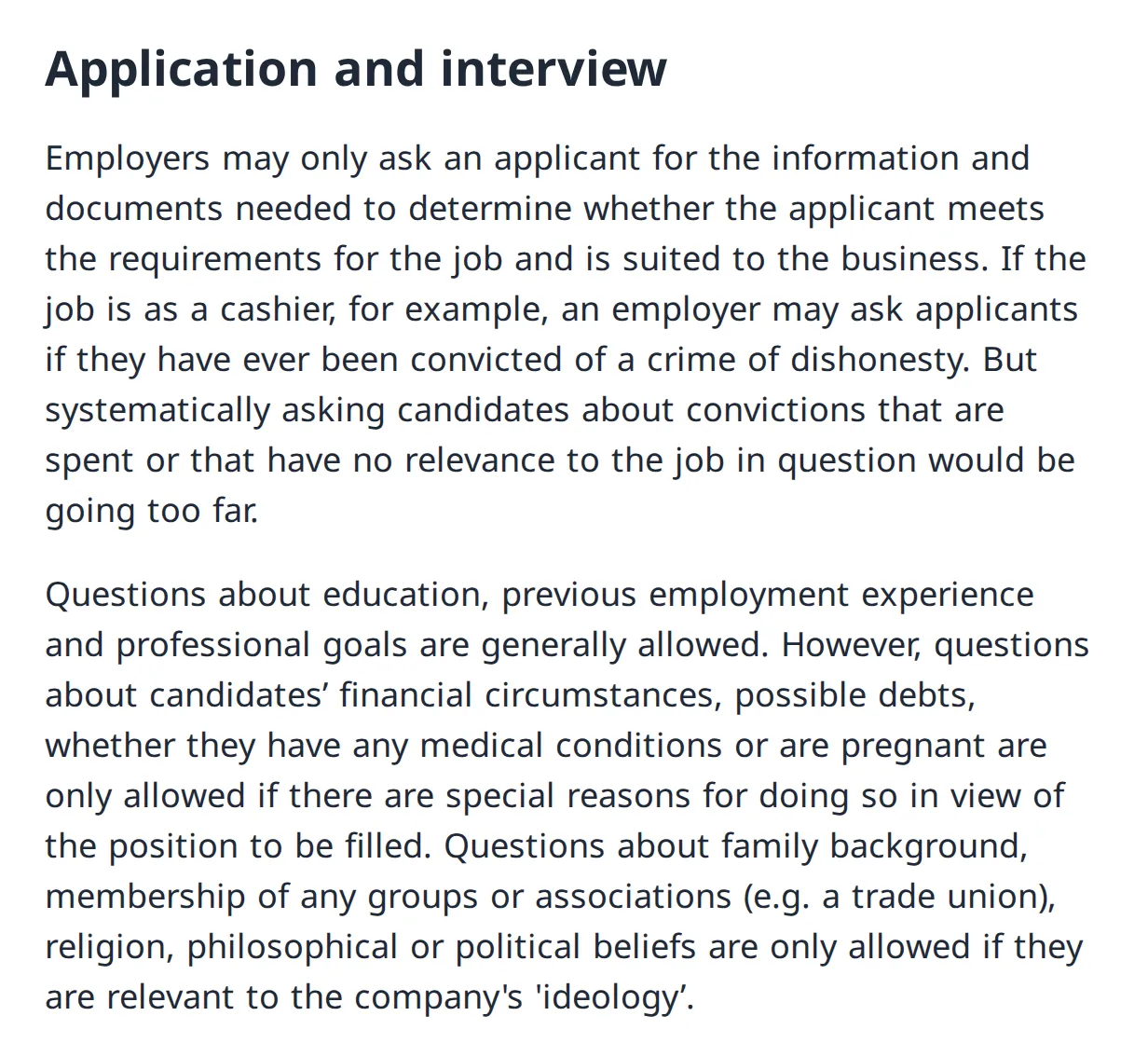
In short, the questions fall into three groups:
| Topic | Can they ask? |
|---|---|
| Education, career, professional goals, start date | Yes, as a rule |
| Income and debts, health, pregnancy, criminal record | Only for a special reason linked to the job |
| Origin, religion, politics, union or association membership | Only if the employer has an ideological purpose |
The middle row is where the details matter, so here is how each topic plays out.
Pregnancy, family plans and health
A pregnancy question is in itself a form of sex discrimination, the FDPIC's 2014 guide on personal data at work says. It is allowed only where the work would endanger the mother or the unborn child, or where a pregnancy makes the work impossible; the guide's examples are models and dancers. The canton of Bern's equality office adds questions about family planning and childcare to the list of what is generally not allowed. The Gender Equality Act backs this up: no one may be disadvantaged in hiring because of their sex, and that includes being turned down because of marital status, family situation or a pregnancy.
On health, the 2014 guide says the employer should not make its own enquiries. It may have a doctor assess whether you are fit for the job, but the doctor is bound by confidentiality and may only report fit or not fit, never a diagnosis. Health forms for the insurance that pays a daily allowance when you are ill are for the insurer; the guide says the employer must have no access to them.
A criminal record or debts
Asking every applicant about past convictions goes too far, the FDPIC says. A targeted question can be fine: an employer hiring a cashier may ask whether you were ever convicted of an offence involving dishonesty. Some jobs need an official extract from the criminal record. The ordinary extract for private persons costs CHF 17 and takes about two working weeks to process. For work with regular contact with children, other vulnerable people or patients, there is a special private extract (Sonderprivatauszug), which shows bans on working with them. You can only order it with a code from the employer or organisation that needs it, so a school, a care home or a hospital asking for one is doing what the system intends.
Origin, religion and politics
These questions belong only to employers with an ideological purpose, such as a church, a party or a union, where shared beliefs are part of the job. For everyone else, your religion, your politics and whether you are in a union are none of their business.
When a question crosses the line
You don't have to answer it, and you may even answer it falsely. The FDPIC's 2014 guide says so in plain words: since it is rarely possible to refuse a question in an interview, applicants have the right to give a false answer to an unlawful one so that they suffer no disadvantage, the so-called Notwehrrecht der Lüge, the right to lie in self-defence. A false answer to an unlawful question does not let the employer cancel the contract later for deliberate deception under art. 28 CO.
The right cuts one way only. Lawful questions must be answered truthfully, and the same guide says you must volunteer facts the employer can take for granted even without asking: a driver who has lost their licence, or a long hospital stay planned shortly after the start date. False answers there let the employer challenge the contract and claim damages.
In practice, a calm deflection is often easier than a lie. Something like this keeps the conversation going:
I'd rather keep my family plans private. What I can tell you is that I'm available from 1 February, at the workload in your ad.
The guide is from 2014 and predates the current Data Protection Act of 2023, but it is still published by the commissioner, and on the interview questions that the commissioner's current page also covers, the two agree. With the boundaries clear, the question you are most likely to face is the one about money.
The salary question
Expect it, usually as "What are your salary expectations?". The data protection officer of the canton of Zurich, writing about public employers, calls questions about salary expectations and the start date unproblematic. The same officer also accepts a question about your current income from a public employer. For private employers the FDPIC is stricter: its German text lists income (Einkommen) among the questions that need a special reason. So with a private employer, you can answer with what you expect for this job rather than what you earn now.
Give a gross annual figure and say whether you mean 12 or 13 payments, because "6,000 a month" can mean CHF 72,000 or 78,000 a year. Our guide to the 13th month salary explains how the extra payment works. To check whether your figure is realistic, the Federal Statistical Office's Salarium calculator estimates the monthly pay for a job by region, sector, occupation, age and training. Some cantons also set a legal minimum wage; our page on minimum wages by canton has the rates and who they cover.
Finally, the advice from berufsberatung.ch is worth repeating here: don't accept on the spot, and take at least 24 hours to think it over. Some employers then ask you to prove yourself in a test or a trial day.
Tests, assessments and trial days
Tests are allowed, within limits. Graphology, psychological and personality tests and assessment centres must serve the purpose of the hiring, be run and scored by professionals, and only take place with your consent, according to the FDPIC's 2014 guide. You should be able to understand what a test is meant to show, and you are entitled to see your results. A handwriting analysis must be announced in the job ad; an employer may not quietly run one on a handwritten letter. Genetic tests are ruled out, apart from narrow safety cases.
A trial day is a different thing from a test, and it can be paid work. Under art. 320 CO, an employment contract exists as soon as an employer accepts work that, in the circumstances, one would only expect to do for pay, even without a written contract. SRF's consumer programme Espresso put it simply in a legal answer: if a company has you work on a trial day, it must pay you the usual wage for the place and the trade, unless it said beforehand that the day is unpaid or only covers expenses. A day that is only for getting to know the company, without real tasks, is not paid. So ask before you go: "Will I be working, and is the day paid?"
Once the tests are over, the employer usually wants to hear from someone who has worked with you.
References: nobody calls without your consent
An employer must have your consent before asking anyone about you, including your current or former employer, and those employers may not answer without it. The FDPIC is explicit on this. Even with consent, a former employer may only speak about what matters for the new job, such as your performance and conduct at work. It may not show your personnel file, and it may not reveal the terms of your old contract, because that could badly weaken your position as an applicant.
In practice, you control the list. Name two or three people who know your work, ask them first, and tell them what job you are going for. If you are still employed and haven't told your boss, say clearly that your current employer may only be contacted once you have an offer. Your written Arbeitszeugnis often does much of the work anyway, since it already records your performance and conduct.
After the interview
Follow up once if you hear nothing in the time the employer named. If you are turned down, the FDPIC says your documents must be returned and copies destroyed. They may be kept until a date fixed in advance if you agree, and in some cases without your consent where the company has an overriding interest, but then it must tell you. What belongs to the employer, such as the answers it got from your references, is destroyed too. You can also ask any employer which data it holds about you, from interview notes to test scores. Under the Data Protection Act, art. 25, that answer is free and normally comes within 30 days.
Video screening adds one more right. If a rejection is based solely on automated processing, for example software scoring a recorded interview with no person involved, the employer must tell you, and you can ask for a person to review the decision, unless you expressly agreed to the automated process (art. 21). Most rejections, though, are simply human, and sometimes for the wrong reason.
If you think you were rejected for being pregnant or a parent
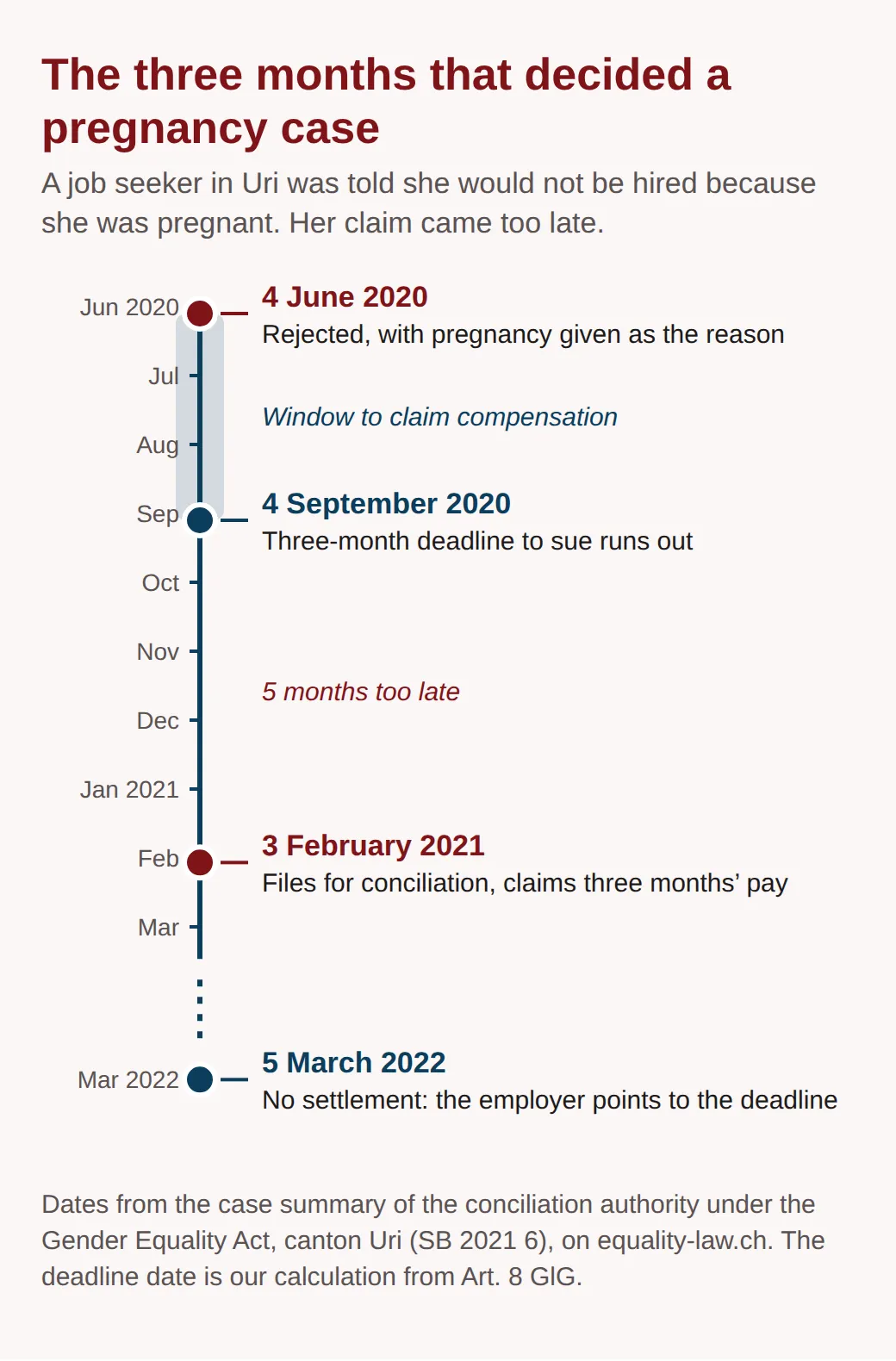
You can claim compensation, but the clock starts the day you hear the news. Under the Gender Equality Act, a person rejected for a job who believes it was discrimination can ask the employer for the reasons in writing (art. 8). The claim must reach a conciliation authority or a court within three months of the rejection, and the compensation is capped at three months' wages of the job (art. 5). You don't get the job itself.
The deadline is strict, as a case from the canton of Uri shows. A woman was told on 4 June 2020 that she would not be hired because she was pregnant, with the reason stated. She filed her claim on 3 February 2021. The employer refused to settle because the three months had long passed, according to the case summary in the database of the Swiss Conference of Gender Equality Officers.
A case from Solothurn, decided in 1998 and 1999, shows what a timely claim can bring. A management assistant had her interview at a construction firm cancelled at short notice because, as a mother of preschool children, she was "not suitable". She asked for written confirmation, and the firm put its reason on paper. The labour court found the reason discriminatory, and the higher court, calling it a typical example of indirect discrimination, upheld the ruling: she received two months' wages, CHF 11,483, plus part of her legal costs.
Two cost rules matter before you start. Disputes under the Gender Equality Act carry no court fees, at the conciliation stage or in court (Civil Procedure Code, art. 113 and 114). In court, though, you can be ordered to pay part of the other side's lawyer if you lose part of the claim: a woman who applied to be a hotel receptionist in Graubünden won CHF 1,000 from the hotel, which wanted a man for the job, and was ordered in the same ruling to pay CHF 1,000 towards the hotel's costs. She appealed, lost, and owed the hotel another CHF 2,000. Unlike in disputes about pay, the law gives you no easing of the burden of proof for hiring, so evidence counts. The equality offices' guide to the act lists what to keep: the job ad, your application, the rejection letter, your request for the reasons and the employer's reply. The cantonal conciliation authorities and equality offices give free advice before you file, though not every canton has an equality office.
Your next interview
Before you go, write down three things: your salary figure as a gross annual amount, the two or three people you are happy for the employer to call, and the one sentence you will use if a question goes too far. Ask whether a trial day is paid before you agree to it, and take a day to think before you accept. Then the interview is about what it should be about, your work.
If you are still looking for a role to apply for, start with the full-time jobs on our board.
Common questions
- Do the same rules apply when the employer is a canton or a city?
- Mostly, but under a different law. A cantonal or municipal employer follows its canton's data protection act rather than the federal one. The data protection officer of the canton of Zurich applies the same test: questions must be suitable and necessary to judge whether you fit the job, and questions about debts, illness or criminal convictions need a special reason.
- Can an employer keep my CV for a future opening?
- As a rule, only with your agreement and only until a date set in advance. After a rejection, the federal data protection commissioner says your documents go back to you and copies are destroyed. A company with an overriding interest may sometimes keep them without your consent, but it must tell you. If you would like to be considered again, say so in writing and agree on how long they may keep the file.
- Do I have to tell my new employer I am pregnant once I have signed?
- Not as a rule. The union Unia states that you have the right to keep a pregnancy to yourself. You must tell your employer if you can no longer do the work as usual or if the work puts your health or the baby's at risk. Unia still advises telling your manager early, so the work can take your health and the baby's into account.
- Does a rejected applicant get a reason?
- Swiss law gives you a right to one in a specific case. If you believe you were turned down because of your sex, your pregnancy or your family situation, the Gender Equality Act lets you ask the employer for the reason in writing. Asking costs nothing and the answer is useful evidence, so ask soon after the rejection.
More posts
All posts
13th month salary in Switzerland: who is owed it and when
No Swiss law requires a 13th month salary, yet three in four employees get one. Who is owed it, when it is paid, pro rata rules, tax and bonuses.

Minimum wage in Switzerland 2026: official rates by canton
Switzerland has no national minimum wage. The official 2026 rates in five cantons and Lucerne, per hour and per month, who is left out and what changes next.