Maternity leave in Switzerland: 14 weeks, pay cap, your job
Before the baby arrives
Swiss law gives employed mothers 14 weeks of leave after the birth, paid at 80% of their earnings up to CHF 220 a day, provided they were insured for nine months and worked for five of them. The other parent gets two weeks within six months. Once your probation period is over, your employer cannot give you notice from the start of the pregnancy until 16 weeks after the birth.
Those are the federal minimums, and they are all the law guarantees. Many guides mix them with one company's policy or one insurer's product, so it is hard to see which part you can count on. We keep the two apart: first what the federal Loss of Earnings Compensation Act (EOG) and the Code of Obligations give everyone, then what Geneva and some employers add, and finally what changes on 1 July 2027.
Who qualifies for the 14 weeks of paid leave?
You qualify if three things are true on the day your child is born, as set out in article 16b EOG. You were insured under the Swiss old-age insurance (AHV) for the nine months right before the birth. You worked for at least five of those months. And at the birth you are an employee, self-employed, or working for a cash wage in your spouse's business.
A few details decide many real cases:
- Coming from abroad. Insurance and work periods in an EU or EFTA country and in the United Kingdom count towards the nine and five months, according to the AHV/IV leaflet 6.02 on maternity allowance. If you moved from the US or India four months before the birth, you do not meet the condition.
- A premature birth. The nine months shrink to six, seven or eight if the baby comes before the seventh, eighth or ninth month of pregnancy.
- Part-time work. Any job counts. The allowance is then 80% of your part-time pay.
- Unemployment or illness. You still qualify if you were drawing daily unemployment benefits until the birth, or if sickness or accident insurance was paying you a daily allowance based on your former salary.
- A stillbirth. The mother is entitled to the allowance if the pregnancy lasted at least 23 weeks, under article 23 of the ordinance (EOV).
What if you don't qualify, typically because you arrived from outside Europe less than nine months before the birth? You still have the right to 14 weeks off (CO art. 329f), and you still may not work for eight weeks. The federal allowance just doesn't pay for them. Your employer may then owe you your salary for a limited time under the sick pay rule of the Code of Obligations, which is three weeks in the first year of service and longer after that. A Federal Council report from 2016 calls this "practically generally recognised". If you are in this position, raise it with your employer before the birth rather than after.
How much maternity pay you get
The allowance is a daily amount of 80% of your average earnings before the birth, capped at CHF 220 a day (article 16f EOG), the ceiling in force since January 2025. It is paid for 98 days, seven days a week. For employees the daily figure is the monthly salary divided by 30, which means the cap bites at a gross salary of CHF 8,250 a month. Above that line, every mother gets the same maximum of CHF 21,560 for the 14 weeks.
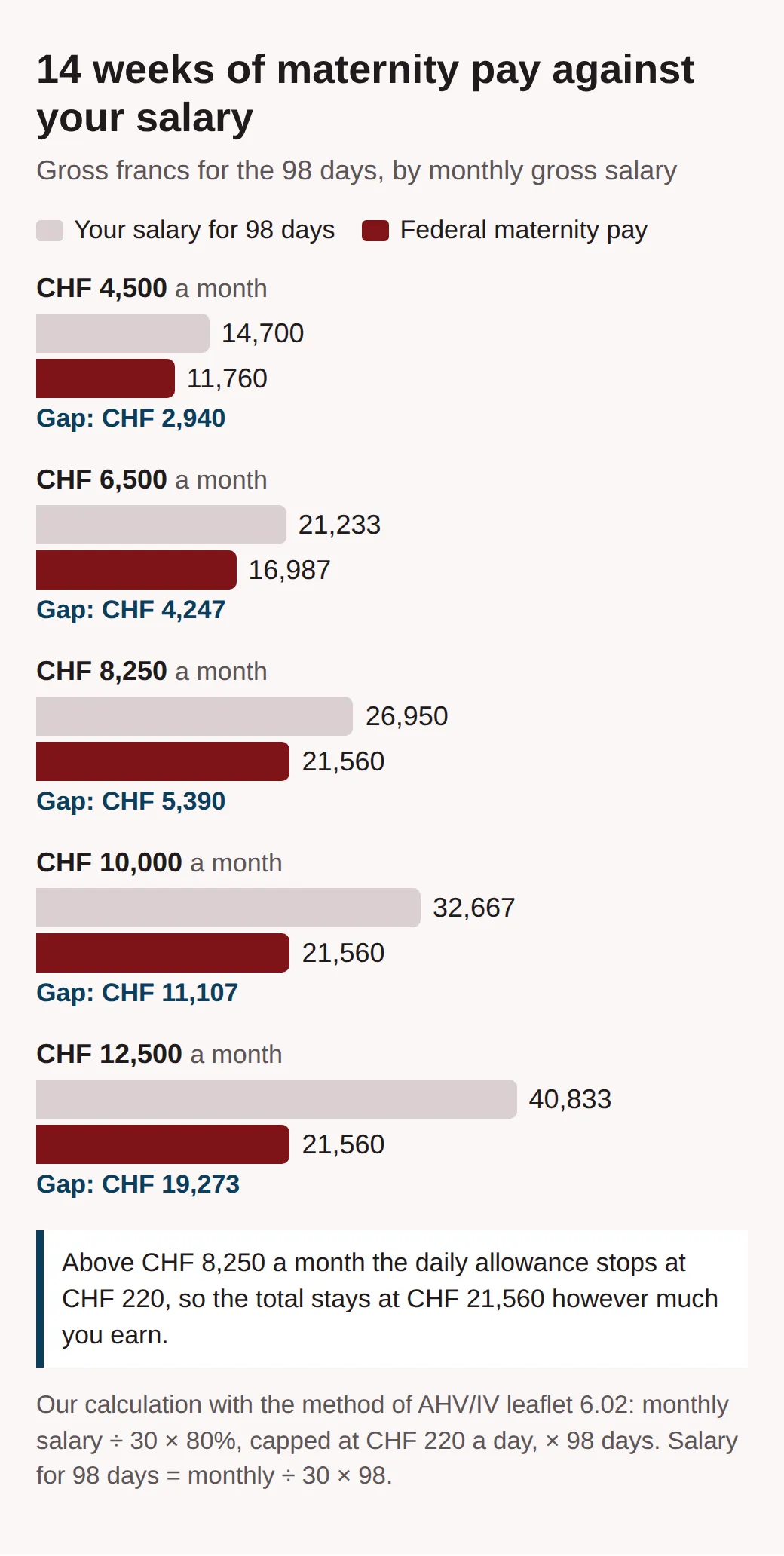
So on a salary of CHF 6,500, the 14 weeks bring in about CHF 4,250 less than you would have earned. On CHF 12,500 the gap is more than CHF 19,000. Both amounts are gross: AHV, disability and EO contributions come off the allowance like off a salary, and so does unemployment insurance if you are an employee. Our gross to net guide shows how those deductions work.
The leaflet adds a warning worth reading twice: taking unpaid leave or cutting your hours before the birth can lower the allowance, because it is based on what you earned just before. If you plan to go part-time, the timing matters.
Does your employer have to make up the difference? Under federal law, no. When the allowance was introduced in 2005, Parliament took the word "birth" out of the sick pay rule, and the Federal Council report explains that this is commonly read as ending the employer's duty to pay wages for the time after the birth. Any top-up comes from your contract, the staff regulations or a collective agreement. If your employer keeps paying your salary, the allowance goes to the employer instead of to you.
The paperwork is light. Your employer fills in its part of the claim form, number 318.750 on ahv-iv.ch, and sends it to its compensation office. You have five years after the end of the leave to claim, after which the right is lost. Your pension fund cover continues on your previous salary, and you stay insured against accidents through your employer.
The first eight weeks are a ban, not a choice
For eight weeks after the birth, nobody may employ you, even if you want to work. From week nine to week 16 you may work only if you agree (Labour Act art. 35a). The ban protects your health. The pay rule then adds a catch: the allowance ends the day you go back to work, even for a few hours a week (article 16d EOG). Going back part-time at the start of week ten costs you the last five weeks of pay.
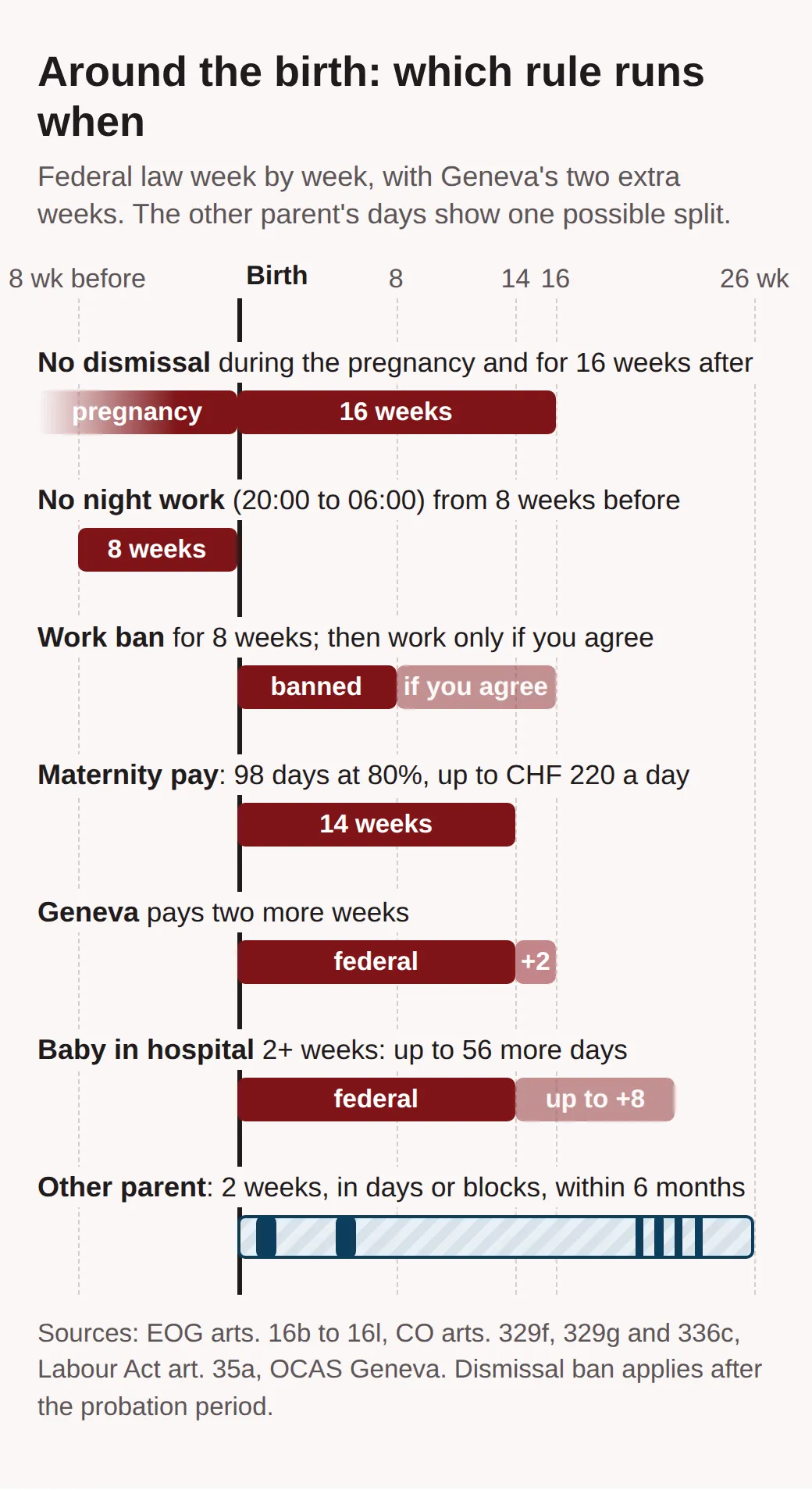
Weeks 15 and 16 are a gap that is easy to miss. Your employer still cannot make you work, but the federal allowance has stopped after day 98, and no federal rule pays those two weeks. Geneva does, and so do some employers, as the examples further down show.
If your baby has to stay in hospital for at least two weeks straight after the birth, you can push the pay back: the allowance is extended by the days in hospital, by up to 56 days (article 16c EOG). The condition is that you had already decided, at the birth, to go back to work after the leave, and you have to prove it with the claim form, a medical certificate and evidence of your return. Your leave and your protection from dismissal are extended for the same time.
Can you be fired while pregnant in Switzerland?
Not by ordinary notice, once your probation period is over. CO art. 336c forbids your employer from giving notice during the whole pregnancy and for 16 weeks after the birth. A notice given during that time is void. It counts from the start of the pregnancy, even if you did not know about it yet.
If you received notice before you became pregnant, the notice period stops running during the protected time and resumes afterwards. Where the contract ends on the last day of a month, the end moves to the next month end. A notice period with two months left at the start of the pregnancy therefore ends about two months after week 16, not before the birth.
The protection has limits that many guides leave out:
- During probation there is no ban, though a dismissal because of a pregnancy can still breach the Gender Equality Act.
- A fixed-term contract ends on its agreed date. Nobody gives notice, so the ban has nothing to stop.
- Dismissal with immediate effect for a serious breach (CO art. 337) is a separate rule and not covered.
- Your own resignation is always possible. The ban binds only the employer; our guide to notice periods covers the rules if you decide to leave.
At work, the Labour Act protects you in other ways too. You may not be made to work more than your usual hours, and never more than nine a day. From the sixth month, standing work is limited to four hours a day (ordinance 1 to the Labour Act, art. 60 and 61), and from eight weeks before the birth you may not work between 20:00 and 06:00. If your job is dangerous or strenuous for you or the baby and your employer cannot give you equal work, you are owed 80% of your salary while you stay away. You may also stay home or leave work on simple notice; your pay continues under the sick pay rules when a doctor certifies you cannot work, so get a certificate rather than assume. After the birth, time to breastfeed or pump in the first year counts as paid work time: at least 30 minutes on a day of up to four hours, 60 minutes on a longer day and 90 minutes on a day over seven hours.
If you are asked about a pregnancy in a job interview, our guide to the Swiss job interview explains what an employer may and may not ask.
Paternity leave: two weeks for the other parent
The other parent gets two weeks of paid leave, which must be taken within six months of the birth (CO art. 329g). That is the legal father, including a man who becomes the legal father within those six months, or the mother's wife where she is the child's other legal parent. The pay conditions match the mother's: nine months of AHV insurance and five months of work before the birth, as the AHV/IV leaflet 6.04 on the allowance for the other parent explains.
The leave is 14 daily allowances at 80%, with the same cap of CHF 220 a day. Taken as two weeks in a row, that is 10 working days plus the weekends. You can also take single days: every five days paid add two more allowances, so ten separate working days still bring all 14. For part-time staff, the employer can count the days by the level of employment. On a salary of CHF 8,250 or more, the two weeks pay the maximum of CHF 3,080, paid after your last day off, to your employer if it keeps paying your salary. Your employer claims it with form 318.747.
Days you have not taken when the six months end are lost. If the child dies, the right ends too, under the rules that apply until mid-2027.
The other parent has weaker protection than the mother. In the normal case there is no ban on dismissal. Instead, if your employer gives notice before you have used the two weeks, your notice period is extended by the days you still have (CO art. 335c para. 3), and your employer may not cut your holidays because of the leave. If the mother dies on the day of the birth or within 97 days after it, the other parent gets 98 extra daily allowances, taken in one block from the day after her death, and cannot be given notice during that leave.
Geneva's 16 weeks and higher cap
Article 16h EOG lets cantons pay more or for longer, and Geneva does. A mother who has worked in the canton for at least five months at the birth gets 16 weeks: the first 14 from the federal scheme, then two more from the cantonal one, as the canton's social insurance office, OCAS, explains. Geneva also tops up the daily amount, to a minimum of CHF 69 and a maximum of CHF 329.60. OCAS gives no salary figure for that ceiling; by our own calculation, at 80% and with the federal method of dividing the monthly salary by 30, it is reached at about CHF 12,360 a month.
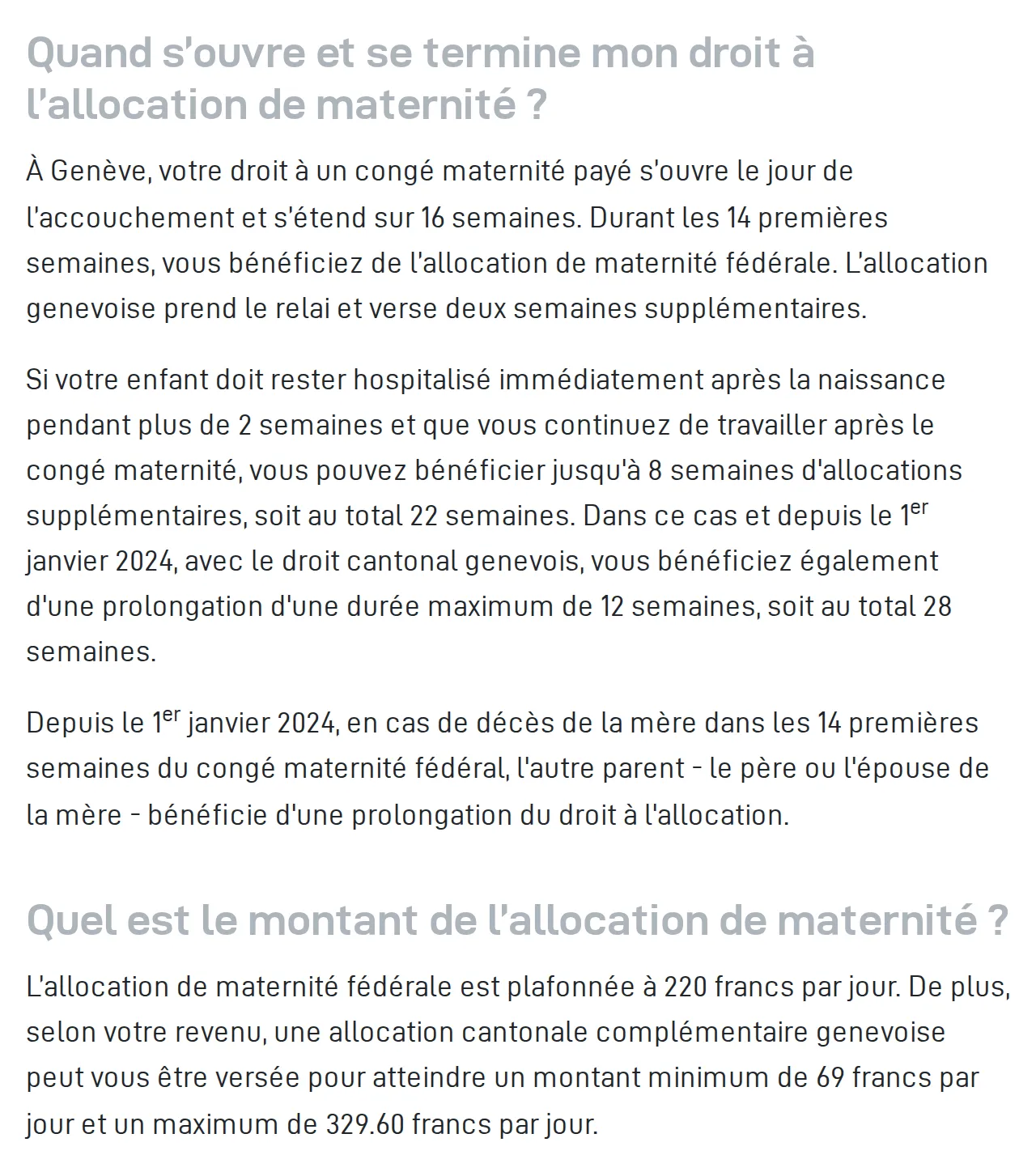
Geneva's rules on a long hospital stay go further too. Where the baby stays in hospital for more than two weeks after the birth and you return to work afterwards, the federal pay is extended by up to eight weeks, to 22 weeks in all. Since 1 January 2024, Geneva's own extension of up to 12 weeks brings the total to as much as 28 weeks. The cantonal part of the allowance carries no social insurance contributions.
For fathers and the mother's wife, Geneva's page on the other parent's allowance lists no cantonal supplement. It gives the federal two weeks, capped at CHF 220 a day, and adds a point worth knowing: unlike the mother's pay, the other parent's allowance cannot be postponed while the baby is in hospital.
What employers and collective agreements pay on top
Here the range is wide, and the only way to know is to read your own contract, staff regulations or collective agreement (GAV). Three examples show the spread.
The federal government gives its own staff well above the minimum. Under the federal personnel ordinance, employees get four months of maternity leave on full salary and may start it up to two weeks before the due date. Fathers get 20 paid working days within six months, and so does the other spouse in a same-sex marriage.
Swisscom's collective agreement, in force since 1 January 2024, gives 20 weeks of maternity leave at 100% of base salary, four paid weeks for fathers and for the mother's wife or partner, plus four unpaid weeks. If both parents work at Swisscom, they share 24 paid weeks, of which the mother must take at least 16 right after the birth. The agreement's text runs to the end of 2026 and continues to the end of 2027 unless one side asked to renegotiate, so check the version in force when your child is born.
In hotels and restaurants, the national collective agreement adds nothing. Its article 24 was repealed when federal maternity pay began, and the commentary says the EO rules apply and each employer is free to offer more. What the agreement does set is a daily sickness insurance paying 80% of gross salary, which covers you when a doctor says you cannot work during the pregnancy.
Before the birth, ask your HR team for the written policy rather than relying on what a colleague got. A short email is enough:
Dear [name], I am expecting a child in [month]. Could you send me the rules that apply to my maternity leave: how many weeks, what share of my salary you pay, whether I can add unpaid leave, and whether I can return part-time? Thank you.
What changes on 1 July 2027
Parliament passed a revision of the Loss of Earnings Compensation Act on 19 December 2025 (BBl 2026 29). The referendum deadline of 17 April 2026 passed without a referendum being called, and on 26 August 2026 the Federal Council set 1 July 2027 as the date it takes effect. The 14 weeks, the 80% and the CHF 220 cap do not change. What changes are the cases where something goes wrong:
- The mother's own hospital stay counts. Today only the baby's stay can extend the pay. From July 2027, a stay of at least two weeks by the mother or the baby, starting within two weeks of the birth, extends it.
- No more 56-day limit. The pay is extended for as long as the hospital stay lasts.
- The other parent keeps the two weeks if the child is stillborn or dies within 14 days of the birth. Today the right ends.
- Extra days for the other parent while the mother is in hospital for at least two weeks within 97 days of the birth: one extra daily allowance per day in hospital, up to 84.
- New allowances during the leave: a childcare cost allowance if, for health reasons, you cannot look after your children under 16 for at least two days in a row and pay for childcare as a result, and a business allowance for self-employed parents. So far only people in military or civil service received these.
The new rules also reach leave that is already running on 1 July 2027: the two allowances are paid from that date for the rest of the leave, and a mother or baby still in hospital then gets the new hospital rules for the rest of the stay. Anything that ended before 1 July 2027 stays under the current rules.
What Parliament has not done is create a parental leave that both parents can share. The federal office for social insurance states plainly that Switzerland has none, and that any longer leave comes from cantons, collective agreements or individual contracts.
Before your leave starts
Work through it in this order. Check that you meet the nine and five month conditions, especially if you moved to Switzerland recently, and ask for proof of your EU or UK insurance periods if you need them. Then get your employer's written policy and compare it with the federal floor, keeping in mind the cap if you earn more than CHF 8,250 a month. Plan the other parent's two weeks inside the six months, because unused days do not carry over. And if you want to come back part-time, agree the hours before the leave and set the start date after your last day of pay, because even a few hours of work in week ten end the allowance.
If your employer says no to fewer hours, you are free to look elsewhere, during the leave or after it. The protected period never blocks your own resignation. Just time the start date: starting a new job ends the federal allowance, like any return to work, and an employer's top-up may be tied to staying on, so check your contract first. These are the part-time roles open now:
Common questions
- Can maternity leave start before the birth?
- Not the federal pay. The allowance starts on the day the baby is born, never earlier. If a doctor certifies that you cannot work in the last weeks of the pregnancy, your salary continues under the ordinary sick pay rules or your employer's daily sickness insurance. Some employers let you start earlier: federal government staff may begin their leave up to two weeks before the expected date.
- Can my employer cut my holidays because I was on maternity leave?
- No. The Code of Obligations forbids cutting your holidays for maternity leave, and for up to two months of absence caused by the pregnancy. The same protection covers the other parent's two weeks. A collective agreement may set a different rule only if it is at least as good for you overall.
- Do self-employed mothers get maternity pay?
- Yes, under the same conditions on insurance and work. The allowance is 80% of the income on which you pay AHV contributions, divided by 360 days, and it reaches the CHF 220 maximum at an annual income of CHF 99,000. You claim it directly from your compensation office rather than through an employer.
- What if I am unemployed when the baby is born?
- You can still get maternity pay if you were drawing daily unemployment benefits up to the birth, or if on the day of the birth you had paid contributions long enough to qualify for them. The maternity allowance then replaces the unemployment benefit for the 14 weeks and is at least as high as what you were receiving.
- Is there leave when you adopt a child?
- Yes. Employed parents who adopt a child under four get two weeks of paid adoption leave, which they can split between them as they like. It is paid through the same loss of earnings scheme, and the federal office for social insurance lists it next to maternity and paternity leave.
More posts
All posts
Work permit in Switzerland 2026: L, B, C and G compared
Which Swiss work permit a job offer gets you: L, B or G by contract length for EU/EFTA citizens, and the test, quota and employer filing for everyone else.

Switch health insurance in Switzerland: 2027 checklist
Switching Swiss health insurance for 2027: the 30 November deadline, the new premiums, and the accident cover you can drop if you work 8 hours a week.

Gross to net salary in Switzerland 2026: every deduction
Gross to net salary in Switzerland for 2026: every payslip deduction and who sets its rate, from AHV to tax at source, with a worked CHF 6,500 example.