Notice period in Switzerland: how to resign in 2026

Before you resign
Under Swiss law you give one month's notice in your first year of service, two months from the second to the ninth year and three months from the tenth, always ending on the last day of a month. Your resignation has to reach your employer before the notice period starts, so by the last day of the month before. A written contract or a collective agreement can set other periods.
That much every guide repeats. Whether you actually leave on the day you planned depends on the details around it: the day a registered letter counts as received, the sick leave that does not move your end date, the holidays your employer can make you take, and the new salary that can reduce what your old employer pays you on garden leave. We go through them in the order you will meet them, with one example running through: you are in your third year in your job, you have signed a contract for a new one starting on 1 April 2027, and your last day should be 31 March 2027.
How long is the notice period in Switzerland?
The Code of Obligations sets the period by year of service: one month in the first year, two months from the second to the ninth, three months from the tenth. A year of service runs from the day you started work, not from January and not from the day you signed, as the employers' association Swissmem sums up the legal view. And what counts is the year you are in on the day your notice arrives. Notice that reaches your employer in your first year carries one month even if that month ends in your second year, and the same goes for the step from the ninth year to the tenth, as SECO's guide to termination explains. SECO is the State Secretariat for Economic Affairs, the federal office for labour law.
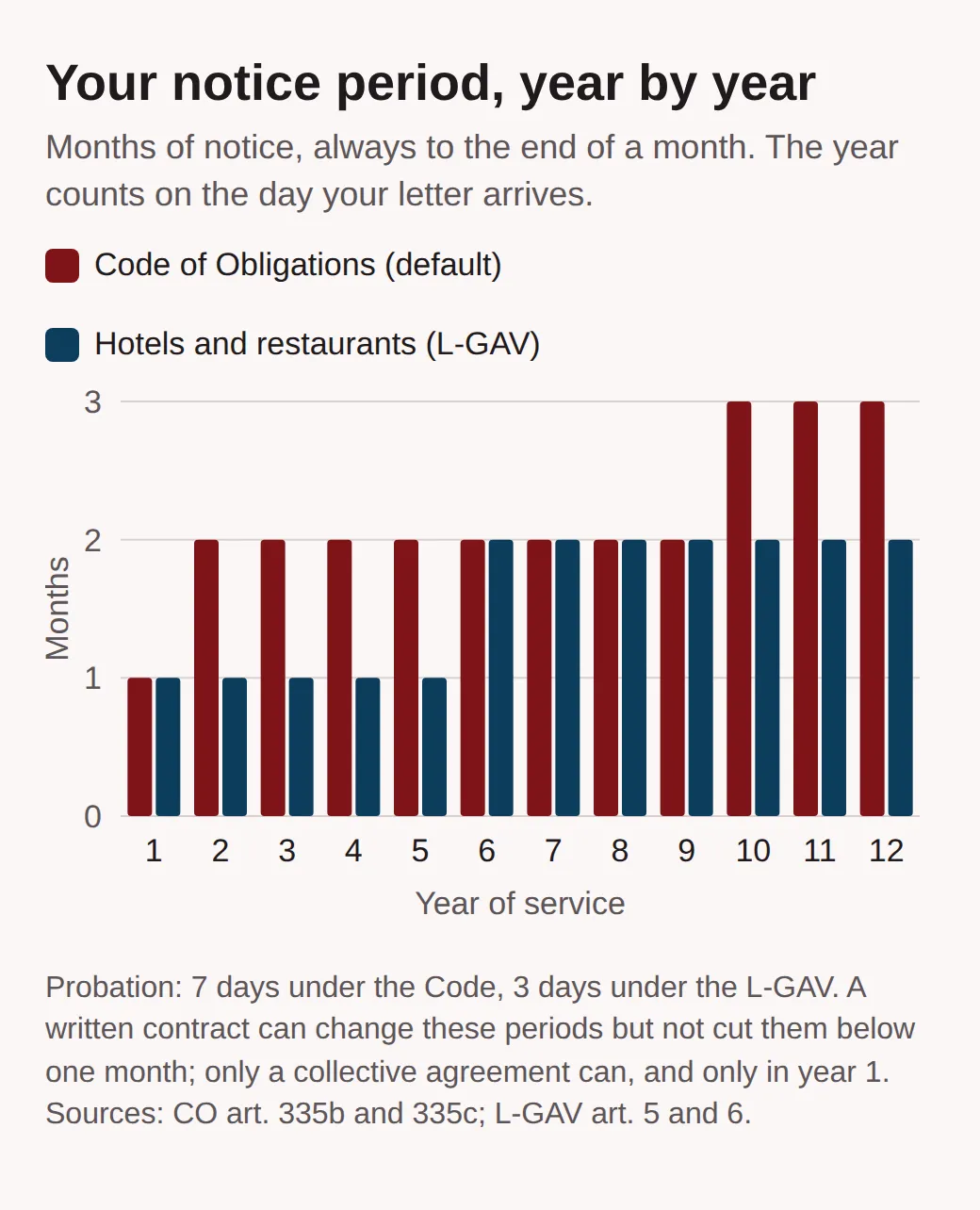
The periods must be the same for you and your employer. If your contract gives you three months and your employer one, the longer period applies to both. A written contract can change the periods, but it cannot go below one month: only a collective agreement can, and only for the first year. Probation is a separate case. Unless your contract says otherwise, it is your first month, it lasts three months at most, and during it notice is seven calendar days and can end on any day, as long as it arrives before probation is over.
When a collective agreement changes the numbers
Many jobs are covered by a collective agreement, a contract between unions and employers that sets pay and working conditions for a whole sector (GAV in German, CCT in French). Its notice clause replaces the Code's defaults. The agreement for hotels, restaurants and bars, the L-GAV, is a good example. It sets one month of notice from the first to the fifth year and two months from the sixth, always to the end of a month. A cook in her fourth year at a Swiss hotel therefore gives one month, where the Code alone would ask for two. Probation is different too: 14 days, with three days' notice.
So before you count anything, read your contract for a notice clause and for the name of a collective agreement. Both can move your date, and the next question is how the date itself is worked out.
The end-of-month rule: when your letter must arrive
Your notice ends on the last day of a month, and it is counted backwards from that day. SECO's own example: you are in your third year and decide on 15 October to leave. The earliest end is 31 December, so the two months run from 1 November, and your notice has to reach your employer by 31 October at the latest.
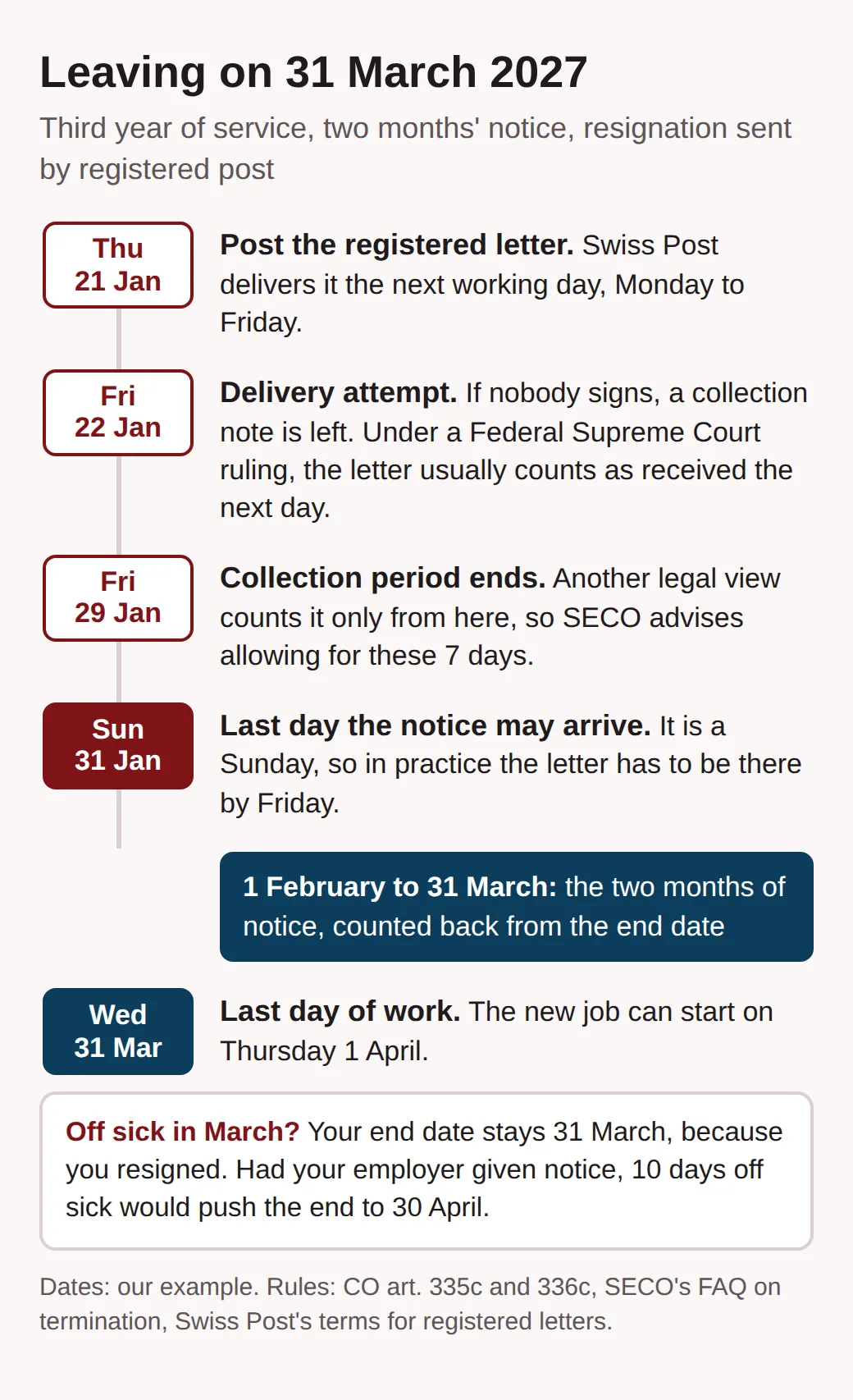
For our example, a last day on 31 March 2027 means two months from 1 February to 31 March. Your letter therefore has to arrive by Sunday 31 January 2027. Few offices open their post on a Sunday, so in practice it has to be there on Friday 29 January. If it arrives on Monday 1 February instead, the earliest end moves to 30 April, while your new employer expects you on 1 April.
Some contracts let notice end on any day of the month instead of the last one. SECO notes that this is allowed if agreed, and the job then ends on the matching day of the later month. Without such a clause, the end of the month applies.
Written form and proof of receipt
The law does not require a letter. Spoken notice is enough, unless your contract or collective agreement asks for written notice. But you have to prove that your notice arrived, and when, and a spoken resignation counts from the moment you say it, even if you confirm it in writing later, as the federal portal for small businesses points out. That cuts both ways: "I quit" said in an angry meeting can be notice, and a casual remark you cannot prove is not.
If your contract asks for "written" notice without saying more, the legal rules on written form apply: the document must carry your handwritten signature, or a qualified electronic signature. An ordinary email does not meet that.
What counts is the day your employer receives the letter, not the date on the postmark. With a registered letter, the postman needs a signature. If nobody signs, a collection note is left. According to SECO, the Federal Supreme Court then treats the letter as received on the day it could fairly be expected to be collected, which is normally the first day after the failed delivery. Another legal view says it only counts once it is collected, at the latest when the collection period ends. Swiss Post usually holds registered items for seven days, and SECO's advice is to post early enough that even those seven days end before your deadline.
In our example that means posting on Thursday 21 January 2027. Registered letters arrive the next working day, Monday to Friday, with no Saturday delivery. Posted on 21 January, the letter is attempted on Friday 22 January, and its collection period runs out on Friday 29 January, before your deadline. In October 2026, Swiss Post charged CHF 5.80 for a registered letter you frank yourself (CHF 6.80 at the counter), and CHF 5.30 more for a signed return receipt.
You can also hand the letter over in person. Then the day of handover counts, and you should ask for a signature with the date on your copy. If your manager refuses to sign, SECO suggests bringing a witness and sending the letter by post as well. A letter that does the job can be this short:
Termination of my employment contract. Dear Ms Meier, I hereby give notice to terminate my employment contract of 1 June 2024, with effect from 31 March 2027. Please confirm in writing that you have received this letter and that 31 March 2027 is my last working day. I would also be grateful for an interim reference now and a final reference at the end of my employment. Kind regards, [your signature]
Add your name and address and your employer's, then date and sign it, as the federal portal ch.ch recommends. You don't have to give a reason. If your employer asks for one, though, you must give it in writing. Write in the language you use at work. Once the letter has arrived, the notice runs, and the next surprise for many people is what does not stop it.
Falling ill after you resign
If you resigned, sick leave during your notice does not move your end date. Swiss law protects employees who are ill or injured through no fault of their own from being dismissed for a time, the so-called protection periods: 30 days in the first year, 90 days from the second to the fifth, 180 days from the sixth. But these periods only apply when the employer gives notice. SECO says so in plain words: if you resign, you cannot rely on a protection period, and the same holds when you leave by mutual agreement.
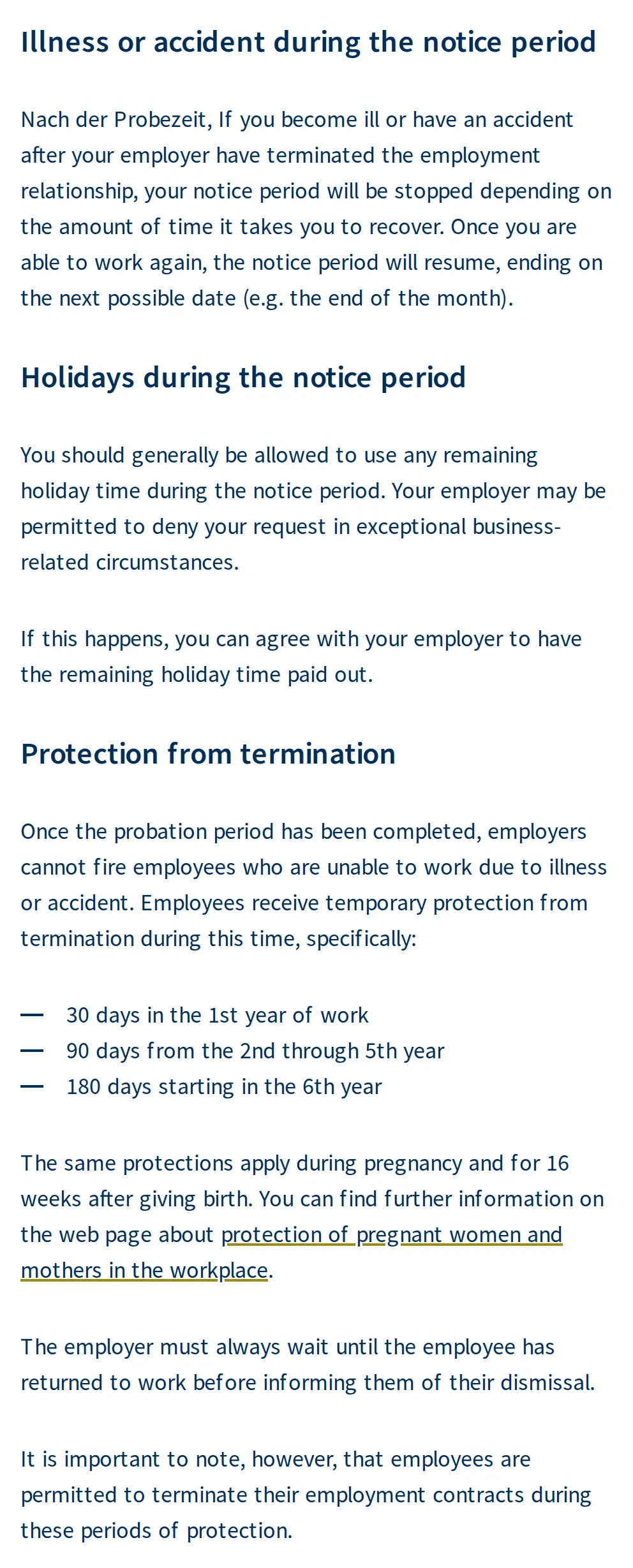
Several popular guides say that illness pauses the notice period, full stop. That is only true for the other direction. When your employer has given notice and you fall ill during it, the notice stops and resumes once you can work again, and then it runs to the next end of a month. SECO's example shows how much that weighs: notice received on 16 September with two months, so an end on 30 November; one week of illness from 21 to 28 November pushes the end to 31 December. A week in bed adds a full month.
In our example, ten days off sick in March leave your end date at 31 March, and your new job starts on 1 April as planned. Had your employer given you notice for 31 March instead, the same ten days would have carried the job into April and, with the end-of-month rule, to 30 April. You can also resign while you are on sick leave; ch.ch confirms that the protection periods do not stop you. What happens to your holiday is the next question.
Holidays during your notice period
Holidays are meant to be taken, not paid, and during the employment relationship they may not be swapped for money. That rule still applies after notice. You can ask to take your remaining days during your notice period, and according to SECO your employer may refuse only in a real emergency at work.
The reverse happens more often: your employer sends you on holiday during the notice period, though you would rather have the days paid. Here SECO draws a line between the two sides. If you resigned, taking your remaining holiday during the notice period is reasonable. If your employer gave notice, finding a new job comes first. Either way, your employer cannot order holidays from one day to the next, and what matters is the ratio between the notice period and the days you have left. Holidays are paid out in cash only if there is not enough reasonable time to take them before you leave, as the Federal Supreme Court held in a ruling published in 2002 (BGE 128 III 271).
Overtime follows its own rule. Your employer can compensate it with time off only if you agree. Otherwise it is paid with a supplement of at least 25%, unless your contract or collective agreement says something else in writing. Count your days and hours before you hand in the letter, because your employer may answer it with garden leave.
Garden leave: paid, but not free
Garden leave means your employer releases you from work for the rest of your notice period. You stay employed and keep your salary until the end date. The Code of Obligations does not mention it; the Federal Supreme Court treats it as part of the employer's right to give instructions, so your employer can decide on it alone. Everything else in your contract keeps running, including your duty of loyalty: you may not do paid work for someone else that breaches that duty, and above all you may not work for a competitor.
Two consequences catch people out. First, your holidays. In the same ruling, the court held that you are expected to use the free time of garden leave to take your remaining holiday where you can, without any instruction from your employer. Job hunting still comes first, and there is no fixed ratio: what counts is how long the release lasts compared with the days you have left.
Second, a new salary. In a ruling from 1992 (BGE 118 II 139), an employee resigned on 31 August 1989 and was released from work the same day, with his contract running until 28 February 1990. On 1 October 1989 he started a new job paying CHF 3,000 a month. His old employer stopped paying his full CHF 4,400 and paid only the difference. The court agreed: unless the parties agreed otherwise, or the circumstances show they meant to, what you earn elsewhere during garden leave is deducted from what your old employer owes you.
So if you are sent home, ask your employer to confirm three points in writing: whether you may start the new job early, whether your new salary will be deducted, and whether your holidays count as taken. If the honest answer to the first is no, there is a cleaner route.
Leaving earlier than your notice allows
You and your employer can always agree on an earlier end date. Put it in writing, signed by both of you, with the new last day. An employer who has a replacement lined up often agrees, but nothing obliges it to.
Simply walking out is expensive. If you leave without notice and without good cause, your employer is entitled to a quarter of a month's salary as compensation, plus damages for any further loss. Leaving with immediate effect is only allowed for good cause, meaning circumstances in which nobody could reasonably expect you to stay, and a court decides afterwards whether yours qualified. Check also whether your contract has a non-compete clause. It only binds you if it was agreed in writing, you had access to customers or business secrets, and using that knowledge could seriously harm your employer. And it no longer applies if you resign for good cause that your employer gave you.
Resigning without a new job
Resigning without a firm promise of a new job costs you money at the unemployment office. Under the unemployment insurance ordinance, unemployment counts as your own fault if you left a job without the promise of another, unless nobody could have expected you to stay. Giving up a suitable job without a new one lined up is listed as a serious fault, which suspends your benefits for 31 to 60 days of payment.
If you resign anyway, start applying from the day you hand in notice. The unemployment insurance expects your job search to start when notice is given, and tells you to register with the regional employment office (RAV) early rather than on your last day. Once notice has been given, your employer also has to give you the time you need to look for a new job. And if you are still at the stage of interviews, our guide to the Swiss job interview covers what comes before the offer you should wait for.
The final reference
The last document you get from your job may be the one you use longest. In Switzerland the work reference, the Arbeitszeugnis or certificat de travail, is part of nearly every application, and you are entitled to one at any time, not only when you leave. A full reference describes your role and how long you held it, and assesses your work and your conduct. If you ask for it, your employer must instead give you a simple confirmation that states only your role and the dates.
SECO lists what a full reference contains: both parties' names, the start and end dates, your main tasks, an assessment of your performance and conduct, and a signature with the date, usually your last working day. It must be true and kindly worded, without codes that sound positive and mean the opposite. Isolated incidents, such as one late arrival, do not belong in it, according to ch.ch. If you find something wrong, ask for a correction. Your claim to a reference only expires ten years after your job ends, but the people who can describe your work best may be gone long before that.
That is why it pays to ask for an interim reference in your resignation letter and to read the final one before your last day. Our post on the Swiss CV shows where references go in an application. With your last salary, everything you are still owed falls due: holiday you could not take, overtime, and a share of a 13th month's salary if you get one, which our post on the 13th month salary works through.
Your resignation, step by step
Start with the facts that set your date. Find your start date, and work out which year of service you will be in on the day your letter arrives. Read your contract and any collective agreement for a notice clause and for the words "in writing". Then count back from the last day of the month you want to leave: the letter must arrive by the end of the month before your notice starts.
Post it by registered mail at least ten days before that month ends, or hand it over against a signature. Ask for an interim reference in the same letter. Agree on your remaining holidays early, and if your employer sends you home, get the terms of garden leave in writing before you start anything new. Our example's reader posts on 21 January, works until 31 March and starts the new job on 1 April 2027.
Common questions
- Can I resign by email in Switzerland?
- If your contract and any collective agreement say nothing about form, yes: the law accepts even spoken notice. The weak point is proof, because you must be able to show that the email arrived and when. If your contract asks for written notice, an ordinary email does not meet it, so send a letter you have signed by hand.
- Can my employer refuse my resignation?
- No. Either side can end an open-ended employment contract, and you do not need to give a reason. Your employer can only ask you to state your reasons in writing, and you then have to do so. What your employer cannot do is shorten or lengthen your notice period on its own.
- Can I resign while I am on sick leave?
- Yes. The protection periods during illness stop your employer from dismissing you, not you from resigning. Your notice runs as normal, and it is not extended by the days you are off sick.
- How do I end a fixed-term contract early?
- Usually you can't on your own. A fixed-term contract ends by itself on the agreed date, and it can only be ended earlier if the contract allows it or if you and your employer agree. In hotels and restaurants, the L-GAV says a fixed-term contract can only be ended early if this was agreed in writing.
- Can I resign while my manager is away on military service?
- Usually yes, with one exception. After probation, the Code of Obligations bars you from resigning while your employer, or a superior whose job you are able to do and have to cover, is on compulsory Swiss military, civil protection or civilian service. If that service lasts more than 11 days, the ban also covers the four weeks before and after it.
More posts
All posts
Swiss CV format: photo, permit, length and work certificates
What a Swiss CV contains, from date of birth and permit to the photo question, how long it may be, and the work certificates that go behind it.

Job interview in Switzerland: rounds, rules and red lines
How a Swiss job interview runs: the rounds, the salary question, reference checks and the questions data protection law rules out, from official sources.

13th month salary in Switzerland: who is owed it and when
No Swiss law requires a 13th month salary, yet three in four employees get one. Who is owed it, when it is paid, pro rata rules, tax and bonuses.