Work permit in Switzerland 2026: L, B, C and G compared

Which permit, in brief
Your passport decides the route and your contract decides the permit. An EU or EFTA citizen with a contract of three to twelve months gets an L permit, one with a longer or open-ended contract a B, and a G if they live across the border. Everyone else needs an employer who applies, proves no suitable candidate was found in Switzerland or the EU, and gets a place in a yearly quota.
The fourth letter, C, is the settlement permit, which comes after five or ten years of living here rather than with a job. For 2026 the quota for workers from outside the EU and EFTA is 8,500 permits; the Federal Council has set each new year's figure in November, so the 2027 numbers are expected late in 2026.
Which permit a job offer gets you
For most people who move here for work, the answer is short. In 2024, 171,454 people came to Switzerland to take up a job, and 157,032 of them, about 92%, were citizens of the EU or EFTA, according to the Federal Council's fact sheet on quota use. For them, free movement means the permit follows the contract. The other 14,422 came through a much narrower door.
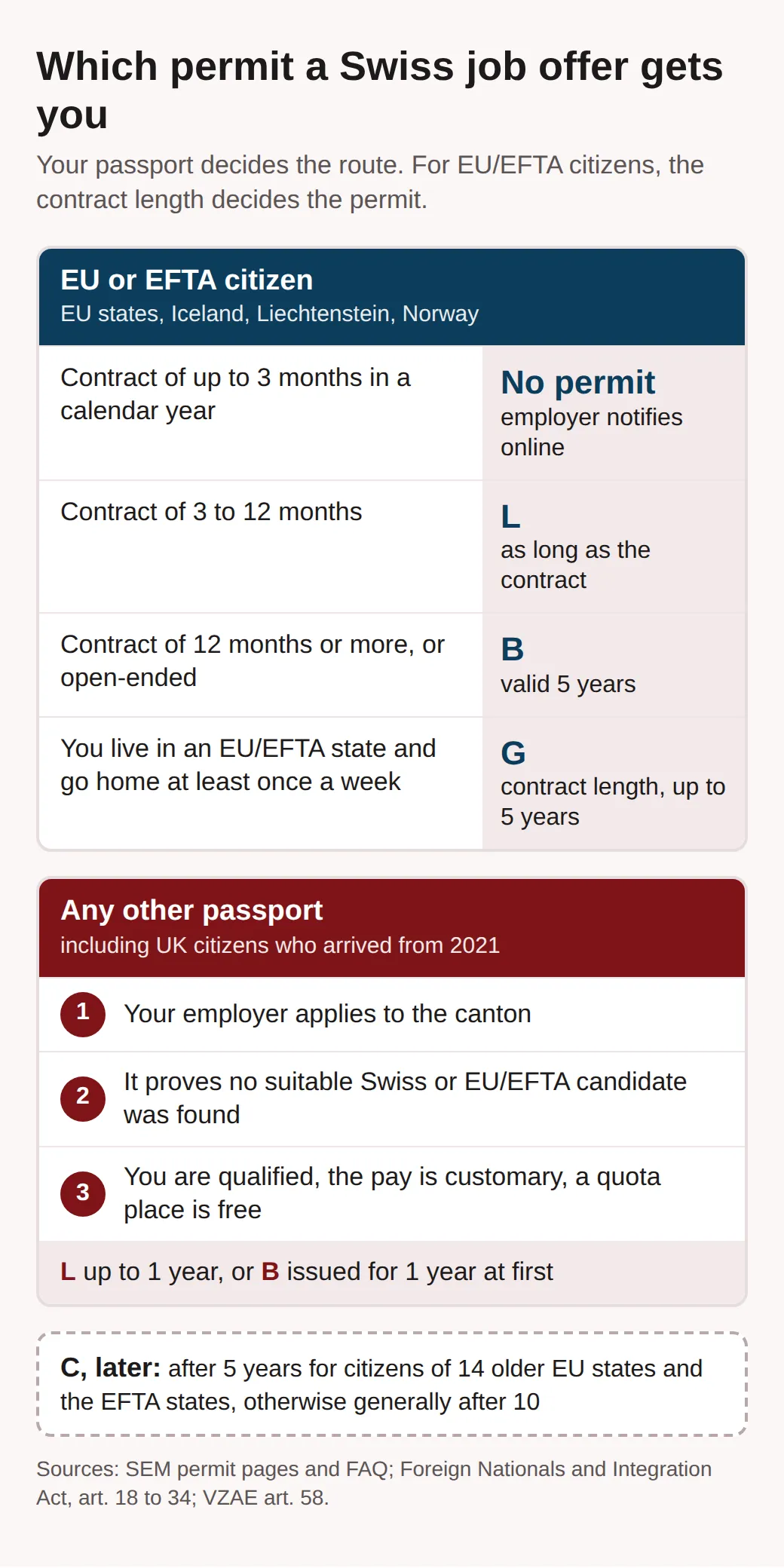
One idea runs through every case: a Swiss residence permit is also your work permit, and it is tied to a purpose. The State Secretariat for Migration (SEM) says so in its FAQ for EU/EFTA citizens: the residence permit "doubles as work permit".
L, B, C and G side by side
The same letter gives you different terms depending on your passport.
| Permit | What it is | EU/EFTA citizens | Other nationals |
|---|---|---|---|
| L | Short stay | Contract of 3 to 12 months, valid as long as the contract | Up to 1 year, extendable to 2, counts against the quota |
| B | Residence | Contract of 12 months or open-ended, valid 5 years | 1 year at first, then extended, counts against the quota |
| C | Settlement | After 5 or 10 years, no conditions on work | Generally after 10 years, after 5 with good language skills |
| G | Cross-border commuter | Live in any EU/EFTA state, go home weekly | Must already live in a neighbouring country's border zone |
The rules for other nationals come from the Foreign Nationals and Integration Act (in German AIG, here the Act) and its ordinance, the VZAE (no English version). For EU and EFTA citizens the free movement agreement comes first, which is why the same letter can last five times longer for a German engineer than for an Indian one.
EU and EFTA citizens: the contract length decides
If you hold a passport of an EU state, Iceland, Liechtenstein or Norway, you do not apply for a work permit at all. You register where you live, show your contract, and the canton issues the permit that matches its length.
A job of up to three months in a calendar year needs no permit. Your Swiss employer reports it through SEM's online notification procedure no later than the day before your first day of work. For anything longer, you register with your commune within 14 days of arriving and before you start work, with your passport or ID and a written contract that states how long the job lasts and how many hours you work.
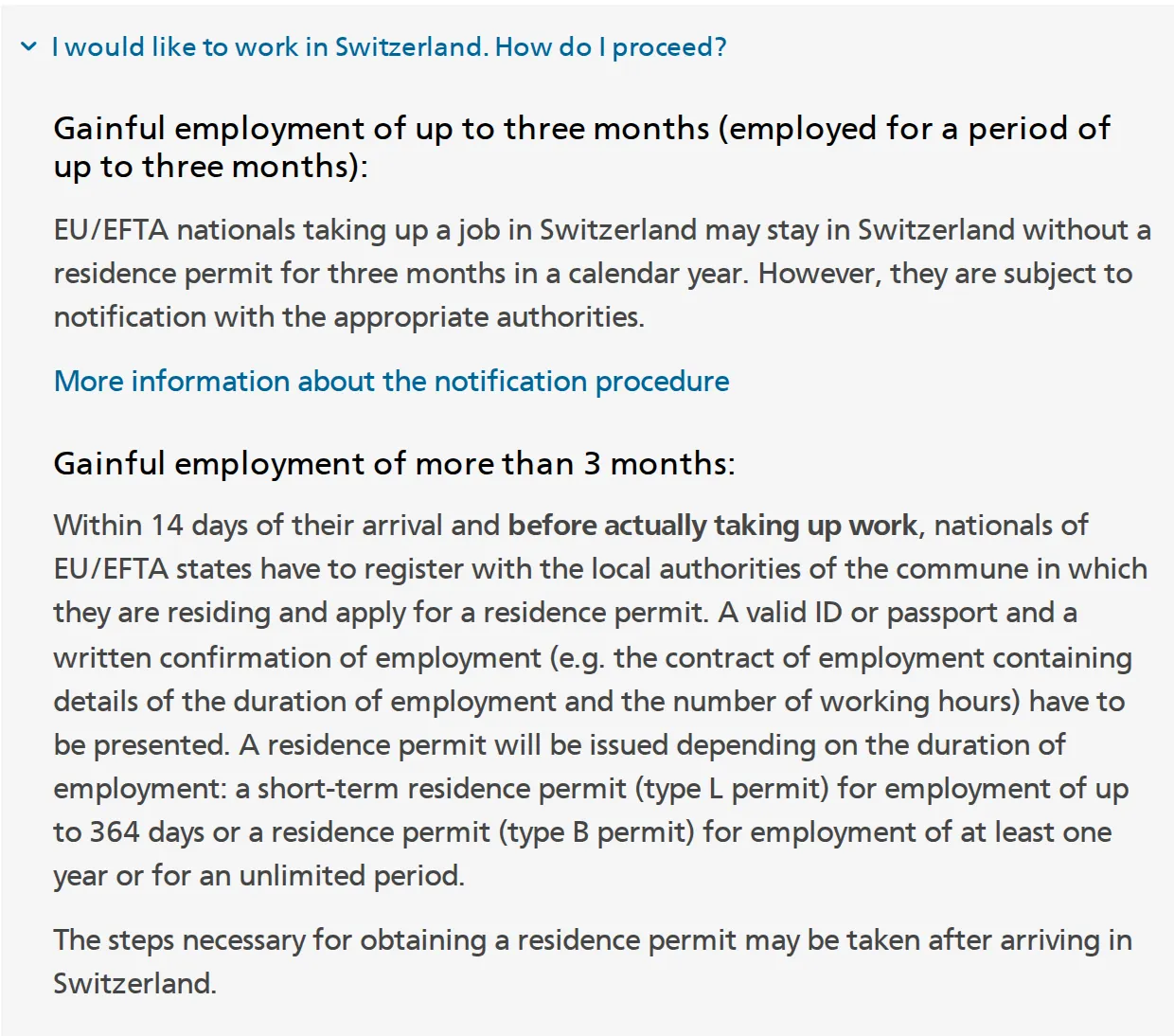
Read that last sentence closely, because the line between L and B is a matter of days. An L permit goes with a contract of three to twelve months and lasts exactly as long as the contract; it can be extended up to a total of less than twelve months. A B permit needs a contract of at least twelve months or an open-ended one, and is valid for five years, then renewable for five more. So a fixed-term contract of eleven months gets you an L, while a permanent contract with a three-month probation period gets you a B. If a longer stay matters to you, for a lease or a family move, ask for the contract to say so before you sign.
On an L permit you can still change jobs: SEM's FAQ says the EU/EFTA L permit lets you change job or profession. Croatian citizens fall under the same rules: in January 2026 the Federal Council found that the thresholds for bringing back quotas had not been reached, so none apply to them in 2026.
The G permit: work here, live next door
The G permit is for cross-border commuters, people who work in Switzerland and keep their home abroad. For EU and EFTA citizens, SEM's G permit page sets few limits: you can live anywhere in the EU or EFTA and work anywhere in Switzerland, as border zones no longer apply to you. You must return to your home abroad as a rule every day, or at least once a week. It lasts as long as a contract of under a year, or five years for a longer or open-ended one, and the canton where you work issues it.
With any other passport, the G permit is tied to the border. Article 25 of the Act admits a cross-border commuter only if they have a permanent right to live in a neighbouring country, have lived in its border zone for at least six months, and work inside the Swiss border zone. In return, the quota, the qualification rules and the housing rule do not apply, though the priority for local candidates and the pay rules still do. After five years of uninterrupted work, you have a right to have the permit renewed (art. 35).
The C permit: after five years or ten
The C permit, the settlement permit, has no end date and no conditions on what work you do. It is the one permit you cannot get through a job offer. For EU and EFTA citizens, SEM's C permit page lists the nationals who get it after five years of regular, uninterrupted residence, under settlement treaties: Austria, Belgium, Denmark, Finland, France, Germany, Greece, Ireland, Italy, Luxembourg, the Netherlands, Portugal, Spain, Sweden, Iceland, Liechtenstein and Norway. Citizens of the other EU states get it after ten years: the free movement agreement does not cover settlement, and no such treaty exists with their countries.
For everyone else, article 34 of the Act asks for ten years in total with an L or B permit, the last five without a break on a B, no grounds for revocation, and integration. The VZAE adds a language test in the local language: spoken level A2 and written A1. You can get it after five years if your spoken level is B1. Years spent studying only count if you then hold a B permit for two years without a break.
The C changes two practical things. You count as a local worker, so a future employer needs no labour market test to hire you. And it ends tax at source, as our guide from gross to net salary explains. Until then, for non-EU citizens, everything runs through the employer.
Outside the EU: why a job offer is not enough
With a passport from outside the EU and EFTA, a job offer is where the process starts, not where it ends. SEM's FAQ on working in Switzerland answers the question in its first word: "No. A job offer in Switzerland isn't enough to make you eligible for a work permit."
The Act lists the conditions in articles 18 to 24. The hire must be in Switzerland's overall economic interest and an employer must apply. Your employer must show that no suitable worker from Switzerland or the EU and EFTA could be found. The pay and working conditions must be those customary for the place, the job and the sector. You must be a manager, a specialist or another qualified worker, which SEM's admission page reads as a university degree plus several years of experience, or special training plus experience in some fields. For a B permit, your qualifications, adaptability, languages and age must also point to lasting integration. You need suitable housing. And a quota place must be free.
What that looks like in practice shows in who gets through. Of the 6,374 quota permits used in 2024, 1,480 went to Indian citizens, 828 to Americans and 531 to Chinese citizens. The largest sectors were IT services with 1,145 and consulting with 1,031, followed by research and development and the chemical and pharmaceutical industry. In health care it is typically specialist and junior doctors who qualify, and in hotels and restaurants only specialty cooks, the fact sheet notes. An offer for a job that many local candidates could do is unlikely to pass, however good the pay.
The labour market test in practice
The priority rule is the condition that decides most cases, and it is the employer's job to prove. SEM's admission page says the employer must show a genuine effort, in time, geography and methods, to fill the job from Switzerland or the EU and EFTA, and should only contact candidates from other countries after that search has failed. The vacancy has to be registered with the regional employment centre (RAV) and advertised through EURES, the European job network.
The list of application documents shows what proof looks like: the RAV and EURES confirmation, copies of ads in Swiss newspapers, specialist portals and social media such as LinkedIn, and information on the applications received and why they could not be considered. Your part is a CV in table form and your diplomas and references, with certified translations if they are not in one of Switzerland's official languages or English. The signed contract must state your salary.
That salary is checked too. The VZAE (art. 22) measures customary pay against the law, collective agreements, what the same firm pays for the same work, and official wage surveys. If you want to know what the authorities may compare your offer with, the federal Salarium calculator in our salary negotiation guide draws on the federal wage survey, the kind of official data the rule refers to.
Two exceptions matter. The priority rule does not apply to senior managers and essential specialists transferred within an international company. And graduates of Swiss universities can be admitted without it when their work is of high scientific or economic interest (art. 21).
Who files, and how long it takes
Your employer files, not you. Article 11 of the Act says that for employees, the employer applies for the permit. SEM's procedure page sets out the steps:
- Your employer sends the application to the cantonal labour market or migration authority.
- The canton checks it and issues a preliminary labour market decision.
- For certain groups of people and professions, SEM must approve it as well; since 1 February 2023 that second check no longer applies to every case, the fact sheet notes. The employer pays the fee.
- If you need a visa, the canton sends an entry authorisation to the Swiss embassy or consulate, and you apply there.
- Within 14 days of arriving, you register with the authority where you live.
SEM's FAQ says to expect six to eight weeks for the whole file, and longer in complex cases or when a company applies for the first time. Plan your start date around that, and do not start work before the permit is granted: any paid activity needs one, whatever its length.
The 2026 quotas: 8,500 places, and where they sit
The quota is a ceiling on new L and B permits for workers from outside the EU and EFTA, and for 2026 it is 8,500: 4,500 B permits and 4,000 L permits. The Federal Council left it unchanged from 2025, together with 3,500 permits for EU/EFTA service providers posted for more than 120 days a year and a separate 3,500 for UK citizens.
Most of it does not sit with the cantons. Annexes 1 and 2 of the VZAE give the cantons 2,000 L permits and 1,250 B permits for 2026, shared out by a key based on each canton's full-time jobs, and keep 2,000 L and 3,250 B in a federal reserve. Zurich has the largest share, 399 L and 249 B, followed by Bern with 231 and 144, Vaud with 181 and 113 and Geneva with 149 and 93. When a canton runs out, it asks SEM for more, and the fact sheet says the extra places are usually assigned within a few days. Places left over at the end of the year can be used the next year.
Not every permit counts: work of up to four months within twelve months stays outside the quota if its length and purpose are fixed from the start (VZAE art. 19).
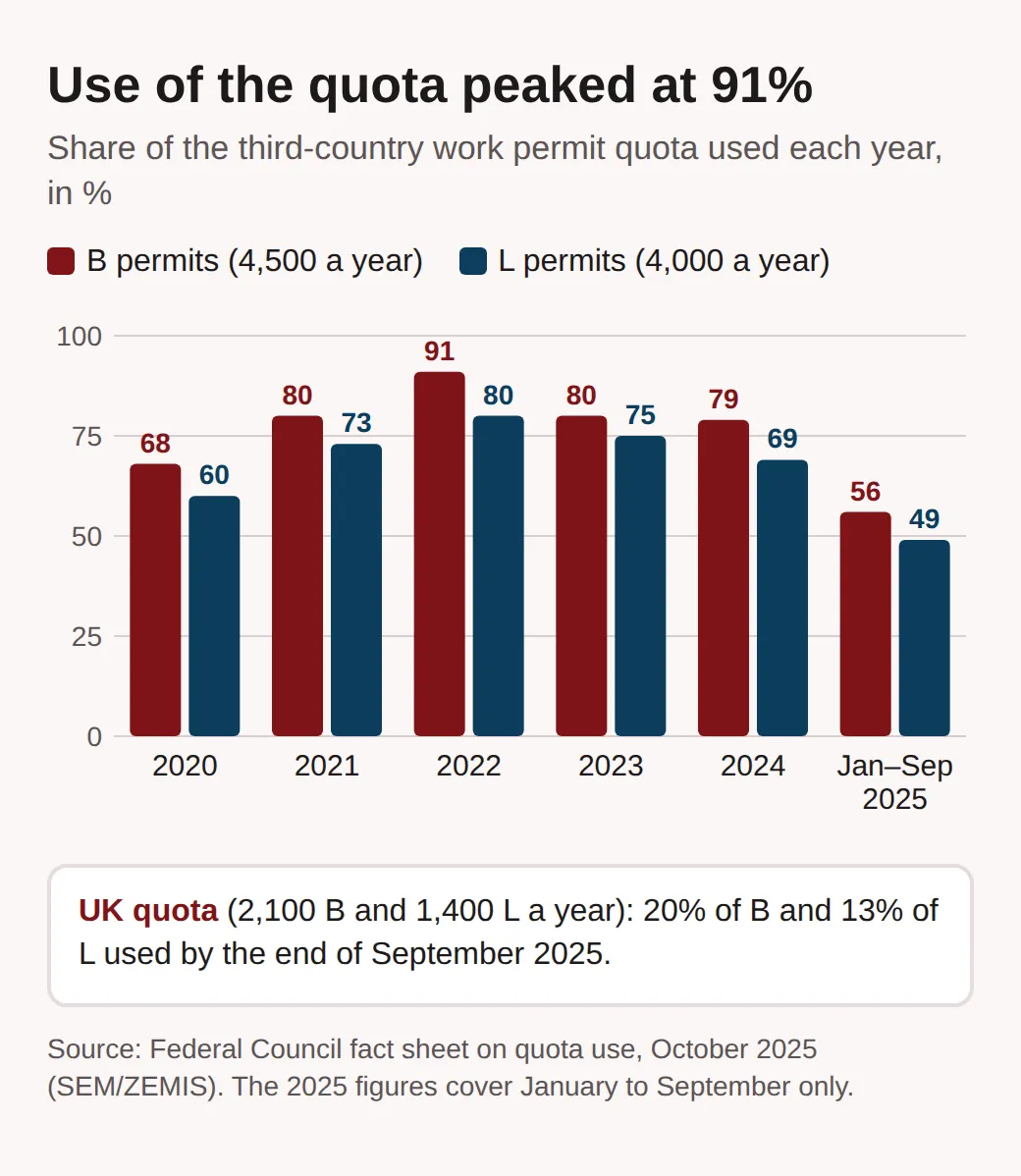
The chart shows why the quota is rarely what stops a hire. From 2020 to 2024 the places never ran out; the highest use was 91% of B permits in 2022. By the end of September 2025, the cantons had used about 52% of the year's places, according to the Federal Council's release. The harder hurdle is the priority rule.
The 2027 figure is still open. Under article 20 of the Act, the Federal Council sets the numbers after consulting the cantons and the social partners, and it has decided in November: on 27 November 2024 for 2025, and on 19 November 2025 for 2026. We will update this article once the 2027 numbers are out.
UK citizens: a quota of their own, the same test
British citizens are now third-country nationals, with one exception. If you lived or worked here under free movement by 31 December 2020, you keep those rights under the agreement on citizens' acquired rights; SEM's UK FAQ says your permit then carries the mark "EU/EFTA" or a reference to the CH-UK agreement.
Everyone else has come under the Act since 1 January 2021. SEM's page for UK workers says only essential managers and specialists are admitted, Swiss residents and EU/EFTA citizens have priority, and local pay and working conditions must be met. That is the same test as for any non-EU hire. What differs is the quota: 2,100 B and 1,400 L permits a year, released in four equal quarterly slices and handed out first come, first served, with no federal reserve behind them. Demand is low: by the end of September 2025, 427 B and 178 L permits had been used, 20% and 13% of the year's places.
For short jobs there is one shortcut: under the Services Mobility Agreement, a UK-based company can post staff to Switzerland for up to 90 working days a year through the online notification procedure, whatever their nationality, as long as staff from outside the UK have worked in the UK labour market for at least 12 months first. SEM's notification page says the agreement runs until 31 December 2029.
Changing jobs and cantons once you have a permit
As an EU or EFTA citizen, your L or B lets you change job, and your permit is valid in the whole country; if you move, you register in the new canton.
With another passport, the B permit is still flexible. Article 38 of the Act lets a B holder work anywhere in Switzerland and, as a rule, change job without any further permit. SEM's FAQ notes one exception: if your permit was granted for one specific job and tied to a labour market condition, the change needs the canton's approval. Moving your home to another canton is different: you need the new canton's permit in advance, and you have a right to it if you are not unemployed (art. 37). The first B is issued for one year and can then be extended by two (VZAE art. 58), and you must ask for the extension at least 14 days before it expires.
An L permit holder from outside the EU is tied far more closely. A job change is allowed only within the same sector and profession, only if staying with your employer is impossible or unreasonable, and not if you caused the change yourself (VZAE art. 55). A new L permit generally needs a one-year break from Switzerland first. If you are weighing an offer that comes with an L, ask whether the employer can make it a B.
Before you sign the offer
Start with your passport, then read the offer with the permit in mind. If you are an EU or EFTA citizen, check the contract length against the twelve-month line and register within 14 days of arriving. If the job is in Geneva, Basel-Stadt, Jura, Neuchâtel or Ticino, also check that the pay clears the cantonal minimum wage.
If you need a permit through your employer, ask three questions before you resign from your current job: who at the company files the application, whether it has hired from outside the EU before, and what start date it has planned around six to eight weeks of processing. A first-time employer may need longer, and the notice period you owe your current employer will not wait for a Swiss permit.
When you apply, put your nationality and, once you have one, your permit type at the top of your CV, as our Swiss CV guide shows. It tells a Swiss recruiter in one line which of the two routes above your hire will take.
Common questions
- Can I come to Switzerland first and look for a job there?
- As an EU or EFTA citizen, yes. You can stay three months without a permit, and after that the canton can give you an L permit to keep looking, without any right to social assistance. With any other passport, SEM says you first need a firm job offer from a Swiss employer. The exception is a degree from a Swiss university, which gives you six months after graduating to find a job.
- Can my husband or wife work if I get a B permit?
- Yes. Under the Foreign Nationals and Integration Act, the spouse and children of a B or C holder who came through family reunification may work anywhere in Switzerland, employed or self-employed, without a labour market test. For the family of an L holder it is harder: an employer has to apply, and the pay and qualification rules apply as for any other hire.
- Is my permit valid in every canton?
- For work, yes. EU and EFTA permits are valid in the whole of Switzerland, and if you move you only register in the new canton. A B holder from outside the EU may also work anywhere in Switzerland, but moving your home to another canton needs the new canton's permit first. You are entitled to it if you are not unemployed and there are no grounds to revoke your permit.
- I studied at a Swiss university. Does my employer still have to run the labour market test?
- Not always. The law lets graduates of Swiss universities and universities of applied sciences skip the priority rule when their work is of high scientific or economic interest. You also get six months after your studies to find a job that matches your degree. The quota, the pay rules and the qualification rules still apply.
More posts
All posts
Jobs in Switzerland for English speakers: fields and cities
One worker in four speaks English on the job in Switzerland, yet only 4% work in English alone. The fields and cities where English is enough, with data.

Minimum wage in Switzerland 2026: official rates by canton
Switzerland has no national minimum wage. The official 2026 rates in five cantons and Lucerne, per hour and per month, who is left out and what changes next.

Switch health insurance in Switzerland: 2027 checklist
Switching Swiss health insurance for 2027: the 30 November deadline, the new premiums, and the accident cover you can drop if you work 8 hours a week.