Switch health insurance in Switzerland: 2027 checklist

Before 30 November
To switch basic health insurance for 1 January 2027, your cancellation has to reach your current insurer by Monday 30 November 2026. What counts is the day it arrives, not the postmark. Sign up with the new insurer at the same time. And if you work at least 8 hours a week for one employer, ask for accident cover to be taken out: it is worth up to 7% of your premium.
The reason to look this autumn is in the numbers. The Federal Office of Public Health (FOPH) announced on 29 September 2026 that the mean premium rises by 5.0% in 2027, to CHF 412 a month. For adults it is CHF 487.60. The deadline is only part of it. What you pay also depends on accident cover your employer may already pay for, on a rule that lets you move into a cheaper model during the year, and on supplementary insurance, which runs on its own clock. We take them in the order you will need them.
What the 2027 premiums mean for you
Premiums rise again in every canton, but the mean figure hides a lot. The FOPH's cantonal tables give these Swiss means, across all deductibles and models:
| Age group | 2026, per month | 2027, per month | Change |
|---|---|---|---|
| Adults (26 and over) | CHF 464.80 | CHF 487.60 | +4.9% |
| Young adults (19 to 25) | CHF 323.40 | CHF 338.80 | +4.8% |
| Children (up to 18) | CHF 122.40 | CHF 128.10 | +4.6% |
| Everyone | CHF 392.40 | CHF 412.00 | +5.0% |
Where you live moves the figure more than anything else. The adult mean for 2027 is CHF 610.60 in Geneva and CHF 603.60 in Ticino, but CHF 324.90 in Zug. Zurich sits at CHF 477.00, Bern at CHF 494.40 and Vaud at CHF 543.50.
None of these is your premium. A mean, as the FOPH explains in its fact sheet, is all premiums paid divided by the number of people insured. Behind it sit more than 200,000 different premiums, set by age group, premium region, deductible, model and whether accident cover is included. Over 80% of people already have a higher deductible, a model with a restricted choice of doctor, or both. Your own premium for 2027 is in the letter your insurer has to send you at least two months before it applies, so by 31 October (KVG art. 7, the federal health insurance act). To compare it with every other insurer, use the FOPH's free calculator on priminfo.admin.ch, which lists every approved premium for 2027. It asks for your postcode, year of birth, deductible and whether you need accident cover, and that last question is worth more thought than most people give it. Before that, the switch itself.
How to switch basic health insurance, step by step
Switching basic insurance takes two steps, done in the same week. Every insurer has to accept you for basic insurance whatever your age or health, and you fill in no health questionnaire, as the FOPH's page on switching puts it. The cover is the same everywhere by law; only the price and the service differ.
- Compare on priminfo, with your real deductible and model, and with or without accident cover (more on that below).
- Sign up with the new insurer for 1 January 2027. You can often do this online.
- Cancel with your current insurer, so that the letter arrives by 30 November.
- Keep paying your current insurer until 31 December, and settle any open bills.
The order of steps 2 and 3 matters less than people fear. Your old insurance only ends once the new insurer has told the old one that you are insured with it without a break (KVG art. 7). If something goes wrong on the new side, you stay insured with the old one, and the new insurer owes you the difference in premium.
The cancellation itself can be short. The FOPH offers template letters for every step, and its cancellation letter boils down to this:
Cancellation of compulsory health insurance (basic insurance). Policy number: [your number]. I hereby cancel my basic insurance as of 31 December 2026. From 1 January 2027 I will be insured with another insurer under the KVG. Please confirm the cancellation in writing. [Date, name, signature]
Say "basic insurance" in so many words. If you have supplementary policies with the same insurer and want to keep them, a vague "I cancel my insurance" invites a dispute about what you meant.
Does the postmark count?
No. The FOPH writes that the cancellation must reach the insurer by 30 November at the latest, and recommends sending it by registered post or A-Post Plus by 15 November. In 2026, 30 November is a Monday, so a letter posted over the last weekend is a gamble you don't need to take.
One thing can stop a switch even when your letter arrives on time. If you owe your current insurer premiums or co-payments, you cannot leave until they are paid in full (KVG art. 64a). The FOPH applies this to debts for which you received a reminder by 30 November and that are still open on 31 December.
Changing insurer is not the only way to pay less, though, and some of the cheaper options follow different dates.
Changing your model or deductible instead
You can often save without leaving your insurer, and since 1 January 2025 one of these changes no longer waits for the end of the year. Here is how the health insurance ordinance (KVV) now handles models, meaning policies where your first stop is a family doctor, a telemedicine line, a pharmacy or a choice among them:
- Into a model: if you have the standard model with free choice of doctor, you can move into a model with a restricted choice at any time of the year (KVV art. 100).
- Out of a model, or to another one: only to the end of a calendar year, with the same notice as for changing insurer.
- A higher deductible: only from the start of a calendar year (KVV art. 94).
- A lower deductible: to the end of a calendar year, with the same notice as for changing insurer.
The FOPH advises telling your insurer about a deductible change by 15 November either way. On priminfo, the models now appear under four new category names: PRAXIS (a set doctor's practice first), TEL_DIG (phone or app first), PHARM (a partner pharmacy first) and FLEX (a choice of several first stops).
The deductible is the yearly amount you pay before the insurer starts paying. For adults it is CHF 300 in the ordinary insurance, or a higher one of CHF 500, 1,000, 1,500, 2,000 or 2,500 if you choose it (KVV art. 93). A higher deductible lowers your premium but raises what you pay when you are ill, which is a calculation of its own. Accident cover is the easier saving, because for most employees it is simply paid twice.
The accident cover your job already pays for
If you work at least 8 hours a week for one employer, you are insured against accidents at work and in your free time through that employer, so you can take accident cover out of your basic health insurance. That follows from three rules. The accident insurance act (UVG) insures every employee in Switzerland. Its ordinance (UVV art. 13) extends that to accidents outside work for anyone working at least 8 hours a week for one employer. And the health insurance act lets you suspend accident cover in your basic insurance once you show you are fully covered under the UVG (KVG art. 8). The FOPH says the same on priminfo:
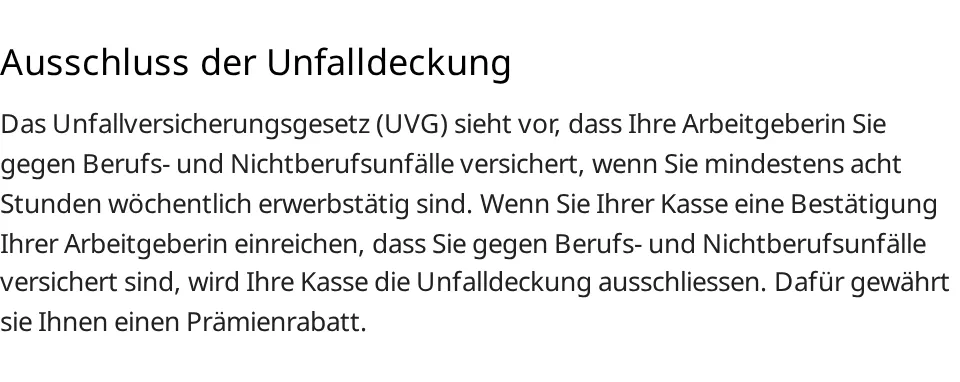
Your insurer has to lower your premium for as long as your employer's accident cover runs, by the accident share of the premium and by no more than 7% (KVV art. 91a). It is not a once-a-year decision either. The change takes effect at the earliest on the first day of the month after your written request (KVV art. 11), so if you have been paying for accident cover by mistake, ask now rather than in January. The change cannot be backdated.
What your insurer wants is proof. Ask HR for a short written confirmation that you are insured against occupational and non-occupational accidents under the UVG. A line marked NBU on your payslip (the German abbreviation for non-occupational accident insurance) is a good sign, but some employers pay that premium themselves, so its absence proves nothing. The FOPH's template letter then needs one sentence:
Since I am insured against accidents through my employer, please remove accident cover from my basic insurance from next month. My employer's confirmation is enclosed.
If you switch insurer, choose "without accident cover" when you sign up and attach the same confirmation. The law only takes accident cover out at your request, so don't assume your old settings move with you.
How much it saves in 2027
In the FOPH's 2027 premium data, accident cover makes up 6.5% to 7% of the adult premium in 82% of all offers, and less than 4.5% in under 2% of them. The law only sets the cap, so the exact share is up to each insurer. In francs, the typical saving depends mostly on your canton:
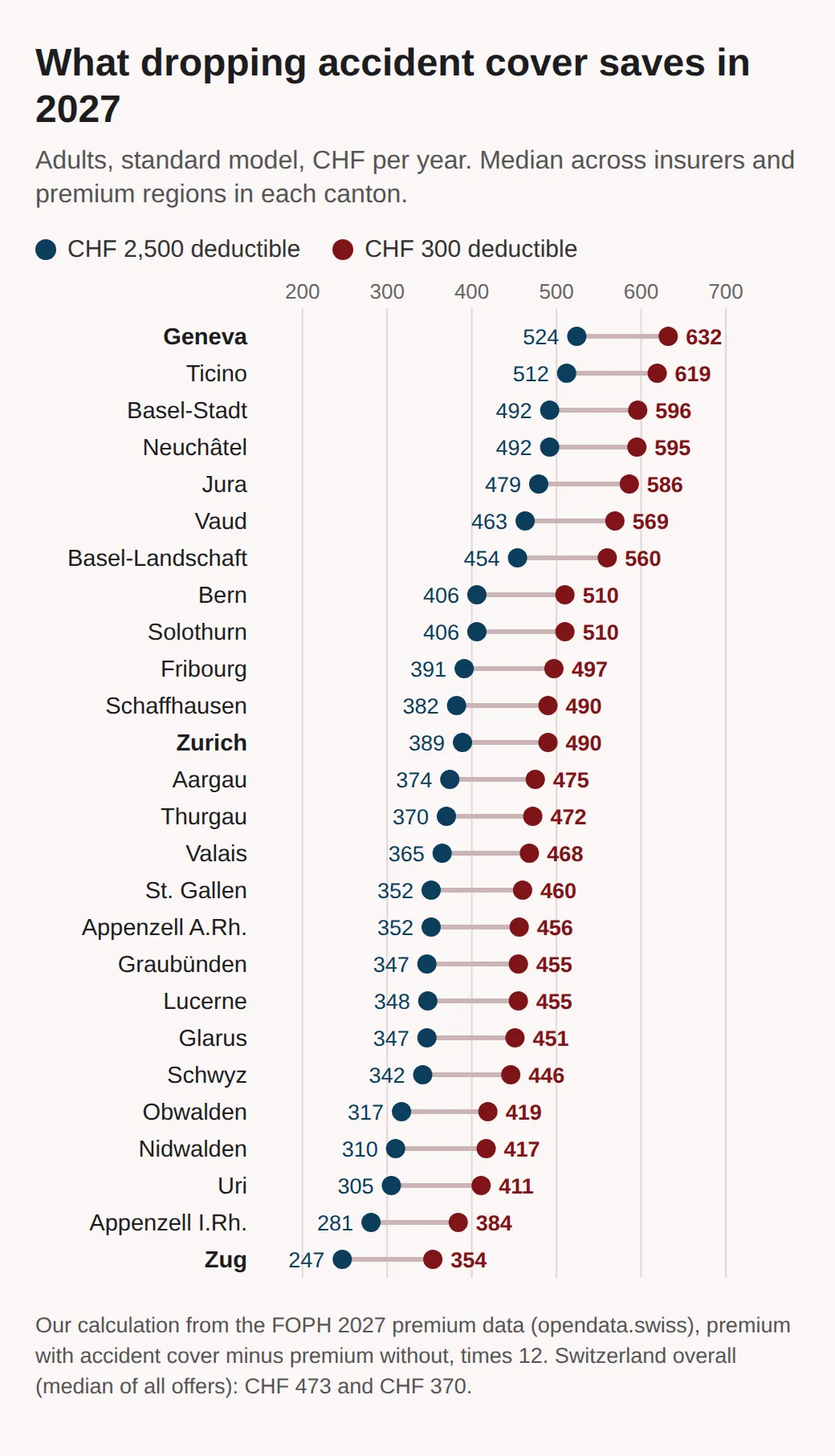
For a model such as PRAXIS or TEL_DIG the francs are lower, because 7% of a lower premium is less. In the city of Zurich (premium region 1), for example, the median monthly saving with a CHF 2,500 deductible is CHF 32.40 for a PRAXIS model against CHF 36.90 for the standard model. Either way, for an employee it is the easiest few hundred francs in this whole list, and the 8-hour line decides who gets it.
Where the 8-hour line matters: part-time and two jobs
The rule counts hours per employer, not in total. Two jobs of 6 and 5 hours a week give you 11 hours of work but no cover for accidents in your free time from either employer. Below 8 hours, the UVV only treats an accident on your way to or from work as a work accident; the rest of your life stays with your health insurance.
That makes the decision depend on your mix of jobs, and on where you are in your working life:
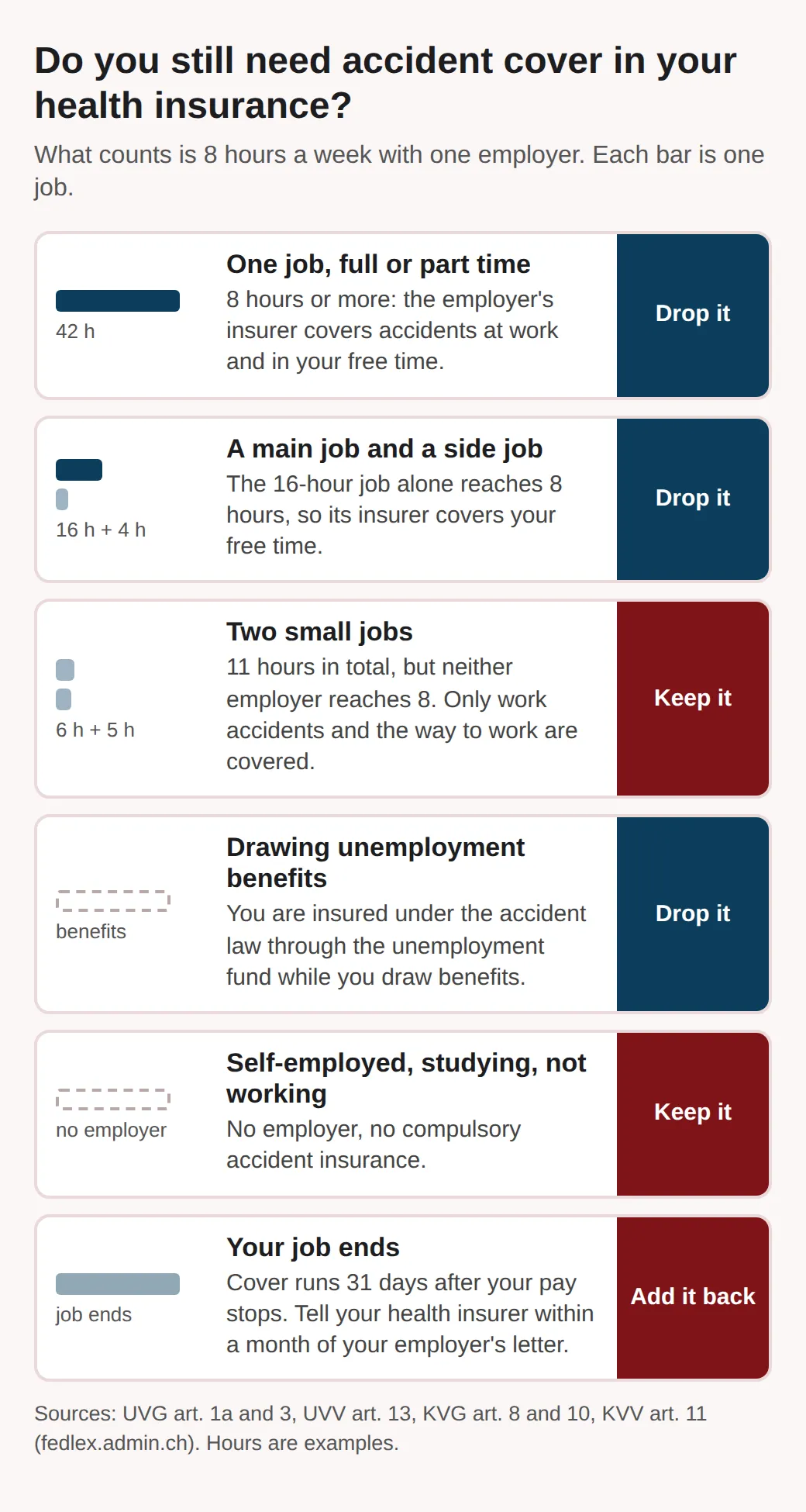
Two cases need a word more. If you draw unemployment benefits, the UVG insures you through the unemployment fund (UVG art. 1a), so accident cover in your health insurance can stay out. If you are self-employed, you have no compulsory accident insurance, so keep it, unless you took out voluntary UVG cover; in that case insurers may lower your premium, but they don't have to. When your hours change across the line, in either direction, tell your health insurer. A change in hours is also often the moment a job ends, which is the one step most people forget.
When your job ends, accident cover has to come back
Your accident cover through work does not stop on your last day. It ends 31 days after the day your right to at least half your salary stops (UVG art. 3). Your employer's accident insurer also has to offer you an extension agreement for up to six months, which is useful if you travel or take a break between jobs.
Your employer has to tell you in writing, before the job ends, that you need to inform your health insurer, and you then have one month to do so (KVV art. 11). You are not left uninsured if you forget: your health insurance covers accidents again as soon as the work cover stops (KVG art. 10). But your insurer can then charge you the accident premium for the whole period since, plus default interest. If you are planning a move, our guide to notice periods covers the dates on the employment side, and the one on gross to net pay shows where the NBU premium appears on your payslip.
Accident cover is part of basic insurance and moves with it. Supplementary insurance is a different contract altogether.
Supplementary insurance runs on its own clock
Supplementary insurance, such as cover for a semi-private hospital room or dental care, falls under the Insurance Contract Act, not the health insurance act, so the 30 November date does not apply to it. Under VVG art. 35a you can cancel any contract at the end of its third year, or of any year after that, with three months' notice in writing or another form that leaves a text record. Your policy can allow earlier cancellation, but the dates are in its conditions. For a policy that runs by calendar year, three months before 31 December means 30 September, which for 2026 has already passed.
You don't have to move your supplementary insurance at all. KVG art. 7 forbids your insurer to make you cancel it when you move your basic insurance elsewhere, and to cancel it only because you did. In supplementary insurance, the right to end the contract in the ordinary way belongs to you alone.
Be careful before cancelling one. Unlike basic insurance, a supplementary insurer may ask about your health before it accepts you. The FOPH warns that a cancelled supplementary policy cannot always be taken out again, especially from the age of 55 to 65 or with poor health. So the safe order is: get written acceptance from the new insurer first, then cancel the old policy.
If you miss 30 November
You still have options, depending on your policy. If you have the standard model with the ordinary CHF 300 deductible, the law lets you change insurer at the end of June too, with three months' notice: a letter that arrives by Wednesday 31 March 2027 moves you on 1 July 2027 (KVG art. 7 with KVV art. 94 and 100). With a higher deductible or a model, the end of the calendar year is the only date, so the next one is 31 December 2027.
In the meantime, two savings are open at any time. You can move from the standard model into a cheaper model during the year, and you can have accident cover removed from the next month on. Neither needs a new insurer, a deadline or a comparison site.
Your checklist for this autumn
If you only do a few things before the end of November, do these, in this order:
- Read the premium letter from your insurer and compare it on priminfo with your own postcode, deductible and model.
- Ask HR for a confirmation of your accident cover if you work 8 hours a week or more for one employer, and send it to your insurer, or to your new insurer with your sign-up.
- Sign up with the new insurer, then send your cancellation by registered post or A-Post Plus by mid-November.
- Leave supplementary policies alone until a new insurer has accepted you in writing.
- Note the date your job ends, if it does, and tell your health insurer within a month of your employer's letter.
You can't do much about the 5% rise. Paying for accident cover twice is a different matter, and it is the one item on this list worth checking even if you decide to stay with your insurer.
Common questions
- What happens if my new insurer never confirms the switch?
- Your old policy simply continues, so you are never left without cover. By law your old insurance only ends once the new insurer has told the old one that you are insured with it without a gap. If the new insurer fails to send that notice, it has to pay you the damage, in particular the difference in premium.
- Do I need my employer's agreement to drop accident cover?
- No, but you need a document from your employer. Your health insurer removes accident cover once you show that you are fully insured under the accident insurance law, which in practice means a written confirmation from your employer or HR that you are covered for accidents at work and in your free time. Send it with your request.
- Am I uninsured if I drop accident cover and then lose my job?
- No. The health insurance law says your health insurer covers accidents again as soon as your accident cover through work stops, in full or in part. What you risk is a bill: if you don't report the change, your health insurer can charge the accident premium for the whole period, plus default interest.
- Can my insurer cancel my supplementary insurance because I switch basic insurer?
- No. The health insurance law forbids an insurer to cancel your supplementary policies only because you moved your basic insurance elsewhere, and it cannot force you to cancel them either. In supplementary health insurance, only you as the policyholder have the ordinary right to cancel.
More posts
All posts
Gross to net salary in Switzerland 2026: every deduction
Gross to net salary in Switzerland for 2026: every payslip deduction and who sets its rate, from AHV to tax at source, with a worked CHF 6,500 example.

Jobs in Switzerland for English speakers: fields and cities
One worker in four speaks English on the job in Switzerland, yet only 4% work in English alone. The fields and cities where English is enough, with data.

Work permit in Switzerland 2026: L, B, C and G compared
Which Swiss work permit a job offer gets you: L, B or G by contract length for EU/EFTA citizens, and the test, quota and employer filing for everyone else.