Swiss CV format: photo, permit, length and work certificates
Before you send it
A Swiss CV is a table of one to three pages, newest job first, with details that US and UK guides tell you to leave out, such as your date of birth and nationality, plus your residence permit and, often, a photo. It never travels alone. Copies of your work certificates (Arbeitszeugnisse) and diplomas go behind it, sent with it as PDFs.
That last point is the one most CV guides written for expats skip, and it decides more than the layout does. A Swiss employer reads the CV, then checks it against what your former employers wrote about you. Below we go through each part as Switzerland's public job centres, two Zurich universities, the canton of Basel-Stadt and the EU job network EURES describe it, including the places where they disagree.
What does a Swiss CV look like?
A Swiss CV is a clear table: your contact and personal details at the top, then work experience and education in reverse order, then languages, special skills, interests and a line on references. The federal public employment service, arbeit.swiss, run by the State Secretariat for Economic Affairs (SECO), lists that order and asks for a CV that is "complete, clear" and without gaps.
The CV is one part of a set the Swiss call the application dossier (Bewerbungsdossier). The national career guidance portal berufsberatung.ch names three parts for a classic dossier: a cover letter, the CV, and your work certificates and qualifications. The Basel-Stadt career guidance service's guide to a digital dossier (October 2024) even gives the order of the email attachments: cover letter, CV, work certificates, then diplomas and further training.
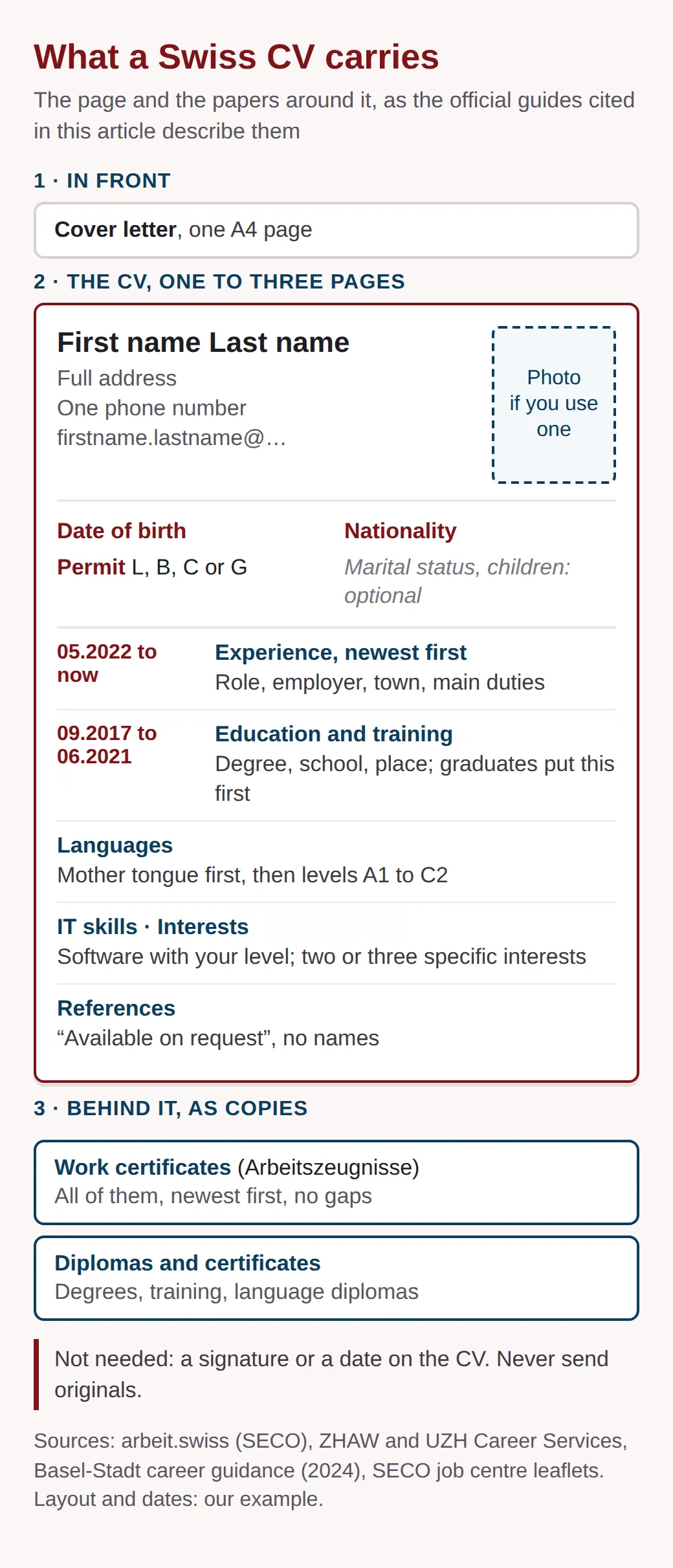
Inside that frame you have room. Basel-Stadt says colours and fonts are yours to choose, and other layouts are fine. What the guides agree on is the content of the top block, which is where a Swiss CV differs most from what you may know.
Personal details: date of birth, nationality and permit
Put your date of birth, your nationality and, if you are not Swiss, your permit type at the top. The career services of the Zurich University of Applied Sciences (ZHAW) say the date of birth is expected in Switzerland and that foreign applicants should name their residence status, for example a B or C permit. UZH Career Services at the University of Zurich asks for the date and place of birth and the nationality, and says non-nationals should cite their L, B or C permit.
The permit line tells an employer, in one word, whether it can hire you without extra paperwork. For EU and EFTA citizens the State Secretariat for Migration (SEM) lists the permit types as L for short stays, B for residents, C for settled residents and G for cross-border commuters. For everyone else the stakes are higher: SEM says an employer hiring a person from outside the EU and EFTA must prove that no suitable person could be found in Switzerland or the EU and EFTA. If you have no Swiss permit yet, your nationality is the line that answers the question, so make sure it is there.
Marital status and children are optional. ZHAW calls them optional but still common, UZH lists them as optional, and SECO's job centre leaflet (Le dossier de candidature, 2018) still lists civil status, the number of children with their ages and, for Swiss citizens, the place of origin. Our view: leave family details out unless you see a reason to add them. The law only lets an employer process data about whether you suit the job, which we cover in our guide to the Swiss job interview. Two things to keep off the page altogether, says ZHAW: a health diagnosis, and a signature. A Swiss CV is not signed, and a date at the bottom is not required.
The photo: expected, optional or only if asked?
The official guides disagree on the photo. ZHAW says a photo is not a legal requirement but is very common and expected, and recommends a professional photographer. Basel-Stadt recommends a recent photo from a studio. UZH says it is optional unless the job ad asks for one. SECO's 2018 leaflet for the job centres says a photo goes in only if the ad asks for it.
Even arbeit.swiss is split by language. Its English page lists "personal details, including photograph". The German version of the same page says "Persönliche Daten, gegebenenfalls mit Bewerbungsfoto": personal details, with a photo where applicable.
So decide by employer. If the ad asks for a photo, send one. For a bank or a traditional Swiss company, a good photo is the safer choice, and ZHAW warns that leaving it out can make the application look incomplete. At a start-up it matters less, ZHAW says, and if an online form asks for a US-style resume, leave it out. If you do include one, follow UZH's specifications: head and shoulders, neutral background, natural and well-groomed, no older than two years, no phone snapshots. A bad photo costs more than none.
How long a Swiss CV can be
Two pages is the length every guide accepts; three is the outer limit. The numbers differ by source, as the chart shows. arbeit.swiss says no longer than three pages. UZH says no more than two to three. ZHAW says one to two, and up to three only for people with a long career or an academic track such as a doctorate. Basel-Stadt and the EU's EURES page on Switzerland both say at most two A4 pages.
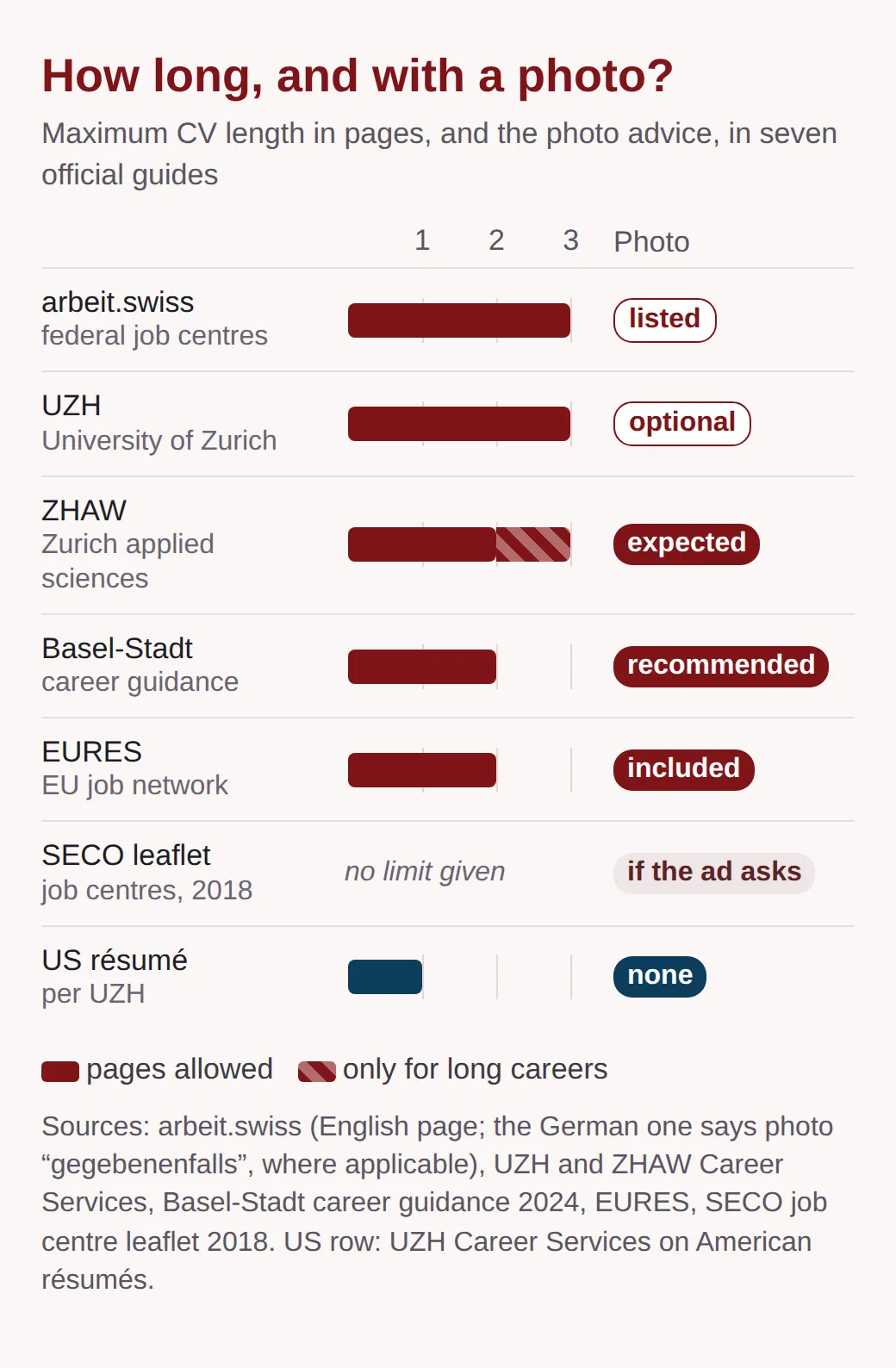
Compare that with the US: UZH's page on applications in English says an American resume is at most one page. The extra room is for facts, not selling: a Swiss CV is a table of dates, roles, places and levels. If yours runs to three pages and you have under ten years of experience, cut the older jobs down to one line each.
Order, dates and the small Swiss details
List everything newest first, with month and year on the left. arbeit.swiss asks for the most recent job first; SECO's older job centre brochure on applications (2009) adds that dates go on the left, with month and year and no day, in a form such as 05.2009 to 11.2009. arbeit.swiss asks for a CV without gaps, and UZH tells you to be ready to explain any you have. Better still, name a gap on the CV in a few words: ZHAW suggests lines such as active job search with further training, a sabbatical, parental leave or a break for health reasons, without the diagnosis.
If you have just graduated, put education before experience. Both ZHAW and UZH advise this when your degree is the strongest thing you have.
A few details mark a CV as written for Switzerland. Give your languages with the European levels A1 to C2 and your mother tongue first, as ZHAW advises. If you quote grades, explain the scale: Swiss grades run from 1 to 6, with 6 the best, the reverse of Germany's, so ZHAW suggests writing a grade as "5.5 / 6.0". If you write in German, use "ss" and never "ß", which Swiss spelling does not use. And list two or three specific interests rather than "reading": ZHAW and Basel-Stadt both ask for something concrete, such as playing piano in a club, or a topic that interests you at the moment.
For a foreign degree, EURES advises naming the Swiss qualification it corresponds to. For a regulated profession, check recognition.swiss to see whether your qualification must be formally recognised before you can work.
References: "on request", not names
Do not print your referees on the CV. ZHAW says to add a "References" heading at the end and write "auf Anfrage" (on request) instead of names. UZH suggests "References will be made available upon request" and says that, as a rule, references are submitted later, when asked for. arbeit.swiss says the same and adds that you can hand over a separate sheet of referees at the interview. SECO's 2018 leaflet goes further: references only if the ad asks for them.
Prepare that sheet before you apply. UZH says it usually lists two people, with name, title, organisation, work address, phone and email, formatted like the rest of your dossier, and that you should ask each person first and tell them about the job. Pick former managers who can speak about your work. How an employer may contact them, and why it needs your consent, is part of our job interview guide.
Work certificates: the part foreign guides skip
Behind your CV go copies of all your work certificates, newest first, with no gaps. This is the biggest difference from a US or UK application. A Swiss work certificate (Arbeitszeugnis) is a written assessment that your employer issues, and employers expect to see one for each job on your CV. ZHAW says they carry extremely high weight in Switzerland and must go in the dossier.
You have a legal right to one. SECO's employment law FAQ explains that under article 330a of the Code of Obligations you can ask your employer for a certificate at any time, either during the job as an interim certificate or at the end as a final one. A full certificate covers the type and length of the job plus your performance and conduct. If you prefer, you can ask for a certificate that states only the type and length of the job, with no assessment. Statements must be truthful, and ambiguous wording is not allowed.
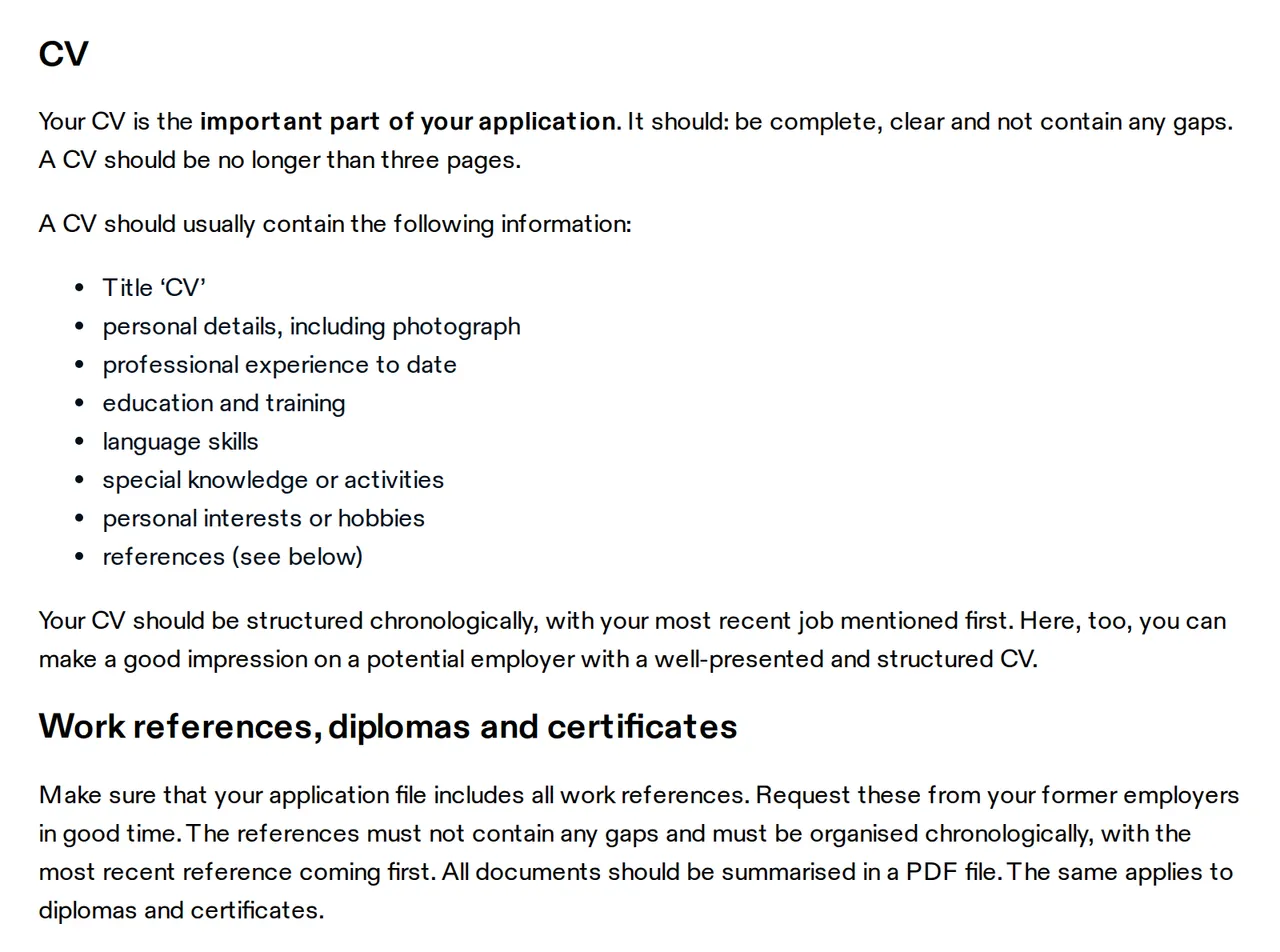
How to send them is spelled out too. arbeit.swiss says the certificates must have no gaps, run chronologically with the most recent first, and go into one PDF, and the same for diplomas. Basel-Stadt says to scan them in colour, and if you have very many, to include only those of the last five to ten years. SECO's 2009 brochure says never to send originals, and that copies do not need to be certified.
If you come from a country where employers do not write such certificates, you cannot produce what does not exist. In that case we would send what you have instead: reference letters, a confirmation of employment from HR, or a short written statement from a former manager, in a national language or English. The University of Zurich's dual career page notes that application documents must be in German, French or Italian, and that some international companies also accept English. And start asking for an interim certificate in your current job now, so that your next application has no gap.
How a Swiss CV differs from a US or UK one
The main differences are the personal details, the photo and the attachments. The table sets the sources side by side.
| Item | Switzerland | US resume | UK CV |
|---|---|---|---|
| Date of birth, nationality | Included | Left out | Left out |
| Photo | Varies by guide | Only if asked | Not mentioned |
| Length | Up to 2 or 3 pages | 1 page | No limit given |
| Work certificates | Copies attached | Not used | Not used |
For the UK, the government's National Careers Service says you should not include your age, your date of birth, whether you are married or your nationality, and suggests "references available on request", as Swiss guides do. For the US, UZH sums up the rules for an American resume: no photo unless explicitly requested, no date of birth, nationality, gender or marital status, one page at most, and no references at the first stage. Behind the photo rule is US anti-discrimination practice: the Equal Employment Opportunity Commission says employers should not ask for a photograph of an applicant.
What if a Swiss employer asks for your application in English? UZH draws a clear line: an application in English for a job in Switzerland can simply be a translation of the German one, with the Swiss content, while an application to a country where English is spoken follows that country's rules. So a Zurich bank that asks for English still gets a Swiss CV.
Sending the dossier
Send PDFs with clear file names from an email address that contains your name. arbeit.swiss asks for exactly that. ZHAW suggests naming the file Lebenslauf_Vorname_Nachname.pdf, which is CV_Firstname_Lastname.pdf in English. Basel-Stadt goes one step further and numbers the files in the order the reader should open them, so a typical email carries four attachments, here with the names translated:
- 1 Cover letter Firstname Lastname.pdf
- 2 CV Firstname Lastname.pdf
- 3 Work certificates Firstname Lastname.pdf
- 4 Education and training Firstname Lastname.pdf
Basel-Stadt also suggests sending the email to yourself first, having someone else read it, and sending it on a weekday during office hours. If the employer uses an online form, follow its upload fields instead; the same documents go in, only the slots differ.
Before you apply
Start with the papers, not the layout. Collect a work certificate for every job you list, ask your current employer for an interim one, and scan your diplomas in colour. If a Swiss employer you left never gave you a certificate, write and ask for one, since the law lets you request it at any time. Only then write the CV, and decide on the photo per employer, not once for all.
Read your CV against your certificates one last time. If a date, a job title or a duty does not match what your employer wrote, a Swiss reader will notice, and the certificate is the document they will believe.
Common questions
- Can I ask my current employer for a work certificate before I resign?
- Yes. SECO's employment law FAQ says you can ask for a certificate at any time, so you can get an interim one while you still work there. An interim certificate lets you apply without a gap in your dossier for the job you hold now.
- How old can the photo on my CV be?
- UZH Career Services says no more than two years old. It asks for a head and shoulders portrait against a neutral background, between 4.5 x 6.5 cm and 6 x 9 cm on the page, and no phone snapshots or holiday pictures. If you no longer look like your photo, take a new one.
- Do I need to send my school-leaving certificate?
- Usually not once you have a degree or a vocational qualification. UZH Career Services marks the school-leaving certificate as not obligatory. SECO's 2009 job centre brochure suggests school reports and final exam results mainly when you apply straight after your training or studies.
- Is the CV different in French- or Italian-speaking Switzerland?
- Not in what it contains. SECO's French-language job centre leaflet lists the same personal details and the same copies of work certificates and diplomas as the German-language guides. What changes is the language: write in the language of the job ad. UZH says documents must be in German, French or Italian, and that some international companies also accept English.
More posts
All posts
Job interview in Switzerland: rounds, rules and red lines
How a Swiss job interview runs: the rounds, the salary question, reference checks and the questions data protection law rules out, from official sources.

13th month salary in Switzerland: who is owed it and when
No Swiss law requires a 13th month salary, yet three in four employees get one. Who is owed it, when it is paid, pro rata rules, tax and bonuses.

Minimum wage in Switzerland 2026: official rates by canton
Switzerland has no national minimum wage. The official 2026 rates in five cantons and Lucerne, per hour and per month, who is left out and what changes next.